Showing posts with label embroidery. Show all posts

Monday, September 5, 2011

Assisi Embroidery

Hello All,

Today i will be talking about a unique form of embroidery which is done in the town of Assisi, Province Umbria, Italy. In Assisi Embroidery, the outline and contours of the design are stitched in back stitch, double back stitch, or Holbein Stitch, then the background is filled in with cross stitch or long-armed cross stitch in a single color,  so that the design becomes negative space. The composition is then finished with border designs again in Holbein or back stitch. The piece as a whole is finished off with hemstitching. Here is an example of a piece which i bought in Assisi in the 1980's.


This form of embroidery was formed in Assisi at the beginning of the 20th cent. These embroideries are still being produced by a woman's cooperative in Assisi, and sold in the gift shops there. They formalized the form based on some embroideries from the middle ages which were preserved in the local churches. The current form of the embroidery is completely a counted thread technique.
Like many specific local embroideries, this style of embroidery was once more widespread. The original embroideries did not have the border designs, and the outlines were done in free form stem stitch. Here is an example of the old style embroidery with the non counted outline. This example is from the Cyclades Islands of Greece.


I have found examples of this type of embroidery from Cyprus, other Greek Islands, Sicily and Morocco. Here is another example from the Cyclades, done in counted thread stitching and more complex than the work currently done in Assisi.


As you can see, these examples do not include the outline stitch borders. Another version of this type of embroidery is found in Hungary, The Silesian highlands of Poland and other areas, but without the outline stitch. Simply being negative space cross stitch embroideries. Here is an example from Hungary.


In modern Assisi work, the outline is done in brown or black thread, and the filling is done in one color, which varies. Sometimes the cross stitch is confined to spot designs, such as this one.


These spot designs may be connected with outline stitch to form an overall composition, as in this example.


Of course, it is very common to do these designs in bands across the ends of a runner or something similar, as is the case with my seahorses above. Here are a couple more examples of this.


It is relatively easy to turn a corner with a design like this. In which case you would have a border around around all four sides of a cloth.


Of course, there is no rule which says that the embroidered areas must be rectangular. You could design them in any shape, and connect them as you would the smaller spot designs.


The design possibilities are endless, and the designs can be very ambitious, or quite simple.


Here are some images of a tablecloth which i recently found in a local antique store. There are 6 luncheon napkins.


The four central motifs are mostly left in outline stitch


The four corners have roses and lions


The mid side designs consist of just roses


Here is an overall view. You can see that this design is somewhat more free-form, but still recognizably within the Assisi Tradition.

 
Thank you for reading. I hope you have found this interesting and perhaps inspiring.


Feel free to contact me with requests for research. I hope to eventually cover all of Europe and the Former Russian Empire/Soviet Union. I also gratefully accept tips on source materials which i may not have. I also accept commissions to research/design, sew, and/or embroider costumes or other items for groups or individuals


Roman K.
:Rkozakand@aol.com

Source Material:
Casa Editrice Mani di Fata 'Ricami d'Assisi', Milan, 1973
Editions Th. de Dillmont Mulhouse, 'Assisi Embroideries' revised, DMC Library, France, 1974
Pamela Miller Ness, 'Assisi Embroidery', Dover Publications, New York, 1979
Gyorgyi Lengyel, 'Keresztszemes Kezimunkak', Budapest, 1981
Pauline Johnstone, 'A guide to Greek Island Embroidery', London, 1972
Sheila Payne, 'Embroidered Textiles', New York, 1990
Mary Gostelow, 'The Complete International Book of Embroidery', New York, 1977


Sunday, May 8, 2011

Orest and Cheryl's Wedding costume - Boiko costume and embroidery of Turka county, Halychyna, Ukraine

Hello All,

Today i will talk about one of the Boiko costumes, that of Turka county, which is the best documented. The Boiko region covers three counties in L'viw Oblast, plus the mountainous part of Ivano-Frankiwsk Oblast, west of the Hutsul area, and the extreme southeast corner of Poland, east of the Lemko area. Drohobych and surrounding areas are also sometimes considered to be part of the Boiko region. Some Boiki do not like the term, preferring to call themselves 'Verkhovyntsi', or 'Highlanders'. Here again is our map of L'viw Oblast so you can orient yourselves.


 I should start with a photo giving a good view of the costume. When Orest and Cheryl got engaged, our dance group [the Omaha International Folk Dancers] decided to make them a set of costumes from this region, because Orest's father is from the village of Berezhok-Zhukotyn' in Turka county. I came up with the idea, researched the costume and organized the project, but everyone helped. Somehow we managed to [almost] complete the costumes in time for the wedding without them finding out. Here is a photo from the wedding reception.


The embroidery on her apron should extend all the way to the edge, which has since been rectified, but otherwise the costume was complete. Today i will show you their wedding costume, andin a later post  i will add some other material that they collected from his father's native village. Here is the chemise which we made for her.


Turn down collar, embroidered inset on top of body piece, smocking and embroidery on top of the sleeve. Smocking is very typical of this region, and forms part of the embroidery design. Here is a closeup of the inset [ustawka] embroidery.


Nyz, or darning stitch embroidery, which in this region is not necessarily filled in with other colors, with border in braid stitch and cross stitch. I got this design from Krawchuk.


The smocking and the bit of embroidery framing it are quite typical of this region as well. Here is a closeup of the lower sleeve and cuff. If i was doing it today, i would put a backstitch frame around the embroidery on the cuff.


Here is a a closeup of the embroidery on the collar.


You can see that the body of the shirt is smocked into the collar, front and back, but not on the ustawka. We had to guess at the collar measurement, and we made it too small, so she added a piece in back. In Krawchuk, this design was originally for a cuff, with smocking on the sleeve.


The skirt would be the maliovanka for every day, with a design more black than white, see the photos in the posting about the Drohobych costume. For festive occasions, the skirt was linen, made of four or five loom widths, the ones in back being embroidered and gathered and also smocked into the waistband, and the fourth left smooth and plain in front. Here is Cheryl's skirt. The opening is in the middle front, and the skirt was tied around the waist by cords pulled through buttonholes in the waistband.


Here is a closeup of the embroidery, cross stitch with some braid stitch which I also took from Krawchuk.


The graph shows this as the shoulder inset, with smocking embroidery on the upper sleeve shown at the bottom.
We put the same embroidery on the apron. The apron, as in other parts of Halychyna was made of two loom widths joined in the middle by a decorative stitch. I had wide material, so i made it in one piece, but put the joining stitch on the surface, so it would look traditional. And, as i promised, the embroidery is now complete. Cheryl took it and finished it.


I took the edge design and turned the corner with it to run on either side of the central joining stitch. I also put a row of merezhka hemstitching on either side, and of course to join the hem as well.  This is often done to finish embroidery compositions.


We made a second apron from challis cloth, just for variety, this was commonly done as well. The middle front of is smocked.


This is one of the few regions where the men's shirts are traditionally embroidered on the shoulder inset. Here is Orest's shirt. It is made with the same cut as the women's shirt, which is typical of Halychyna.


We made an attempt to choose embroidery designs that harmonized between the two. Here is a closeup of the shoulder inset and upper sleeve embroidery.


The embroidery is cross stitch, with a decorative joining stitch holding the pieces together. Here is another view. If i were making this today, i would have some small framing embroidery on the sides of the sleeve.


I picked shades that i thought would harmonize nicely. In Krawchuk, this design was originally drawn from a man's wedding shirt


I took the same design and altered it to make the embroidery on the cuffs, collar and front. The ties to close the shirt were sewn into the seam. I made the ties by twisting the same floss i embroidered with.


 Then we made the vests, very similar for both, except Orest's is short. Actually we had his made to order by a woman who did sewing, her company name was Folk Couture. We had our hands full finishing the embroidery. Both vests are finished with red and white cording, with loop and knot closures.


Cheryl's is longer, and is slit on the sides.


Just for verification, i would like to post two drawings by Kul'chytska.


Thank you for reading. I would like to thank everyone who participated in this project. If you would like to be mentioned by name, let me know. You know who you are. I decided to err on the side of privacy. I hope that this may inspire someone else to undertake such a project.

Feel free to contact me with requests for research. I hope to eventually cover all of Europe and the Former Russian Empire/Soviet Union. I also gratefully accept tips on source materials which i may not have. I also accept commissions to research/design, sew, and/or embroider costumes or other items for groups or individuals

Roman K.
Rkozakand@aol.com

Source Material:
The photos were taken by Orest Lechnowsky, and the costumes are obvioulsy part of his and his wife's private collection.
L. Krawchuk, 'Ukrajinski Narodni Vyshywky L'viws'ka Oblast' [Ukrainian Folk Embroidery of Lviw Oblast], Kyjiw [Kiev] 1961
K. Matejko, 'Ukrajinskyj Narodnyj Odiah' [Ukrainian Folk Clothing], Kyjiw [Kiev], 1977
O. Kul'chytska, 'Folk Costumes of the Western Regions of the Ukrainian SSR, 1959


Thursday, April 28, 2011

Costume & Embroidery of Drohobych county and vicinity, Halychyna, Ukraine

Hello All,

Today we will continue our series on the costumes and embroidery of Halychyna. We will talk about Drohobych county. Here again is our map so we can orient ourselves.


This area is sometimes considered to be part of the Boiko Region, although in my opinion the Boiko Region properly speaking is in the mountains, and this area is just foothills. The Boiko region consists of Turka, Skole, Dobromyl, Perehinsk counties, and a piece of Poland east of the Sian river. The costume is similar, although an argument could be made that the costume is typical of Halychyna. Here is a woman wearing the Drohobych area costume from the village of Ripchytsi.


The outfit consists of a chemise with local embroidery on inset [ustawka], cuffs and collar, skirt, in this case of store bought cloth. apron of two loom widths of linen, embroidered on the bottom edge, with an ornamental joining in the middle. Kamizelka in cloth matching the skirt of standard Halychyna cut, fastening in front, ribbons around the bottom edge. Kybalka on the head [wooden ring covered with cloth], covered by a kerchief, and boots. Here is another photo of a somewhat older form of the costume; this one is from the village of Litynia.


Maliovanka type skirt, of linen with home printed design. In this region there was usually a white design on a black background, the same double width apron, kybalka and kerchief, sash, footcloths with khodaky, moccasin type footwear with straps, and a keptar, sheepskin vest similar to the Hutsuls, but with simpler ornamentation.


Here is a couple from the village of Hruxhiw, showing the men's costume, again typical for Halychyna. Shirt same cut as women's, but shorter, with embroidery on the front, collar, cuffs, and a narrow band around the shoulder inset. Linen pants, with either boots or khodaky and footcloths, and a sash, or in this case a leather belt, from which hangs a knife and other daily useful items. men would also wear a sheepskin vest when needed. As in other parts of Halychyna, a long linen overcoat was worn in warmer weather, and a wool or sheepskin one in colder. The linen 'hellgrauefruejahrsmantel' is called a polotnianka, and it had minimal embroidery, as in this photo showing another costume from the village of Hrushiw. This man seems to be wearing two of them.


Kul'chytska verifies this basic costume, here is a drawing she made of a woman in the village of Hrushiw, around 1930. She includes some examples of embroidery.


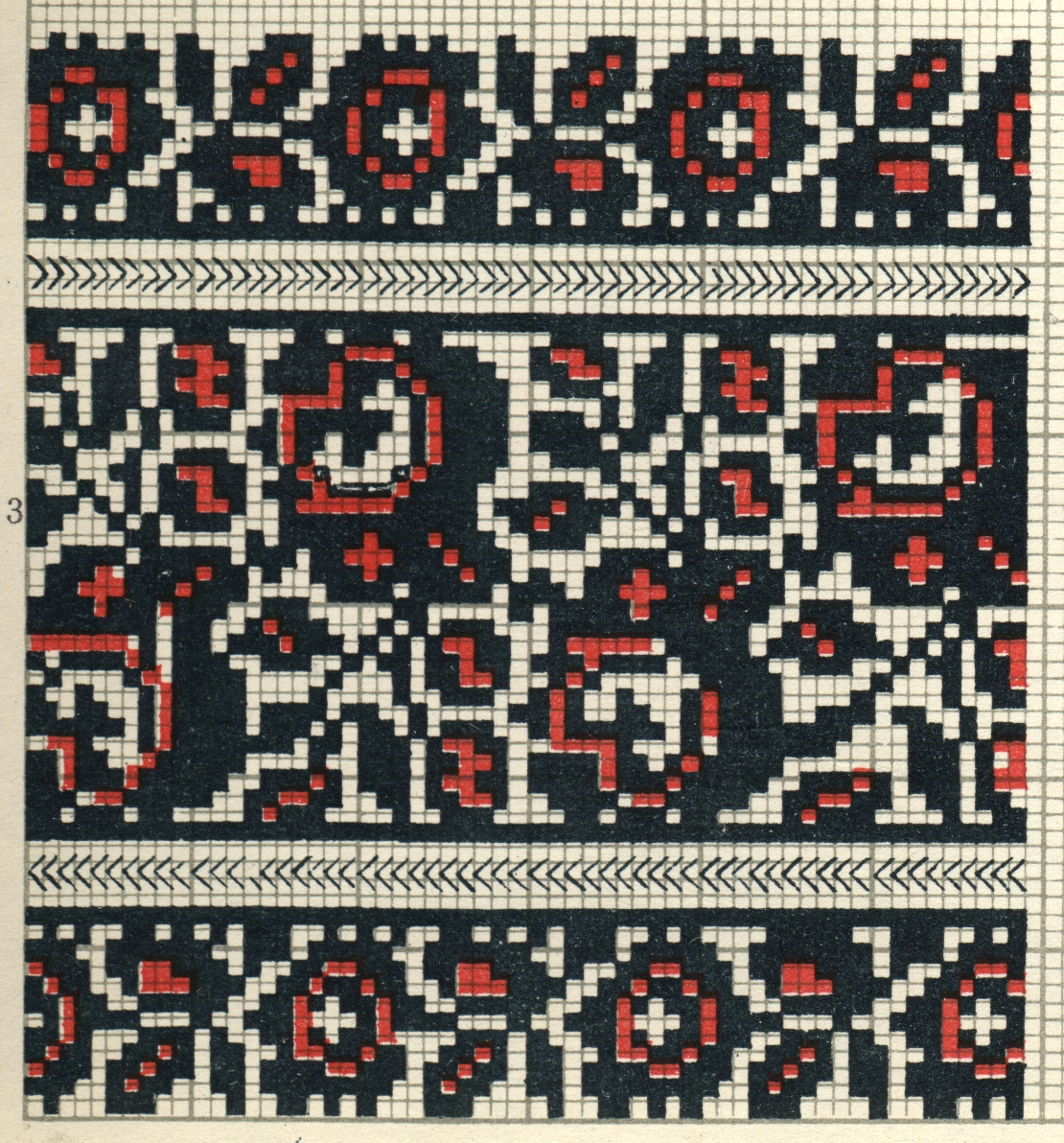
In contrast to the neighboring county of Rudky, where the embroidery is mostly red with some admixture of other colors, the embroidery of Drohobych county is mostly black, with some red. Some of the more recent designs resemble the designs of Rudky quite a bit, being rows of small roses with braid stitch in between. Here is an example of one such design. Change the colors and you would have a Rudky design.


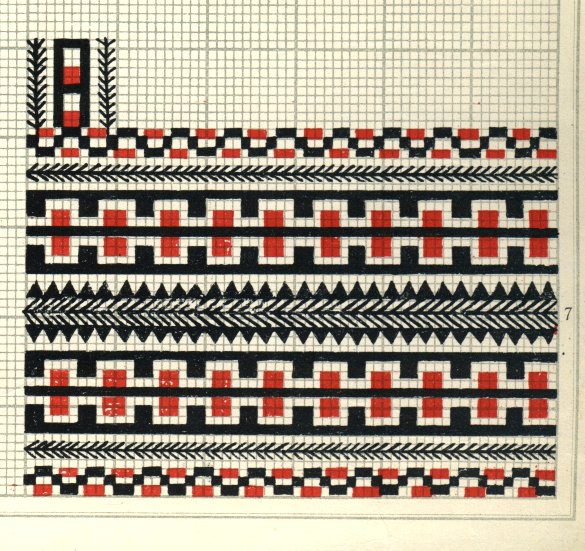
The older embroidery designs were based on rows of braid stitch, herringbone and flat stitch in geometric designs, similar to Javoriw emboidery, and which are also still found to some extent in Horodok and Rudky counties, but in the same color scheme, mostly black with some red. Here is an example.


This is the embroidery on the shoulder inset of a woman's chemise. You can see the row of herringbone right on the seam turns up and forms a frame on the two sides of the ustawka. The small cross stitch design continues up the middle, as is typical of Halychyna. The several rows below are embroidered on the upper sleeve, and continue to the sides for a while. Later some cross stitch came to be incorporated in the designs, as in this example.


Again, you can see the design that frames the ustawka, and some of the rows on the bottom would have been on the upper sleeve. The more elaborate floral designs are the most recent to develop. Here is a graphing of the design from the ustawka and also the cuff of  woman's chemise.


The design for the cuff is at the top. The cuff is relatively wide, but not as wide as in the Sokal' region, and is overcast around the edge with alternating black and red thread. you can see the narrow design which frames the ustawa, and forms a line along the upper sleeve, but in this case, not below the ustawka embroidery. This design looks like it is meant for the shoulder inset and the sleeve to be cut in one piece. The cut of the chemise is the typical one for Halychyna. Approximate dimensions are shown in cm.

The chemise was not cut to be seen below the skirt in this region. If we look at some chemises, we see narrow designs embroidered not only along the sides of the shoulder insets, but along the top of the sleeve, and the sleeve seam as well. The sleeve on the right in this first photograph has embroidery very similar to the graphed one above which consistes only of braid sttich, herringbone and geometric flat stitching. The one on the left has a design similar to the one just above, including the narrow design that turns the corner and goes towards the seam of the sleeve.


Here is an embroidered shoulder inset from a woman's chemise, showing how the embroidery is distributed on the inset itself. It also includes part of the upper sleeve, the seam being the wide black line between the two rows of the rose design. This is made by means of a joining stitch different from that of the Sokal' region. Instructions can be found in Tanya Diakiw O'Niel's book, 'Ukrainian Embroidery Techniques', on page 127, under 'Boikian Joining'. [I think the 'woman's shirt' she has illustrated is actually a man's shirt, though].


The men's shirt has almost the same cut, except that there is wide embroidery on the collar and cuffs, and just the narrow frame on the shoulder pieces.


Here is a closeup of the embroidery on the collar and front of a man's shirt.


The cuffs are gathered into the cuffs, and sometimes the lower sleeve is smocked over the gathers, as in this example.


In some villages, the women wore a headpiece called a 'promychka' under the kerchief. The piece that showed in front on the forehead was embroidered and edged with buttonhole stitch. Here is an example of that embroidery.


Often you will see design typical of this region graphed in general books on Ukrainian Embroidery referred to as Boiko. There is, in fact a great deal of variety in Boiko embroidery, in color and technique. Here is one such example from Ruryk's 'Ukrainian Embroidery Designs and Stitches'.


This is the design embroidered on the disjointed shoulder inset shown above. That is enough for one posting i think, so i will give you just one more embroidery design and close.


Thank you for reading. I hope that you find this interesting, and will be able to use some of these ideas or designs in your own handiwork.

Feel free to contact me with requests for research. I hope to eventually cover all of Europe and the Former Russian Empire/Soviet Union. I also gratefully accept tips on source materials which i may not have. I also accept commissions to research/design, sew, and/or embroider costumes or other items for groups or individuals.
Roman K.
Rkozakand@aol.com


Source Material:
L. Krawchuk, 'Ukrajinski Narodni Vyshywky L'viws'ka Oblast' [Ukrainian Folk Embroidery of Lviw Oblast], Kyjiw [Kiev] 1961
Myroslava Kot, 'Vyshywka Drohobychyny, Tradytsiji i Suchasnist'' [Embroidery of Drohobych Region, Tradition and Present Day], L'viw, 1999
Nancy Ruryk, 'Ukrainian Embroidery Designs and Stitches', Winnipeg, Manitoba, Canada, 1958
Tania Diakiw O'Neill, 'Ukrainian Embroidery Techniques', Mountaintop, Pa, 1984.
O. Kul'chytska, 'Folk Costumes of the Western Regions of the Ukrainian SSR, 1959