Hello all,
Today I will talk about the basic costume of the district of Horodenka. This is often given as the typical costume of Pokuttia, but in fact, there is much variation in Pokuttia costume. The Horodenka district lies in the easternmost corner of Ivano-Frankiwsk Oblast, and is in the northeast corner of Pokuttia, bordering Podillia on the north and Bukovyna on the east. The costume has much in common with both. Here is the location of Horodenka district.


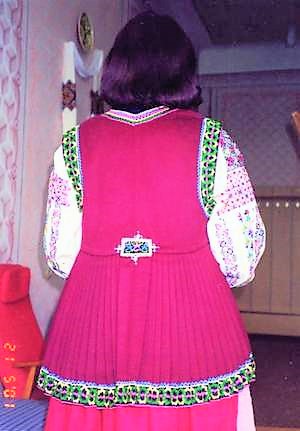
As you can see from the photo at the head of the article, the predominant color of this costume is a rusty brick red. The embroidery and weaving do have accents of yellow, black, green and other colors, and some individual villages have unique details. The villages of Torhovytsia and Toporivtsi, which lie in the south bordering Sniatyn district often embroider in white, and the villages of Serafyntsi and Yaseniw Pil'nyj in the east each have a rather distinct costume. In modern times the embroidery has tended towards more of a true red.

Here you can see the basic pieces of this costume. For the women, a long chemise heavily embroidered on the sleeves. A wrap around overskirt obhortka, sometimes called fota, which is held in place with a wide sash. A narrow sash is used to hold the wide sash in place. A one panel apron is worn; sometimes flat with woven ornament, but often it is pleated lengthwise, and pulls together at the bottom.
Men wear a long shirt with embroidery on collar cuffs and front, a wide sash similar to the womens', and narrow linen or wool pants.
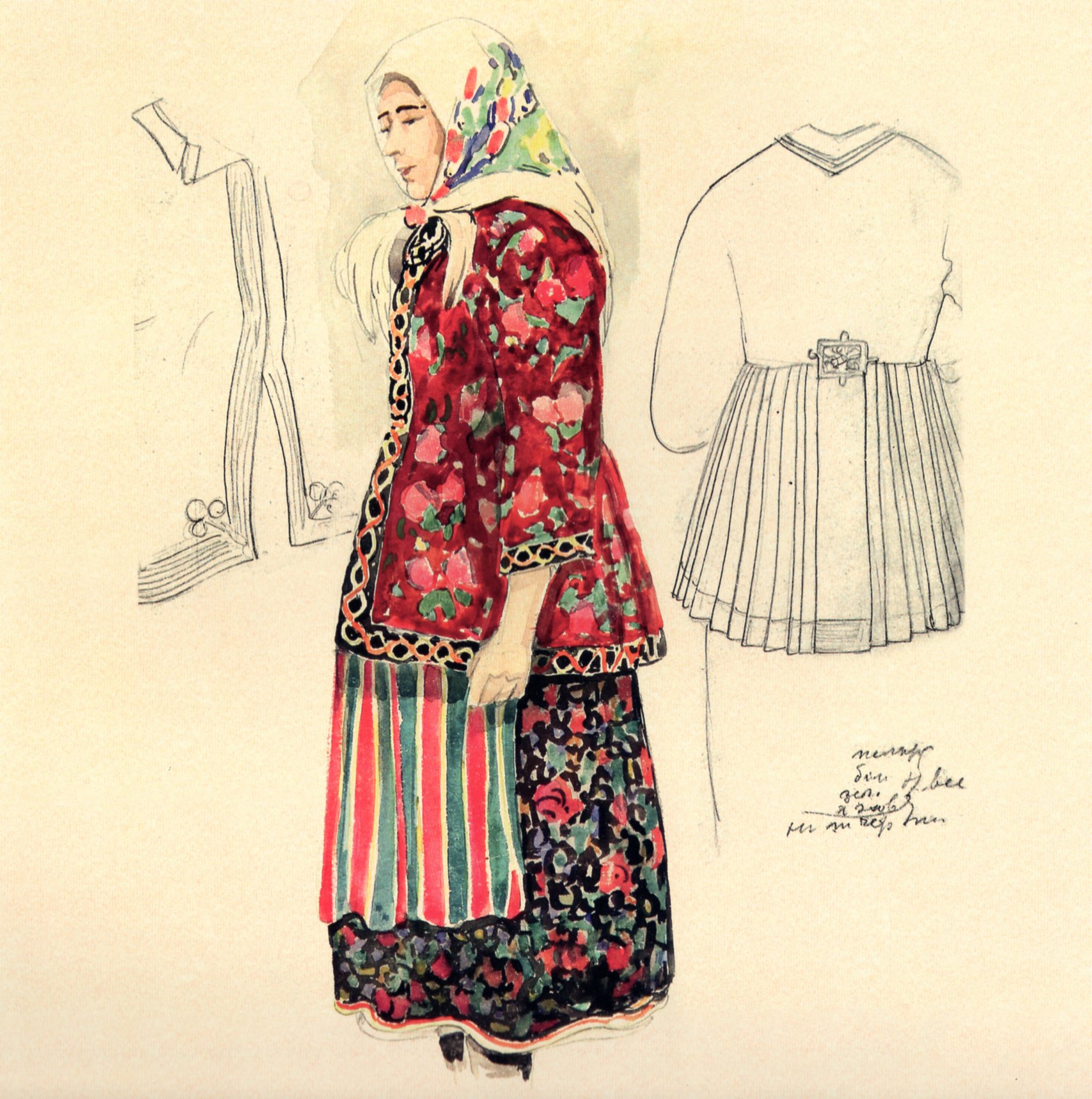
Both wear short, relatively simple sheepskin vests, and rather plain jacket made of sukno.
The chemise has ustawky, or shoulder pieces sewn to the top of the body pieces. The shoulder insets are embroidered, and also a stripe on the top of the sleeve. A strip is sewn to each side of the front and back fields, and all these seams are embellished with interlace.

The sleeves are often crimped, and sometimes the front as well, in the unembroidered space.

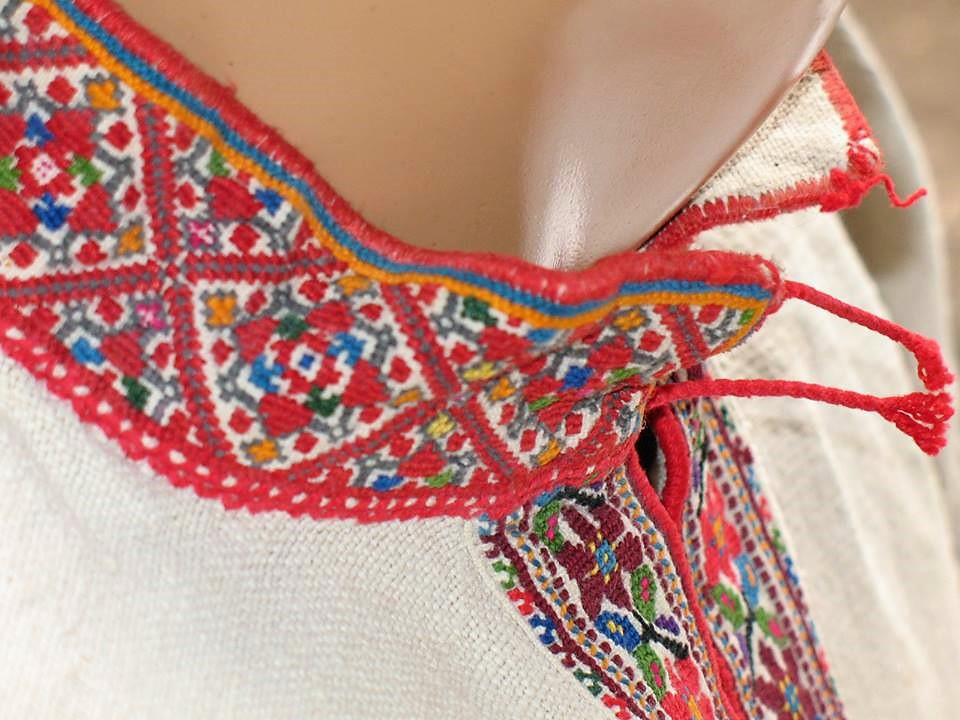
The sleeves and body are usually gathered into the collar and cuffs, which are embroidered.


Sometimes the ends of the body and the sleeves are gathered without an actual collar or cuff attached.

Today the embroidery is often cross stitch. A portion of the design is often repeated once or twice above the main motif.


It is my belief that this technique was borrowed from Armenians who lived in Halychyna.
I have previously written an article on this detail.
https://folkcostume.blogspot.com/2013/06/interlace-embroidery-of-horodenka.html
Some of the cross stitch designs were adapted from other, older techniques. These are still seen to some extent. Here are some examples.
Nabir.


Nyzynka.


Nastyl.


Pozaihlenne.


Some chemises have a sleeve which narrows at the end, and are neither gathered nor have a cuff.


Some of these have a seam which spirals down the sleeve. I have no idea how they are cut.


The overskirt is woven with incredible detail. The overwhelming color is always brick or orange, but the details of design vary remarkably with the individual.


This display shows the classic way of wearing this costume. Obhortka tucked up, apron pleated, and large sash holding all, with a small sash keeping the large one in place. There are, of course, other variations.

Some aprons were highly ornamented, and worn flat rather than pleated.


The narrow sashes were often highly ornamented.
https://krovets.com.ua/uk/poyasniy-odyag/krayka-zhinocha-9

Married women put their hair up, most likely with a cap, and then wrapped a long length of cloth, the namitka around the head. Thise was ornamented on the ends, and along the edge which was placed over the forehead.


The ornament, as in this one, was often woven in. This image shows woven ornament from a namitka, and a cap, either sprang or crochet which would have been worn under it.


Many were embroidered, often in cross stitch.


This woman's namitka seems to be embroidered completely with eyelets. This may perhaps indicate influence from the Towmach district.


But the most impressive ones were done in nabir, also known as Horodenka stitch.


The men's outfit consisted of a long shirt with embroidery on cuffs, collar, front opening, and sometimes the shoulder. Long narrow pants were worn, linen in summer, or wool in winter, almost always white, but you will see photos of men wearing jodphurs, which they must have acquired during military service. Boots were worn by those who could afford them. Sashes were about 6 inches wide, and were usually plain orange in the center with colored stripes towards the ends, which showed when they were tied, and often had tassels.
Here are three men's shirts from my private collection.
On this first one, the collar is embroidered in cross stitch with the edging in blanket stitch. The collar and cuffs are done in shabak, or needleweaving hemstitch, using a fuzzy wool thread. As you can see, my cat insisted on helping.


This second one also has open sleeves, the collar, front opening and cuffs are all done in cross stitch.


The first two were of hemp, this one is linen, has a side gusset, a line of embroidery on the shoulder seam, and sleeves gathered into cuffs.


Here are some more examples of men's shirts.


This man is wearing clothing from the village of Luka.

This man is from the village of Tyshkiwtsi.

This one is from the village of Cherniatyn.

An example from the village of Korniw.

This boy is from Kopachyntsi. The collar embroidery at right is from Tyshkiwtsi.

You can see examples of the men's sashes above. I have one somewhere, if the moths havn't destroyed it yet. Here are a couple more examples.


As you can see from the various images above, both men and women wore short sheepskin vests, simpler than those of the Hutsuls, the ornament varying by village.


Here is a family from Cherniatyn.


Full length coats of sheepskin or sukno were also worn.


This couple is from Cherniatyn.

The next few images are all from Tyshkiwtsi.




Thank you for reading, I hope that you have found this to be interesting and informative.


Roman K
email: rkozakand@aol.com
Source Material:
Iryna Svyontek, 'Pokutski Vyshywky Prykarpattia', L'viw, 2013
Tania Diakiw O'Neill, 'Ukrainian Embroidery Techniques', Mountaintop, Pa, 1984
Olena Kulynych-Stakhurska, 'The Art of Ukrainian Embroidery', L'viw, 1996
Tamara NIkolajewna, 'Ukrainian Costume, Hope for a Renaissance, Kyjiw [Kiev], 2005
K. I. Matejko, 'Ukrajinskyj Narodnyj Odjah', Kyjiw [Kiev], 1977
Tamara Nikolajewna, 'Istoria Ukrajins'koho Kostiuma', Kyjiw [Kiev], 1996
Oksana Grabowicz et al, 'Traditional Designs in Ukrainian Textiles', The Ukrainian Musem, New York, 1977
M. C. Bilan and H. H. Stel'mashchuk, 'Ukrajins'kyj Strij', L'viw, 2000
Lubow Wolynetz, 'Ukrainian Folk Art', The Ukrainian Museum, New York, 1984
O. Kul'chytska, 'Folk Costumes of the Western Regions of the Ukrainian SSR, 1959