
Hello all,
Valsesia is the valley of the Sesia river. It is found in the north of the Italian Paese of Piedmont, east of Valle Aosta, and forms the northern lobe of the province of Vercelli. Here is a map of the general area.


All of the variants are based on a chemise, traditionally of linen, sometimes today of cotton. The sleeves are attached at at right angle to the body, as is traditional in most places.


This type of openwork is called Puncetto [poon-chet-toe], and is indigenous to Valsesia. The only tools used are needle and thread. It is worked in journeys back and forth to the right and then to the left. Knots are made, and some portions are left open, and thus the pattern is built up. The knots to the right are mirror images of the knots going to the left. Here is a photo of the technique.


A bodice with an attached skirt is worn over the chemise. They are black, and there is a panel of red cloth attached to the hem, which varies in width from village to village. Here is E. Calderini's image of the Fobello costume. The hem length varies according to time period and taste.

Here is her drawing of the bodice, showing the ornamentation of the back. The neck and arm openings are bound with red, and there are many-colored silk pompoms attached to the back at the ends of applied ribbon.


The apron is similar over all of the Mastallone valley. The Walser inhabitants of the village of Rimella tie it around the waist, but the rest of the valley's inhabitants tie it under the armpits, as in Calderini's image above. Here is her image of the costume of Rimella.
For more on the Walser, see this article.
http://en.wikipedia.org/wiki/Walser


Set into the middle of the apron is a wide panel of the same sort of puncetto as is used on the chemises, except this is done in the same colors as the embroidery on the apron. This colored puncetto is only native to Val Mastallone, but has since spread.


This panel only reaches to the waist, as you can see here. Another panel is set into the bottom of the apron, with the middle left blank. Since the apron is always worn folded up, the blank part is not visible when worn. A narrow band of floral embroidery flank these central panels of puncetto in matching colors.


For more formal occasions such as weddings and baptisms a short red jacket is worn, along with a richly decorated plastron which is tucked into the opening of the bodice, and has the top edge showing above the sash.


And this is the costume of Val Mastallone.

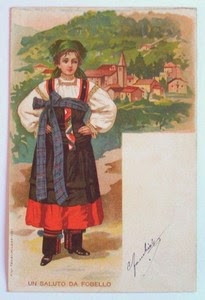
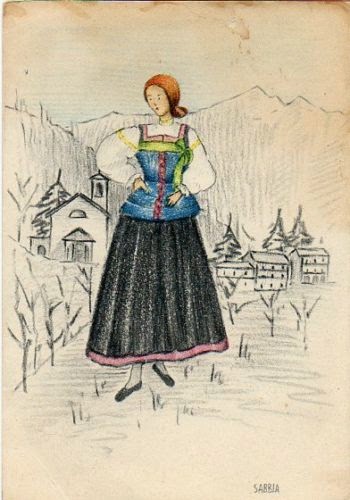
Here are some images which I have been able to assign to a particular village. There was evidently variation in the past.
Fobello


Cervatto


Cravagliana

Sabbia



Just a couple more images of this costume.


Here is a video showing displays in the village museum of Fobello.
https://www.youtube.com/watch?v=Z_0YzgNoC6Q
For those who are interested in puncetto, there are good sources online in Italian,
https://www.youtube.com/watch?v=XweZDJ7vKc4
German
https://www.youtube.com/watch?v=XcNNhAELstg&list=PLRzJzdncOnWqpiIiCD2uXwAjBDfiKW-gh
and even Slovak
http://sitakrajka.blogspot.com/2012/03/puncetto-valsesiano-1-plne-prazdne.html
but little in English.
http://lacenews.net/2010/09/06/on-the-internet-puncetto-valsesiano/
Roman K
email:
rkozakand@aol.com
Source Material:
Emma Calderini, 'Il Costume Popolare in Italia', Milan, 1934
Carla Rossetti et al, 'A Scuola di Puncetto Valsesiano', Varallo, Italy, 2009
Paola Scarrone et al, 'Manuale del Puncetto Colorato', Varallo, Italy, 2006
http://www.valsesia.it/tradizione/costumi.htm

