
Hello all,
Today I am going to talk about a type of costume which was found in the southern and western parts of the Karelian Isthmus. The Finns call this type of costume 'Rekko', after the particular kind of embroidery done on the chemise. This embroidery is done on the front just under the collar and results in the opening being on the side, as you can see in this image above.
Karelia is a contiguous region, but references to it are complicated, as it is divided into three parts politically. Here is a map showing the various regions of Karelia.

The regions of South Karelia [Etelä-Karjala] and North Karelia [Pohjois-Karjala] are within the current borders of the Finnish state. The regions of White Karelia, Olonets Karelia and Ladoga Karelia are within the Karelian Republic of Russia. This also includes the region of Zaonezhia, which lies east of Lake Onega and which is populated solely by Russians, so as to dilute the percentage of Karelians within the Republic. The Karelian isthmus [Karjalankannas] is currently part of Leningrad Oblast in Russia, along with Ingria.
The famous Kalevala was written in Karelia.

The Karelian isthmus, along with a strip of territory north of Lake Ladoga was annexed by the Soviet Union from Finland in the 1940's. This land is still shown on Finnish maps. The costume which I will be addressing today was found in various versions in the southern part of the Finnish Karelian Isthmus, together with communities of Ingrian Finns including Tuuteri [Tuutari] in Ingria, which is south of the previous border. This costume is still maintained by the small community of Karelians and Ingrian Finns which remain in the area, as well as by many who now live within the current borders of Finland.
The history and ethnogeography of this region is rather complicated, including, besides the Finns and Karelians the Votes, Izhorians, Ingrian Finns, Veps, Swedes, and Russians. For more information see these articles.
http://en.wikipedia.org/wiki/Karelian_Isthmus
http://en.wikipedia.org/wiki/Ingria
http://en.wikipedia.org/wiki/Karelia

As you can see from this map, besides Tuuteri, costumes with the rekko are found in the districts of Koivisto, Kuolemajärvi, Uusikirkko, Muolaa, Äyräpää, Kanneljärvi, Valkjärvi, Kivennapa, Rautu, Sakkola, and Metsäpirtti. These have, of course. now all been given Russian names. There are differences of detail between the costumes of the various districts. This costume was also found south of the border in some parts of Ingria, particularly in districts north of St. Petersburg, like Miikkulainen, and Vuole, but also in the district of Skuoritsa, which borders Tuuteri on the southwest, and the district of Tyrö on the Baltic coast to the north and west of Tuuteri [Tuutari].

Here is a photograph of the rekko paita or chemise. This particular example is from Sakkola.

The rekko is a center piece in the front of the chemise which is gathered into tubes as for smocking. Embroidery is done across these tubes and onto the neighboring piece of material Here is a schematic of a rekko chemise. Unlike English smocking, the gathering threads are left in place, and the result is not elastic.

The design, color and extent of the embroidery varies by district. Here is a closeup of a rekko from Valkjärvi done in orange, blue and white wool. Apparantly the original color of rekko embroidery was golden yellow. Some shade of yellow/orange still seems to generally be the primary color. The side opening is held closed by an engraved silver or pewter brooch, smaller for single girls, and larger for married women. This is the size of brooch which would be given to a girl by her fiance.

Here are a few images I took from a Finnish woman's blog showing how she made a rekko from Kivennapa, step by step. She is an amazing seamstress and makes Sarafans as well.
Her name seems to be Soja. Here is a link to her blog.It is very inspiring to see her work.
http://soja.blogit.fi/tag/rekko/

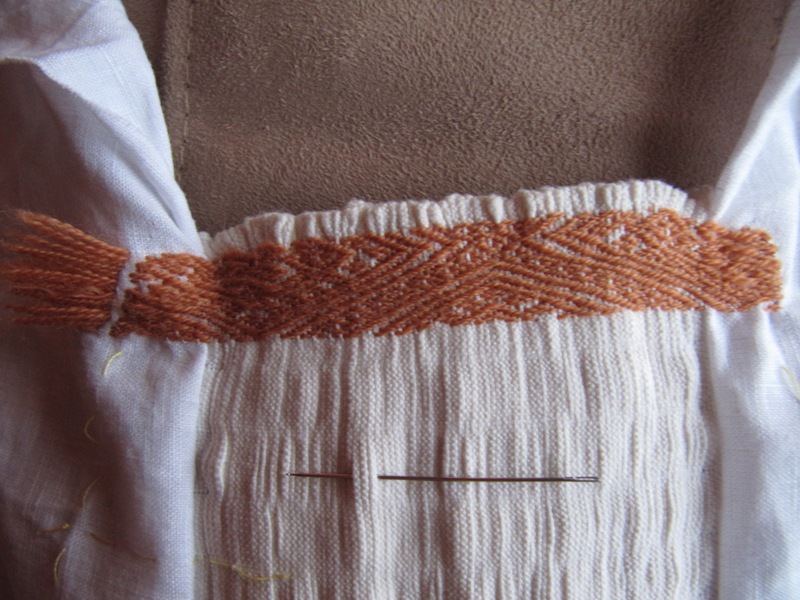


Here are a couple of closeups of a rekko from Kuolemajärvi.


Here is a closeup of a rekko from the district of Tyrö in Ingria.

Sometimes you will see one of these costumes made with a fake rekko, substituting it with a patch just sewn onto the chemise, like this example from Tuuteri. This photo is from a catalog of a company that makes mass produced costumes. It is much easier to do this.

Here is a closeup of the rekko embroidery from Metsäpirtti.This photo looks like the embroidery was originally done over the smocking and then was cut off and sewn onto a newer chemise.

The photo was taken from this webpage, which shows every detail of the Metsäpirtti costume and has detailed instructions on how to make it, in Finnish, [Karelian?]. The images are not of the best quality, but the information is still very valuable and interesting.
http://www.metsapirtti.net/perinne/metsapirttipuku/luku6.htm
Besides the rekko, embroidery is done on a narrow band or stand-up collar, on the cuffs, and in Tuuteri, Skuoritsa and Tyrö on the shoulders above or below the sleeve seam. In the area from Sakkola to Vuole, a colored strip of printed cotton cloth was sometimes inserted in this seam. See the image above. Here is an example from Miikkulainen. In Ingria, the sleeves are often gathered at the top of the shoulder.

This is the collar to the Kivennapa chemise that Soja shows on her blog.

On the Karelian isthmus, sarafans were worn in the east and south, and skirts in the north and west. The Rekko costumes are of either type, depending on district. This map shows the sarafan-wearing area shaded and stippled.

There are two similar cuts used for the sarafan in this area.

Examples from Sakkola

An example from Miikkulainen.

In Tuuteri and Skuoritsa the upper part is ornamented.


On the west side of the isthmus, a skirt is worn, either of a single color, as in Muolaa, or plaid with striped broadcloth sewn onto the bottom hem, as in Koivisto and Kuolemajärvi.

In Ingria the rekko costume is also sometimes worn with a skirt.

Aprons are either wool or linen, usually with woven in designs, and/or embroidery.


The linen aprons often have nyytinki bobbin-lace inserts and/or edging, like this example from Sakkola.

Tan leather shoes are worn which are typical of Karelia, and are similar to those worn by the Saami [Lapps], but shorter. They have a distinctive pointed toe.

Girls wear a headband or ribbon around the head. In Ingria in particular this was often highly ornamented with beadwork and metal plates. Here is an example from Tyrö.


While married women wear a headdress called sorokka, which is made of cloth with embroidery and/or appliqued ribbon, and ties around the head. Here are a couple of examples.


Here is what the two constituent pieces look like


Here are some more examples of the embroidery on the sorokka.


I will close with some photos showing the various forms of this costume in the various districts.
Koivisto


Kuolemajärvi


Uusikirkko and Kanneljärvi

Muolaa


Äyräpää

Kivennapa


Valkjärvi


Sakkola and Rautu


Metsäpirtti

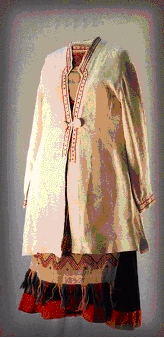
Miikkulainen and Vuole


Tuuteri


Skuoritsa


Tyrö


Thank you for reading, I hope that you have found this interesting and informative. I find this type of embroidery to be fascinating. I hope that some of you will find a way to adapt this idea and make something beautiful to enrich the world.

Here is a Finnish website where you can order some of these costumes
http://www.kansallispuvut.fi/puvut/koivisto_np.htm
Feel
free to contact me with requests for research. I hope to eventually
cover all of Europe and the Former Russian Empire/Soviet Union. I also
gratefully accept tips on source materials which i may not have. I also
accept commissions to research/design, sew, and/or embroider costumes
or other items for groups or individuals. I also choreograph and teach
folk dance.
Roman K.
email
Source material:
Ildiko Lehtinnen, 'Rahwaan Puku Folk Costume', Helsinki, 1984
Leena Hokkanen, 'The Bobbin-Laces of Karelian National Costumes', Saksa, Finland, 1991
Sylvi Kauhanen, 'Kansallispukuja', Helsinki, 1952
Ritva Somerma, 'Kansallispukuja', Lahti, Finland, 1991
Ritva Somerma, 'Finnish National Dresses', Lahti, Finland, 1987
Viola Malmi et al, 'Kostium i Prazdnyk', Petrozavodsk, Karelia, 2008
T. Jashkova, 'Kostium Karelii', Petrozavodsk, Karelia, 2009
Also the website of Finnish Museums online, which has remarkable images of items from various collections.


