Hello all,
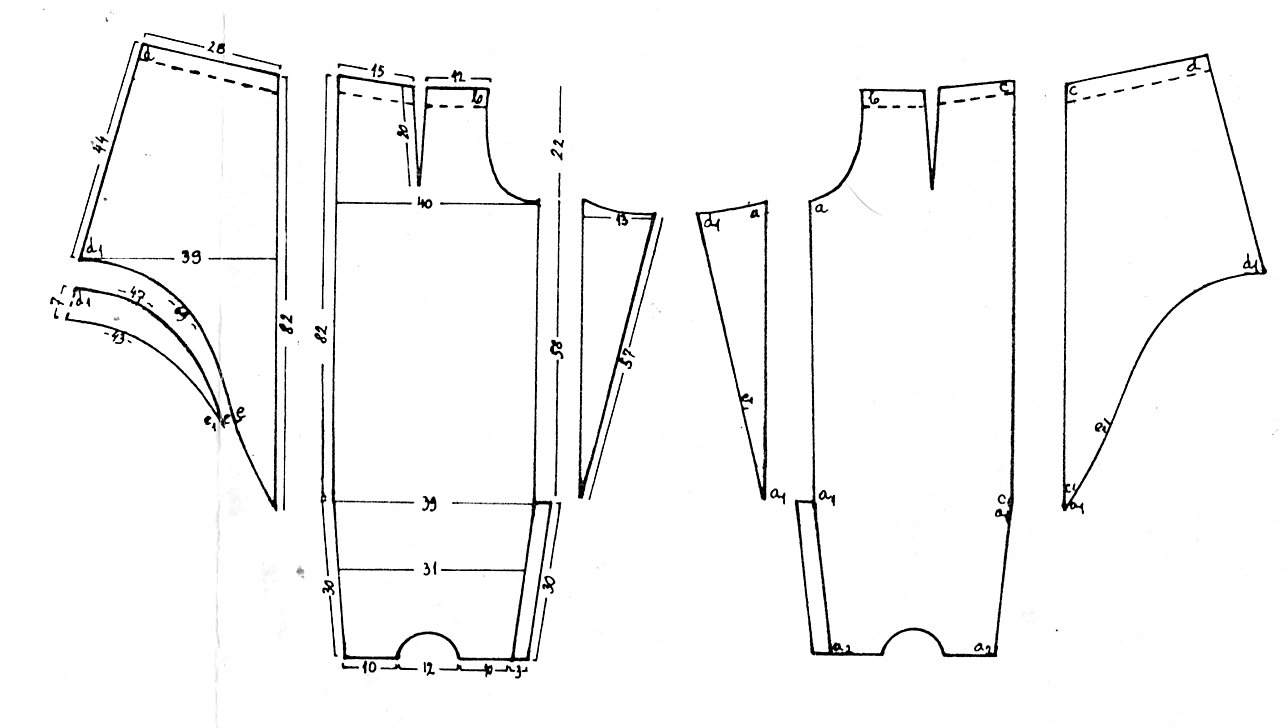
The Sarafan has become one of the symbols of Russia. In spite of the fact that the garment is only a couple hundred years old, It has permeated from its point of origin in the extreme northwest of the country to be found in many parts of that country. In fact, it is likely that the sarafan originated from the traditional costumes of the Finnic peoples around the area of Olonets, Arkhangelsk and vicinity, many of whom have been fully assimilated by the Russian people at this point in time. The sarafan consists of a long full skirt which hangs just below the arms and has straps or an extremely abbreviated bodice which secures it over the shoulders.
The sarafan may be gathered at the top like these two examples from Arkhangelsk.


Or it may be cut on an angle and flare towards the bottom, like this example from Olonets.

It may be made of costly materials, like this example from the Urals.

Or it may be made of homespun striped, plaid or block printed cloth, like the example at the top of the article. It is often worn unbelted, but sometimes it is worn with a sash.

An apron may be worn with it, sometimes hanging from the waist, like most aprons do, but more commonly tied around the body at the top of the sarafan, like these two examples from Vologda.


This was quite fashionable in St. Petersburg and other cities at one time, often made very full and long as in these two drawings by Maliavin, made around 1904.

This basic concept has apparently been at the center of the fashion world a few times. As a result, there are folk costumes which resemble the sarafan scattered around Europe. There is no genetic relationship between them, but rather are examples of a similar idea arising or being retained from popular fashion in different places at different times. Each locality developed a distinct outfit with specific forms of ornamentation and accessorization.
So today we will take a tour of Europe and view various 'cousins' of the sarafan. Some are belted, some are not, some have the full apron like the Russian form often does, some do not.
Finns and related peoples
It is no surprise that the northern Finnic peoples which are within Russia, or border on Russia in Finland wear a type of sarafan. These ARE genetically related to the sarafan of Russia.
Komi

Karelians


Veps [Vepsians]

Finns


West Karelia, which is in Finland

The Karelian Isthmus and Ingria, which is along the coast south of the current Russian/Finnish border. Many Finns and closely related peoples [Luud',Votes, Izhorians, etc] lived in this area before it was annexed by Russia, and some still do.


The rest of the costumes I will cover today are not related to the sarafan directly. They are each found in a small area, and none are considered typical or representative of their respective nations. However each of these is alive and preserved with great pride by the local people of these communities.
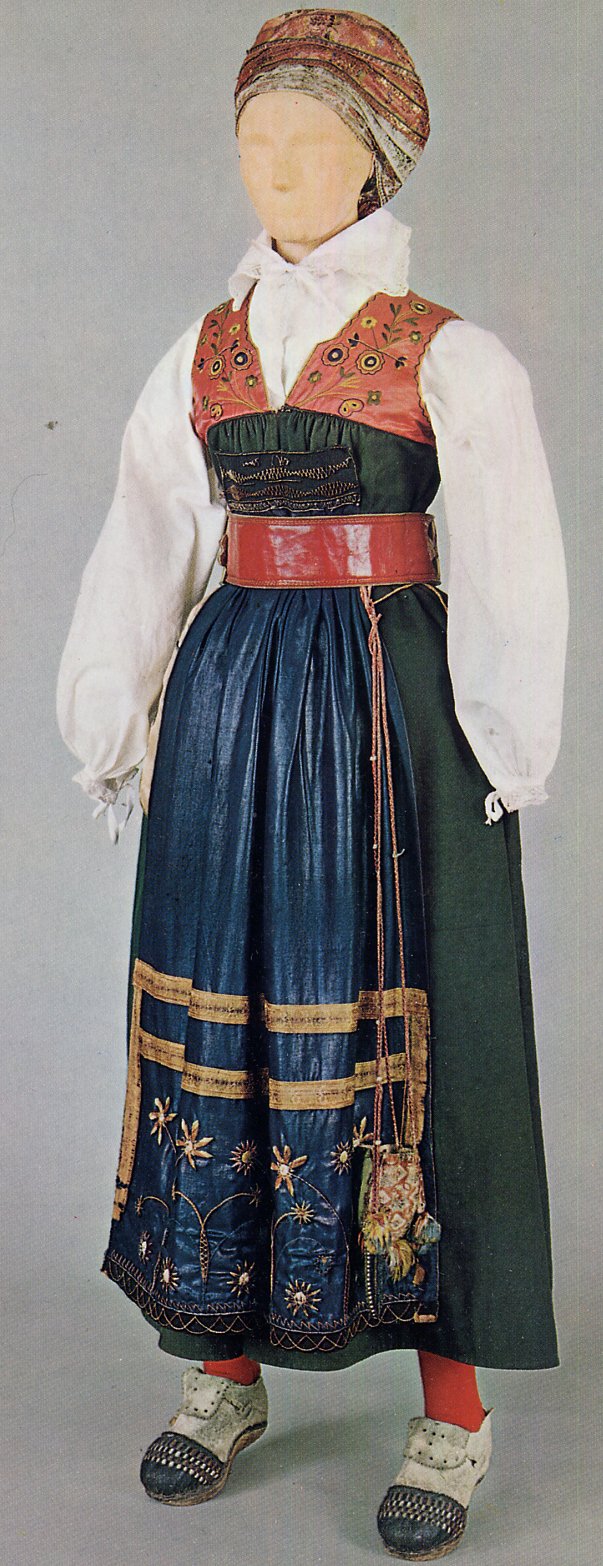
Sweden
Two neighboring communities of Vingåker and Österåker
Province of Södermanland or Sörmland
These two communities have very similar costumes. This type of dress is called Livkjol in Swedish.
Vingåker


Österåker


Norway
Gol, Ål, Flå and neighboring communities in upper Hallingdal and Hemsedal
Province of Buskerud
There are several similar costumes worn in various communities in this area. Of all the costumes in this posting, this one has the widest distribution. They have a very distinct form of embroidery in this region, based on Rosemaling. Mary Gostelow has a project based on this costume in her work 'The Complete International Book of Embroidery', however she incorrectly identifies it as being from Telemark. In Telemark they also do Rosemaling embroidery, but it is of a different style.


Spain
Valley of Ansó, region of Huesca
Province of Aragon
This is a very beautiful and distinct costume. I am indebted to Marco Leon of Madrid for the following information.
'The "basquiña" is the local name for the green garment without sleeves. In Ansó, the black garment like basquiña, used for religious ceremonies, is called "saigüelo", and there is another dress like those called "saya" with sleeves, worn only on very special days. All three names (basquiña, saigüelo & saya) have centuries of use in Spanish costume, both rural and urban, referring to different types of dresses and skirts. So there is no special relationship with Basque costume, but these terms belong to Spanish (or occidental) rural costume in general.'
Lilla Fox writes that the term basquina indicated that the costume had been picked up from the Basques. This seems to be a conclusion on her part which in which she was apparently mistaken.


Switzerland
Valleys of Verzasca and Maggia
Canton of Ticino
These two neighboring valleys in the center of Ticino have costumes that differ primarily in color, Verzasca having a light colored dress and that of Maggia being made of dark colors.


Austria
Region of Bregenzerwald
Province of Voralrberg
This costume has the same construction as a sarafan, but it is pleated and the upper part has the pleats sewn together, as indeed the Russian sarafan sometimes is. It is always worn with a belt. The complex gold cap for girls is found in many German speaking areas. Brides wear a larger version of it. There is beautiful embroidery around the neck While this region is next to Switzerland, it is not close to Val Verzasca.


Italy
Community of Guardia Piemontese
Province of Calabria
This isolated community in Calabria has an interesting history. They are traditionally Waldensian, and settled in the area a few hundred years ago. They staunchly keep their costume alive, as well as their unorthodox faith. The costume they currently wear has nothing in common with that of Valais, however.


Croatia
Zlarin, Korčula and coastal region
Province of Dalmatia
Some of the costumes found on the islands and Adriatic coast of Dalmatian Croatia bear some resemblance to the sarafan. It is interesting to note that this is the only Slavic nation that I could include in this article.
The Island of Zlarin

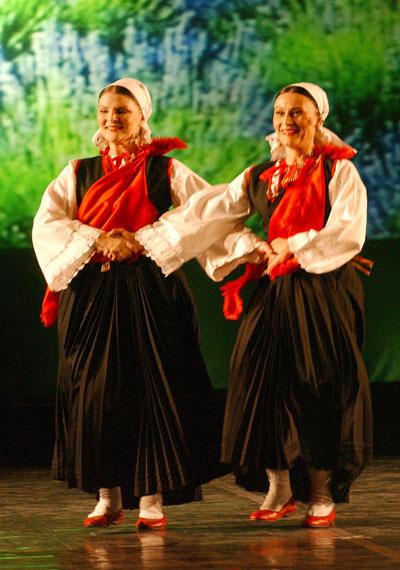
The Island of Korčula

A couple more costumes from the Dalmatian Coast. The beautiful costume on the right is a good example, but I have been unable to find out the exact community which it is from.

Greece
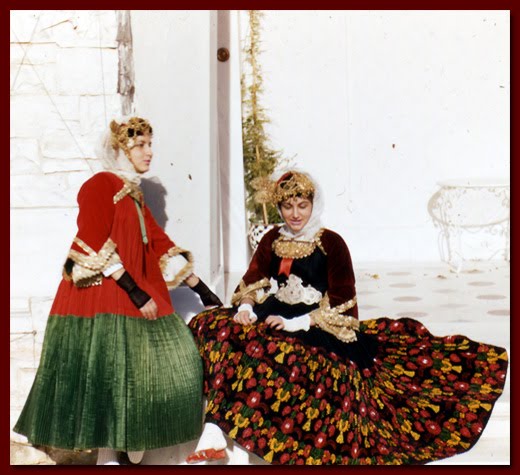
Island of Skopelos, the Sporades
This type of costume was formerly found on Crete and other islands as well, as we know from Museum collections. This dress is known as foustana or stofa.


There may well be more, but if so, then I am unaware of them. I would be glad to include any others which you may know of, as I am always glad to learn more. Also if anyone knows the origin of the mystery costume from Dalmatia, I would love to find that out as well.
So you can see that particular concepts in costume can be widespread and may have arisen in different places at different times independently. I find this to be one fascinating example. The fact that Slavic nations are almost unrepresented in this survey lends weight to the idea that the sarafan does not have Slavic roots.
Thank you for reading, I hope that you have found this interesting and informative.
Roman K.
Feel
free to contact me with requests for research. I hope to eventually
cover all of Europe and the Former Russian Empire/Soviet Union. I also
gratefully accept tips on source materials which i may not have. I also
accept commissions to research/design, sew, and/or embroider costumes
or other items for groups or individuals. I also choreograph and teach
folk dance.
Roman K.
Source Material:
This article has a very extensive bibliography, if anyone wishes information as to some of my sources, I will gladly provide them for a specific region. I will be building it slowly.
L. Molotova, 'Russian Folk Clothing', Leningrad, 1984
S. Gorozhanina et al, 'Russkij Narodnyj Svadebnyj Kostium', Tver, 2003
Viola Malmi et al, 'Kostium i Prazdnyk', Petrozavodsk 'Karelia', 2008
T. Jashkova, 'Kostium Karelii', Petrozavodsk, 2009
Sylvi Kauhanen & Alli Touri, 'Kansallispukuja', Helsinki, 1952
Ritva Somerma, 'Finnish National Dresses' [sic], Helmi Vuorelma Oy, Lahti, Finland, 1987
Viola Malmi et al, 'Kostium i Prazdnyk', Petrozavodsk 'Karelia', 2008
T. Jashkova, 'Kostium Karelii', Petrozavodsk, 2009
Sylvi Kauhanen & Alli Touri, 'Kansallispukuja', Helsinki, 1952
Ritva Somerma, 'Finnish National Dresses' [sic], Helmi Vuorelma Oy, Lahti, Finland, 1987
Inga Arno Berg et al, 'Folk Costumes of Sweden - a living tradition', Orebro, 1985
Anna-Maja Nylen, 'Folkdrakter', Arlov, 1982
Bent Vanberg, Kjersti Skavhaug et al, 'Norwegian Bunads', Oslo, 1991
Heidi Fossnes, 'Norges Bunader', Oslo, 1994
Lilla Fox, 'Folk Costume of Southern Europe', Boston, 1972
Jose Ortiz Echague, 'Espana, Tipos y Trajes', Madrid, 1953
Cesar Justel, 'Espana, Trajes Regionales', Madrid, 1997
Plinio Grossi, 'Rachele Giudici e i Suoi Costumi', Bellinzona, CH, 1978
Louise Witzig, 'Schweizer Trachtenbuch', Zurich, 1954
Lotti Schurch et al, 'Trachten der Sweiz', Bern, 1978
Louise Witzig et al, 'Costumes Suisse', Payotte Lausanne, Berne
Maria Rehm, 'Oesterreichs Trachtenbuechlein', Innsbruck, 1981