Friday, April 27, 2012

Costume of central Serbia, or Šumadija, Шумадија


Hello All,
Today I will venture into yet another new country, Serbia. It is more difficult to find material on Serbian Folklore than it is for Croatia, for example. I am not sure why this is the case. Serbia has been a very forward looking country since they emerged from under the Ottoman Empire. I will be covering the most common Serbian costume, that of central Serbia, or Šumadija. This is the heart of Serbia, extending from Beograd south along the Morava river.This costume comes in several forms, varying mostly in the type of skirt. As in most of my posts, I will not be able to cover every variation. This photo above shows one of the more common versions.
http://en.wikipedia.org/wiki/Serbia 


 http://en.wikipedia.org/wiki/%C5%A0umadija

The basic garment, as in the rest of the Balkans and much of Eastern Europe, is the chemise. Typically there is a band collar and no cuffs. One typical feature of the Serbian chemise is that the sleeve is gathered just above the elbow. Very often a red garter or ribbon is tied around the arm at this point, as in the photo above.


 There is embroidery around the sleeve opening, around the neck opening, often on the lower part above the hem, and very often a spot design on the upper sleeve, above the gathered area. There is very little material on the traditional designs used. Today what is seen in  almost all cases is multicolored cross-stitch floral designs which are very reminiscent of Berlin Work. This is of recent origin, not going past the mid 19th cent at most. There are various cuts used for the chemise, here is one version. There are also versions in which the sleeves are set in perpendicular to the body. The pieces used are narrow because the constraint of a hand-loom does not permit wider pieces to be woven.


There are various vests or bodices worn with this costume, called pamuklija, djudica, grudniak, zubun, etc. The most commonly seen today is the one called jelek. Each of these vests has a different cut. The jelek is short, coming just to the waist, it hooks closed in front, with a point in the center and a curved opening on either side. It is usually red or black, and typically has rich ornamentation consisting of couched gold braid. For young  women the neckline is low, functioning as a bustier,  but for older women the neckline may be considerably higher. 


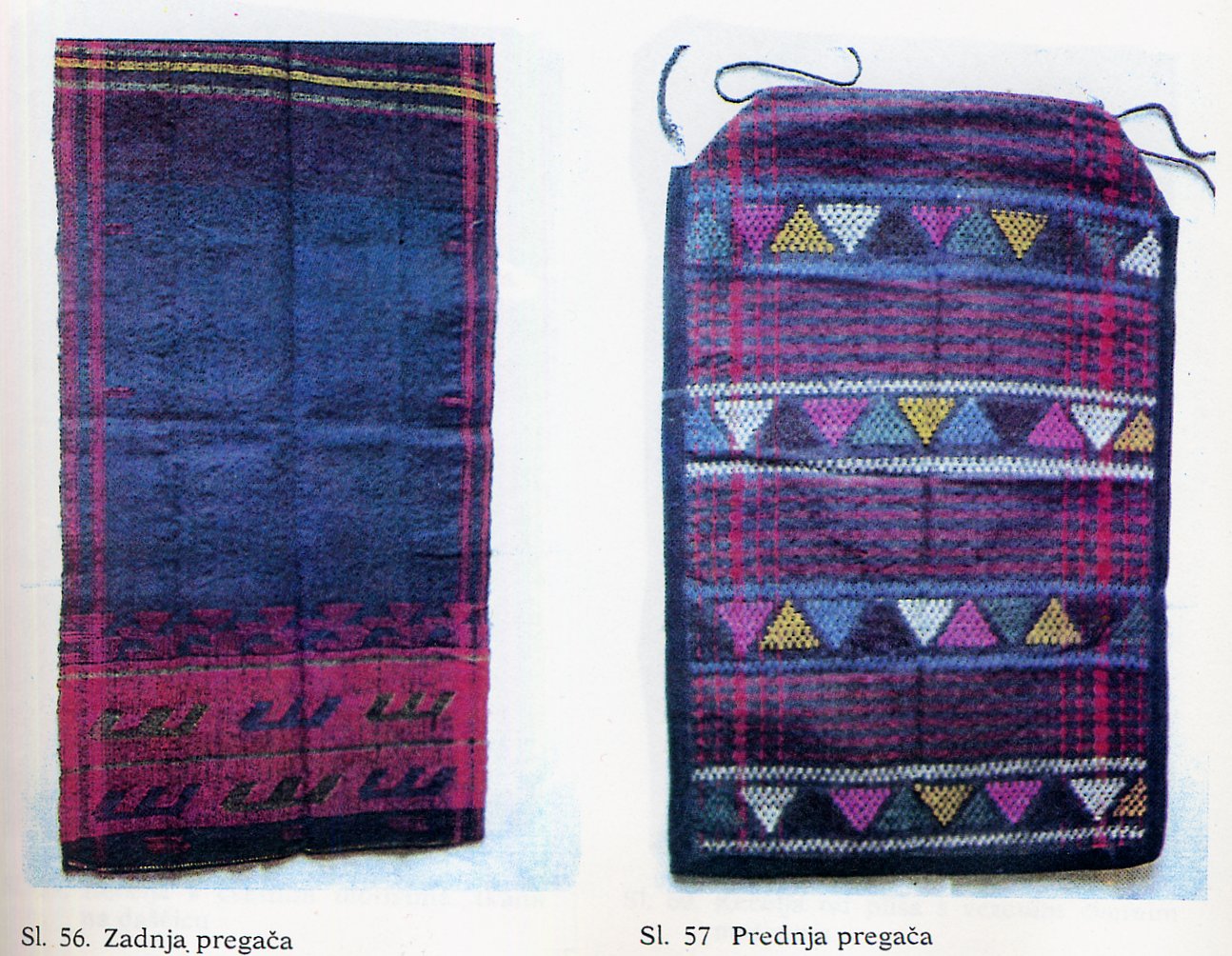
 There are various types of skirts worn with this costume. One of the oldest and simplest is the two apron version. This has two aprons of a single panel each, the front apron being ornamented and the rear apron mostly plain, with ornamentation just along the bottom. This is common over much of eastern Europe. Here is a painting by the artist O. Benson showing a young woman from the village of Kumodraž near Beograd.


On the left is a rear apron, on the right is a front apron.

This is part of a painting by the artist Carol Pop de Szathmari, of a scene in a market in Beograd in the mid 1800's.


What is most commonly seen today is a closed skirt woven in narrow stripes or plaid, often of two widths of cloth sewn together horizontally, with the plaid deliberately not matched. This is pleated finely, and usually has a black velvet hem and lace sewn onto it above that. See the image at the top of the article.


Some forms of the skirt were plain in color with a decorated hem, either wide or narrow. Here is another part of the same painting by Carol Pop de Szatmari. The artist has painted himself into the scene at right. He was apparently a Hungarian Orthodox Priest. Below is another painting by Benson showing a young woman from the village of Kusadak.


 Some contemporary versions of the skirt in particular communities have become quite short.The first photo is from Užice. The second is from southern Pomoravlje.


The most spectacular version of the skirt is basically the same as the narrow pleated one, but is not sewn closed in front, and is worn with the corners tucked into the waistband behind. This gives the outfit a lot of movement. Typically the hem that shows is ornamented with crochet and embroidery. See some of the images above. Here are a couple more images of that type of skirt.


The kerchief wrapped around the torso seen in these last three images was commonly worn in the mid 1800's, under influence of Western fashion of the day. This has died out and is no longer seen. The last image is of a painting by Nikola Arsenović, who also painted in the mid 1800's.


The apron is traditionally woven in tapestry technique, with colorful geometric motifs. Today it is more commonly made of red or black wool with floral cross-stitch or crewel embroidery. 


In the past, unmarried girls and brides often wore embroidered linen aprons, as you can see in this painting by Arsenović This is rarely seen today, however.


There is often a striped sash tied around the waist. The stockings are hand knitted, either with geometric, or more often, floral designs either knitted into or embroidered onto them.


The traditional footwear are moccasins, which are called opanci, They have thin goatskin strips woven on the uppers, and stereotypically in Serbia have curled toes. This is not traditionally true for all communities, but they have become somewhat of a symbol of Serbia.


This last painting is by the celebrated Jugoslavian artist Vladimir Kirin. Thank you for reading, I hope that you have found this interesting and perhaps inspiring.


Here is a website showing how a Serbian community in France made a 'parade giant' figure in Serbian costume named Bela Rada.
There are many photographs of the finished figure, of the details of her costume and how she was made. Quite fascinating.
http://belarada.canalblog.com/

A couple of Serbian groups performing traditional dances. Serbian dances are famous for small precise intricate footwork.
http://www.youtube.com/watch?v=rUlnyX-ijxM&feature=related 

http://www.youtube.com/watch?v=NBHMgfJAB4g&feature=related 

This video shows the winged skirt.
http://www.youtube.com/watch?v=tVaUo-DApwo&feature=related 


Feel free to contact me with requests for research. I hope to eventually cover all of Europe and the Former Russian Empire/Soviet Union. I also gratefully accept tips on source materials which i may not have. I also accept commissions to research/design, sew, and/or embroider costumes or other items for groups or individuals. I also choreograph and teach folk dance.
Roman K.

Rkozakand@aol.com

Source Material:
Mitar Vlahovic et al, 'National Costumes of Serbia - Watercolours by N. Arsenovic', Beograd, 1954
Erina Shobich, 'Odezhda i Ornament Serbii', Beograd, 1956
Vladimir Kirin, 'Narodne Nosnje Jugoslavije', Zagreb, 
Mirjana Prosic-Dvornic, 'Narodna Nosnja Sumadije', Zagreb
Nikola Pantelic, 'Traditional Arts and Crafts in Yugoslavia', Belgrade, 1984
Vladimir Salopek, 'Folk Costumes and Dances of Yugoslavia', Zagreb, 1989
Kaoru Tanaka, 'World Folk Costumes in Natural Color', Osaka, 1961

Saturday, April 21, 2012

Costume of the Arvan valley, Savoy, France


Hello all,
This is going to be my last posting about Savoy, at least for a while. This is the most unusual and likely the most famous of all the costumes in Savoy. The Arvan valley is in the southwest corner of Maurienne, south of Villards and west of Valloise. The image above is of a print which I have hanging on my wall. The costume worn in this valley is distinctive, but there are three basic variants, which differ primarily in the coif used, but also in other details.
The first variant is found in the communities on the north side of the Arvan river, namely, Jarrier, St. Pancrace, Fontcouverte and Villarembert. There are subtle differences between the costumes of each community.
The second is found in the three communities at the head of the valley, along the two upper branches of the Arvan, St. Sorlin d'Arves, St. Jean d'Arves and Montrond. The print above is of the second variant, which is the best known.
The third variant is found in the communities on the south side of the river valley, Albiez the Old, and Albiez the Young. 
Here is a schematic map of the Arvan valley, It is found in the southwest  'corner' of Maurienne, off the main river valley of the Arc.
 This costume is extremely colorful and quite unusual in several respects. The basic garment is a chemise, which seems to have a stand-up collar, and only shows around the neckline, but is important as a foundation garment. The skirt is separate from the bodice, or jacket, which has sleeves. The Jacket is closed either by lacing up, in the first variant, or by a line of hooks in variants 2 and 3. The skirt is heavy wool, with a unique construction, with one double band of blue cloth sewn onto the back, a little below the waist in variant 1, somewhat lower in St Jean,  variant 2, and just above the knees in variant three. The front is flat, and has 25 pleats from one hip to the other in varians 1 and 2, and only 11 in variant 3. The cincture 'ceinture'  is closed in front with homemade 'chainettes', it is about 20 cm wide in variants 1 and two, and considerably narrower in the Albiez's. A rich apron and embroidered shawl is worn in all three variants, and in color  varies with the Liturgical season. The three styles of coif are very different. 

1. The hair is gathered in a chignon on top of the head, covered with a small coif, and then a 'beguine' of fan or butterfly shaped lace mounted onto a small piece of linen is pinned to it. It varies slightly in shape from one community to another.

Jarrier


Saint Pancrace


Fontcourverte


Villarembert


2. The coif is shaped somewhat like a bonnet without the front frill, it is set back somewhat on the head. The main part is cylindrical with a flat back. It is covered with red or rose colored cloth or ribbon. There is a ruched frill of lace attached  halfway with the top slanting forward  and the sides slanting back. In St. Sorlin the coif is covered with spangles and metallic braid behind the lace frill, and finished off with colored ribbon. In St. Jean the rear is covered with white gauze  and finished off with a white ribbon.

Saint Sorlin


Saint Jean


3. In the two Albiez, the coif is a white bonnet which somewhat resembles the eskeuffia of Upper Maurienne, and combines features of the other two versions.


In these last couple of photos, you can see that the jacket is trimmed with colorful woven ribbon, and is hooked closed up the front. This is visible because the Albiez sash is so much narrower than that of the other versions. Sometimes a hand-embroidered strip of cloth is used instead. The hooks are clearly visible, and in this case have been sewn on with green and yellow thread to match the embroidery. A cross on a ribbon is part of all three variants of the costume.


The narrow ceinture of Albiez is usually embroidered, edged with ribbon and closed with a simple row of hooks. The apron is of a colorful  material, has a patterned ribbon worn over it. The apron and/or the shawl may be embroidered as well.


By contrast, the ceinture of the other two variants is wider, is also made of rich cloth, and has ribbon edging, but the two ends do not meet, rather there  is a piece which overlaps behind. There are a series of chainettes which stretch across this central panel, and hook onto the edge beyond. This is one of the most striking features  of this costume. This first example I believe is of variant 1, and the others of varient 2.


There is often trim sewn onto the upper edge of the apron in variant 2.


The last component of this costume which is very unique is the skirt and its construction. The top of the skirt is a normal full gathered skirt, but the lower edge is made of up to 30 separate strips sewn on one at a time, each longer than the last, and eased in to fit. Thus the skirt gets larger and larger with each new strip. The front is left flat. Since the number of pleats remains constant, either 25 or 11, each individual pleat gets wider towards the bottom. In many of the communities, the skirts turn up at the bottom to form 'magpie tails'. It takes a skilled seamstress up to 6 months to make such a skirt, the bottom hem may be up to 11 meters around, and the skirt itself may weigh 7 kilos. This results in a remarkable movement of the skirt when walking. If you look carefully, you can see the separate strips in the following photos.

St. Jean


Albiez


 St Sorlin


Jarrier


 Magpie tails


 The only other example of this kind of skirt construction which I know of is the Xhubleta of Albania [ pronounced Djoobleta ]. The xhubleta also has a number of strips sewn on one after the other, each of which is longer than the one before, making the garment wider and wider towards the bottom. In other respects the xhubleta is very different, not being pleated, being attached to a bodice, and having braid sewn on the various strips. Why these two unrelated, widely separated regions uniquely use this method of construction, I have no idea.  Interestingly, the xhubleta is also worn with a short waist length jacket which fastens in front, called a mintan, and a wide  [to 20 cm] cloth cincture which is highly decorated and hooks closed in front, called kerdhokla. Both of these are additional similarities to the Arvan Costume. This makes for some interesting speculation.
Here is a schematic of the construction, a photograph of a xhubleta from the rear and a woman wearing the full costume.


Update: Since i published this article, some Albanian researchers have taken this further. They point out the similarity of Arvan with Arvanitiki, one of the names used for the Albanians, the similarity of some genetic haplogroups between the two populations and hypothesize a migration from Albania to this region. Here is one of the articles published on this topic:
https://imgur.com/a/a54Lebx


Here are just a few more images of the Arvan costume. 


Thank you for reading, I hope you have found this interesting and informative.


Feel free to contact me with requests for research. I hope to eventually cover all of Europe and the Former Russian Empire/Soviet Union. I also gratefully accept tips on source materials which i may not have. I also accept commissions to research/design, sew, and/or embroider costumes or other items for groups or individuals. I also choreograph and teach folk dance.
Roman K.

Rkozakand@aol.com


Source Material:
Daniel Dequier, 'Maurienne d'Hier et d'Aujourd'hui', Albertville, 1980
G. Collomb, 'Les Costumes de Savoie', Chambery, 1972
Fabian et Anne da Costa, 'Costumes Traditionels de Savoie', Lyons, 2000
Daniel Dequier & Francois Isler, 'Costumes de Fete en Savoie', Seyssinet, 2002
R. Feuillie, 'Quelques Costumes de Savoie', Annecy,
Andre Sainsard, 'Costumes Folkloriques Provinces Françaises', Paris, 1972
Royere, Gardilanne, Moffat et al, 'Les Costumes Regionaux de la France', New York, 1929
Charles-Brun, 'Costumes des Provinces Françaises', Paris, 1937
P. Leroux, 'Costumes Regionaux', Paris, 1940
Caroline Brancq, 'Les Costumes regioneaux d'Autrefois', Paris, 2003
Royere, Gardilanne, Moffat et al, 'Les Costumes Regionaux de la France', New York, 1929
Andromaqi Gjergji, 'Albanian Costumes through the Centuries', Tirana. 2004