Showing posts with label shirt. Show all posts

Tuesday, March 15, 2011

Hutsul Men's Shirt, Ukraine

Orest requested this for a friend of his. This proved to be a bit of a challenge. I covered the Hutsul costume in a couple of my previous posts, and often in photographs, the shirt is simply not visible. By the time the Hutsul man puts on his kyptar, his serdak, slings a bag over one shoulder, a powder horn on a strap over the other shoulder, you can't see his shirt.
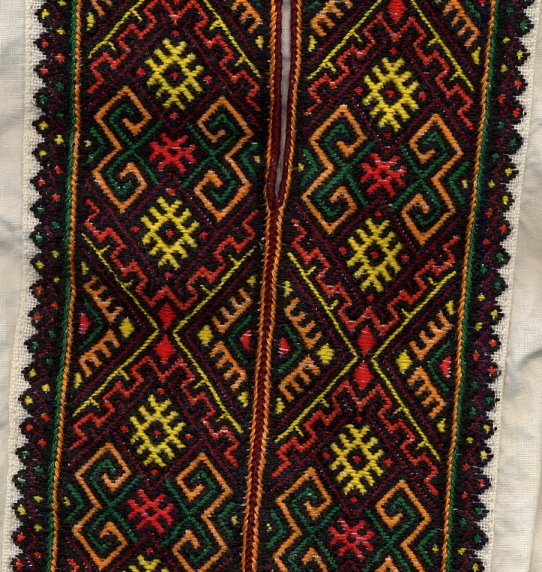
Nonetheless, I have come up with some information. What i see in my library are two kinds of shirts, one is what has become the standard Ukrainian shirt, with Hutsul embroidery on the band collar, the cuffs, and especially down the front. This is perfectly fine. Here is an example from my personal collection. By the way, for you textile enthusiasts out there, embroidery may be reproduced perfectly well on a copier or a scanner. This is a scan of one of my shirts.


You can see the typical Hutsul style 'nyzynka' embroidery. This is the color scheme that has become synonymous with Hutsul ornament in the minds of many people. In fact, the Hutsuls use a wider palette depending on the particular area. The embroidery was done on a counted thread material, as you can see on the inside of the collar. The cuffs, collar and front plackets were then sewn onto thin cotton which was made into the shirt. Here is a closeup of the embroidery


This type of shirt has become standard all over Ukraine. Mean wear it with modern slacks when they wish to be somewhat formal, or show their identity, or participate in a festival, and it is often worn with a suit. It is also used in stage costume, or by local performing groups. The only current distinction between regions is the type  of embroidery, of which Ukraine has a tremendous variety. But even this is often ignored. The older traditional shirts tended to have embroidery which stopped halfway down the front, or even shorter, but the modern shirt usually takes the embroidery to the beltline. The embroidery varies in width from about a centimeter for each strip, to wider than the collar. This dates back, more or less to the 1950's, about the same time that women started cutting the chemise in two parts horizontally, to be able to wear the embroidered shirt with modern clothing. Here is a photograph showing a man wearing this type of shirt. Note that his does not actually have a cuff. Both cuffed and cuffless shirts are known.. You will also notice that his shirt has the traditional constuction, with the so called 'drop shoulder'. [the only kind of sleeve that anyone wore until recently, but it has become necessary to explicitly tell people that no, you don't need that curved seam at the point of the shoulder].
Set in sleeves are now also widely worn.


As for the traditional Hutsul men's shirt, i did find one schematic for a shirt from Kosmach.


One piece for the body of the shirt, folded over the shoulders. Sleeves joined at right angles to the body. Neck opening cut into the middle of the shirt body, Panels under the sleeves to widen the shirt, plackets under the arms. Embroidery on the cuffs, turn down collar, along the sleeve seam, and around both the front and sleeve openings. Note that the embroidery does not extend past the opening. Typical Kosmach embroidery, which will be the subject of a future posting. This is borne out by some of the old photos I found. These two were in the posting about kyptary.


Here is a photo of several young men taken in the 1930's in Kosmach

You will notice a wide range in the extent of the front embroidery, from none at all, to a narrow strip, to a wide singe fold over placket. This is still typical today, depending on how ambitious the individual embroiderer is. In keeping with Kosmach tradition, all of the shoulder seams show a narrow strip of embroidery, this is not the case in all of the Hutsul region. The shirt is traditionally worn outside the pants, reaching to mid thigh, with no embellishment on the lower hem. You will sometimes see a narrow strip of embroidery, or some whitework or hemstitching, [merezhka] but this is confined to individual villages or particularly ambitious embroiderers. Mens work shirts were sometimes not embroidered at all, while women's work chemises always had at least a narrow strip. here is a group of Hutsuls most of whom are in everyday summer clothing from Pechenizhinsk.


You will notice the narrow collars and lack of front embroidery on many of the men, while the one young man in full regalia has embroidery around the front shirt opening, but not extending any lower. Not all Hutsul shirts had fold down collars. Here is an example from the village of Biloberezka, in the county of Verkhovyno, showing a band collar, and the typical cool color scheme of that area.


This shirt was made in 1939, I am not sure how old the custom of putting the little colorful addendum underneath is. Hutsul shirts were apparantly always gathered into cuffs, which makes sense, given the cool weather in the mountains.  Here is a closeup of the cuff of another man's shirt from the Verkhovyno area from the 1970's. You will notice the floral design, which was a popular development in the nyzynka technique at the time. This area uses a unique form of gathering which gives this texture. Instructions may be seen on pgs 139-140 in Tania Diakiw O'Neill's wonderful book, 'Ukrainian Embroidery Techniques'.


Hutsuls do, in fact do other kinds of embroidery, especially in those areas which border other regions with their own embroidery tradition. But conversely, Hutsul embroidery has been widely admired and copied in lowland regions, especially eastern Halychyna, around the city of Ivano-Frankiwsk, to Lviw and other city areas, adapted in parts of western Podillia and Bukovyna, and even in Poland and Hungary.
I suppose I should stop here. I find I have trouble confining myself to discussions that are appropriately short enough for a posting. One topic always leads to another.

I am trying to do research on the traditional shirts of Halychyna. I would like to appeal to my readers if they have any material on the costume of the area from Nadsannia to eastern Halychyna. This is one of those 'blank areas' which appear on the maps of folk tradition and costume in most countries, where industrialization came early, with the resultant loss of the local tradition. Or perhaps distinctive traditions never materialized. My own family is from this area. The costume of the Yavoriw area is of course well known, and the costume of the southern strip of foothills has some attestation as well. I would love to obtain information about the costume of the rest of Halychyna, especially around Peremyshl and east of Lviw. Thank you in advance.
And thanks to all of you for reading. I hope you found this interesting and inspiring.

Feel free to contact me with requests for research. I hope to eventually cover all of Europe and the Former Russian Empire/Soviet Union. I also gratefully accept tips on source materials which i may not have. I also accept commissions to research/design, sew, and/or embroider costumes or other items for groups or individuals.
Roman K.
Rkozakand@aol.com

Source Material:
Olena Nykorak, 'Hutsul'ska Vyshywka' [Hutsul Embroidery], publisher Rodovid, 2010
K Matejko, 'Ukrainskyj Narodnyj Odiah' [Ukrainian Folk Clothing] Kyjiw [Kiev], 1977
Various Authors, 'Ukrajins'le Narodne Mystetstvo - Odiah' [Ukrainian Folk Art - Clothing] Kyjiw [Kiev], 1961
Tania Diakiw O'Neill, 'Ukrainian Embroidery Techniques', Mountaintop PA, 1984


Saturday, March 12, 2011

Short history of Krzczonow embroidery


Hello all, today i will talk about the 'mystery stitch' of Krzczonow. For the remainder of the costume, see my last two postings. The cut of the shirt for both men and women is the same, with shoulder insets, 'przyramki' in Polish sewn above the body pieces. For a schematic see my first Krzczonow posting. The older shirts were embroidered on the collar and cuffs, and as you can see from this old photograph, often on the shoulder przyramki. Later on, the shirts began to be embroidered around the front opening as well.
The embroidery consists of linear designs, travelling around the cuff, across the przyramki, down the front,
and on the collars, the design runs across both ends, and then lengthwise along the back edge. So that the whole thing looks like this old shirt.

You can clearly see the cut of the shirt in this image. The only real difference between the mens and women's shirts was that the collar is bigger on the woman's, almost like a sailor type collar. Today,  you will also see the embroidery on the mens shirt extending lower down the front, because the men often wear the kaftan, which is open in front. The woman's kaftan is never worn open, and the gorset only shows the upper part of the front of the shirt. Here are two recent examples.

Woman's shirt

Man's shirt.


You can see the typical color palette of this region, black, red, yellow with some green. These pieces are done in the modern style, with  cross-stitch. There seems to be a general tendency for many embroidery traditions to migrate to cross-stitch from older techniques, because it is easier. I find this regrettable, many local traditions and unique expressions get lost this way. At least in this region they have developed a style of cross-stitching that is unique and recognizeably of their own tradition. See this photo of a woman doing crafts.


What happens very often is that they start cross-stitching roses, and then go to satin stich roses, [and always blue ones, for some reason] so that they completely lose their own particular tradition. I have seen this in my research from many places around the world,some specific regions of  Mexico, Holland and Albania come to mind. Krzconow has so far escaped this, although i did find this one photo. Some of my Polish books have said that at the beginning of the 20th century, there was a fashion in Malopolska of embroidering in 'Rus'ky' style. [read Rusinsky, e.g. Ukrainian style]


Originally, however cross-stitch was not used. the oldest information we have is from the 18th century, when the woman's costume was made of unbleached linen,with a finely pleated skirt and apron. The collar however was the same shape, and embroidered with the same layout in white cotton, like this.


A little later on, some red, and then some black was added, as in this photo

Ok, i see back stitch, i see buttonhole stitch around the edges, i see wavy lines and zigzags made from chain stitch, i see lazy daisy flowers, i see counted satin stitch filling in small areas, but i could not figure out how those wider lines were done. Janusz Swiezy and Aleksander Blachowski said that they were rows of herringbone stitches, although Blachowski does not dwell on the techniques. Here is a drawing by Swiezy of some of the embroidery motifs

a

You can see the stitches well represented, the 'mystery' stitch is part of the grouping in the lower right corner. Not a convincing representation. It is not herringbone. This explanation was also picked up by Elzbieta Piskorz, as shown here.


This is from a later period, when more colors had been added to the embroidery tradition. Very attractive. These are the same colors which are still used in the cross stitch tradition. Lets take a closer look.


Very pretty, but that is NOT herringbone. Notice that some cross-stitches are part of the overall design.
Kazimierz Pietkiewicz says that this stitch is a combination of a braiding stitch, 'Janina' edged by two rows of backstitch. Hmm, yeah that's what it would look like, but i don't think that is right.
Jadwiga Turska puts a couple of drawings of this type of embroidery in her book, but does not adress the identity of this stitch directly. You can see her drawing them in this image here below, the wider horizontal lines.


I saw the same stitch in a Bulgarian book. I said, that's it! But it gave no explanation of how to do it.


Then i found this description in a general book of folk embroidery by Margaret Ohms. "Turkmen stitch. This stitch resembles a closed feather stitch...forms a characteristic ridge on either side of the crossed filling."
Turkmen Stich? Turkmen?
So i took a look at a piece of Turkmen embroidery that I have, and sure enough, look at this.


It's the same stitch! The composition and design are very different, but it's recognizably the same technique. Ted Zed suggested that it could have been brought to Poland by Tatars. Well, its possible, but i doubt it. In actuality, this is a variation of the chain stitch, sometimes called closed double chain stitch, in which a wide chain stitch is executed alternately to right and left. Chain stitch is very old, and while it is typical of the Tatars and Central Asian Peoples, it is also widespread in Europe, from Horodok in Ukraine to the Smocks of England. So there is no need to go seeking a foreign origin of this technique. So i am convinced that i have solved this little mystery. I was very surprised that no-one seemed to have noticed this before. But i do embroidery myself, and i always look at a new design with the idea 'would i want to do that?, do i know how to do that?' Here is Margaret Ohm's depiction of how to do this stitch. Notice how the beginning leaves a characteristic gap, at the top in this diagram.


And here we see the same gap, at the bottom of the stitching


So i had to try for myself, here is what i made, a little rough, but i am not practiced at this technique.
I will get better, and i am now convinced that i could make a Krzczonow shirt. This is somewhat magnified, by the way.


So i will leave you with two images of a collar from the heyday of this type of stitching, a black and white photograph that shows details of the stitching, and a color drawing that shows the colors. I like the way that rickrack is used to imitate tatting. 

  If there is anyone out there who does not do embroidery, i hope you did not find this too tedious.
Thank you for reading, and tune in again. I believe we are done with  the Krzczonow costume. I expect all of you to be able to go out and make one now.
Go and be creative.
And hello to mr. Calabash.


Feel free to contact me with requests for research. I hope to eventually cover all of Europe and the Former Russian Empire/Soviet Union. I also gratefully accept tips on source materials which i may not have. I also accept commissions to research/design, sew, and/or embroider costumes or other items for groups or individuals.
Roman K.
Rkozakand@aol.com


Source Material:
Margaret Ohms, 'Ethnic Embroidery', London, 1989
Stanislaw Gadomski, 'Stroj Ludowy w Polsce', Warsaw, no year given
Janusz Swiezy, 'Stroj Krzczonowski', from the series 'Atlas Polskich Strojow Ludowych', Poznan, 1952
Aleksander Blachowski, 'Hafty Polskie Szycie', Lublin, 2004
Elzbieta Piskorz, 'Wzory Polskich Haftow Ludowych', Warsaw, no year given
Jadwiga Turska, 'Polish Folk Embroidery', Warsaw, 1997
Jackowski & Jarnuszkiewiczowa, 'Sztuka Ludu Polskiego', Warsaw, 1967
Rossitsa Choukanova, 'Bulgarian National Embroidery, vol 1' [volume 2 seems to never have been published, alas!] Sofia 1957