Friday, February 4, 2011

Erzya costume from the Shentala District of the Kuybyshev Region

Hello All,
Today i will continue the series of Costumes of the Volga Peoples. In 1103, Muscovite chronicles recorded that one of their princes, attempting to expand Moscow's territory east to the mid-Volga was defeated by a people he referred to as 'Mordovtsi'. This term has since been used in the west to refer to this people, found to the south of the Volga, south of the Mari and the Udmurt peoples, over quite a wide area. This is translated into English as 'Mordvin', 'Mordovian', 'Mordvinian', etc. They were eventually brought into the Muscovite Empire in 1552. These people inhabit approximately the red areas on our map. The clump in the northwest of their distribution is more or less coterminous with the Mordvin Autonomous Republic in the Russian Federation, This holds about 30 percent of the Mordvin population. The capitol is Saransk and this is their flag.


Now the word mordovanets in Russian means murderer, which i believe was applied to them because of the battle in question, i assume, as apparantly it was ok for Muscovites to kill others, but not for others to kill Muscovites. When the Soviets decided to start using self-designations for indigenous peoples, they had a problem with the Mordvins, because they didn't have one. The people in the east of their territory called themselves the Erzya, and the ones further west called themselves the Moksha. Their dialects are mutually unintelligible, and they do not consider themselves to be the same nation, foreign scientists to the contrary. So in official documents they continue to be called the Mordovians, although i have seen in indigenous printed material the term Moksh-Erzya.
Today we will be looking at one version of the Erzya costume from the Shentala District of the Kuibyshev region. Again you can see that the base of the costume is the embroidered linen chemise, which in Erzya is called pokay. This version of the costume includes an apron, although some do not. There are the obligatory sash, ornaments which depend from the sash and the neck and a headpiece for married women, which come in a great variety of shapes. This particular one is called the soroka. There is also what might be called a back apron which is called a pulokarks.The concept of a front and back apron is quite common in east European costumes, found among the Serbs, Hutsuls, Transylvanians, Vlachs, and other peoples, but the Erzya pulokarks is unique. Here is a display from a Museum in Helsinki showing the back view of this type of costume

This was originally part of the dress of a married woman, but later was worn by unmarried girls as well. The upper part was embroidered by the woman herself, but the lower portion was made by specialists, and included tassels, fringe, chains, cowries, coins and beads. It was said of Erzya women that you heard them coming long before you saw them. All this, of course, provided the pulokarks with a great deal of movement whenever she walked, which i suspect was the point. Here is a closeup of one


and another one, with the embroidery on the top tier more visible.


The headdresses come in many varied shapes, you may notice that the back view shows one with a somewhat different shape than  the first picture. Here is a closeup of the front and back of the soroka. You can see that the embroidery is similar to the pulokarks, and the part which hangs in the back is similarly provided with coins, chains, tassels, beads and cowries. In this case the cross stitch embroidery of red and black in cross and diamond shapes is covered with metal sequins sewn on top.


Here is the back view. You notice that the bands with gold galloon are made very stiff, so as to spread out the noisemakers.


The embroidery on the apron and the chemise are of the same style. Here is a closeup of the apron.
Notice it is also equipped with tassels and beads.


This type of embroidery is made up of outline stitch done in a very heavy wool, so that the design is lost, and the effect is basically one of texture. Here is a closeup of some Erzya chemise embroidery


You can see darning stitch on the bottom hem, in the center the typical Volga Finnic outline stitch filled in with slant stitch, in this case with each alternate row of slant stitch going in opposite directions, and what is sometimes called 'star stitch', basically outline stitch forming units of textured design which are distributed to make a larger composition.
an old Russian book graphs a couple such designs like this:

Notice that the notation in the margin calls this a Russian Design, which it is not. Russians do not do this kind of embroidery, except in  the same way that they might dabble in other embroideries not of their own tradition. If you do research into folk art, you have to be aware of this. I once saw a beautiful Croatian Posavina costume on display as Austrian, because the woman who collected it was traveling in the Austrian Empire pre WWI, which of course, included a huge part of central and southern Europe, and the curators had no idea. It is important to know where the various empire borders were when a particular book was published.
Here is another example of Erzya embroidery in which you can see the individual design motifs.


The Mens costume, consists, as it does throughout the Volga area, and indeed much of eastern Europe, of an embroidered shirt, sash, linen or woolen pants, and boots, or foot cloths worn with woven birchbark shoes. The type of embroidery and placement of the front opening are the distinguishing characteristics.
In general mens costume is much less varied than womens.

Here is a photograph of an Erzya musical group, showing the mens costume.
 

The name of the group is Toorama, and some of their perfomences are viewable online.
[the oo is not pronounced oo like in food, but as a long O as in OOOOH No]
This link will take you to see one of their songs, here a very lively one
http://www.youtube.com/watch?v=RzWWHaD8uYo&feature=related
And here a more gentle one.
http://www.blogger.com/post-create.g?blogID=5790425923241370525
Both highlight the incredible polyphony native to the Erzya people,
I hear echos of this type of harmony in some Russian folk music.
I invite you to view them and enjoy.
You might take the concept of larger compositions made of small beautiful intricate motifs and
do something of your own with it.
And as always, i invite your feedback, comments, and any ideas for research or blogging that you might wish to send my way.
Thank  you

 Feel free to contact me with requests for research. I hope to eventually cover all of Europe and the Former Russian Empire/Soviet Union. I also gratefully accept tips on source materials which i may not have. I also accept commissions to research/design, sew, and/or embroider costumes or other items for groups or individuals. I also choreograph and teach folk dance.

Roman K.
Rkozakand@aol.com


Roman K

Source Material:
Ildiko Lehtinen, The Finno-Ugric Collections at the National Museum of Finland. Helsinki?
U. Yushkin et al. 'Mordovia Narodnoe Iskusstvo' [Mordovia, Fok Art] Saransk, 1985
T. Razina et al. 'Folk Art in the Soviet Union' Leningrad, 1990
V. Nikolaev, 'Chuvash Tume' [Chuvash Costume] Cheboksary, 2002
L. Molotova. 'Narodnoe Iskusstvo Rossijskoj Federatsii' [Folk Art of the Russian Federation] Leningrad, 1981

Wednesday, January 26, 2011

Foreign Embroidery in the Ukrainian Tradition

Hello all. I intend to continue my series on the Volga region costumes, i have yet to cover the Moksh-Erzya, [Mordvin], and the Chuvash, i am waiting for the arrival of a couple of books that will provide more information on this topic.
Today i want to talk about two particular embroidery designs that have come from outside Ukraine but have become very important in Ukrainian Culture. This is the first one.
This piece was embroidered by my late grandmother, Maria Kozak. Believe it or not, this image is a bit larger than life-sized. The original piece has about 20 cross-stitches to the inch. Originally it was made for a shirt that she embroidered for my father, some time in the 1930's. After he outgrew it, she took the embroidered pieces and made them into a cover for a sofa pillow. This is very typical. In any Ukrainian home where someone embroiders, you will find several decorative pillows lined up on top of the back of the sofa.


The image on the left is a photograph of my grandmother taken in 1935, about the time that she embroidered this piece. She is the one on the right. This photograph was taken in the city of Lviw, during an event that was called a "Folk Costume Fashion Show". Many photographs exist of this event. I admit to wishing fervently that i could go back and visit it with a high-resolution color digital camera. The image on the left shows my grandparent's flat in the 1950's. The admittedly cheap couch is covered with a cloth woven in crosswise stripes and many embroidered pillows. I always remember her house and that of all of her friends being full of embroidery in this manner. That is my mother sitting on the couch. This image was remastered from an old slide, which explains the scratches. On the wall is one of my grandfather's paintings and a woven shoulder bag from Ukraine.
Here is a graph of the design shown at the top of the posting. The green circles indicate that the area should be embroidered in blue cross stitch. This graph is taken from the book 'Ukrainian Embroidery Stitches Designs and Stitches' which was published by the Ukrainian Women's Association of Canada' in 1958. It was not unusual to graph designs with symbols representing various colors. Blue is rare in Ukrainian Embroidery, and adding an extra ink color would substantially increase the cost of printing. This design is universally referred to as 'Polubotok'. It is definitely not a design that fits into the Ukrainian embroidery tradition, especially not the northeast region, which it is associated with. The name refers to Het'man Pavlo Polubotok, from the Chernyhiw region, who lived from about 1660 to 1724. He was an important figure in Ukrainian History. You can read more about him in Wikipedia here. http://en.wikipedia.org/wiki/Pavlo_Polubotok

I half-remember a story my grandmother told me that Het'man Polubotok obtained a shirt embroidered with this design, whether as loot or ransom or a gift  I have read in other sources that he married a foreign woman who wore this design on her chemise. In any case, according to my grandmother, the design was copied far and wide by embroiderers because of its connection to this important person, and because it was different from what they were used to. The design is more reminiscent of the embroidery of the Volga region or of the Balkans, [which have a historical connection through the Bolgar tribe] than of Ukrainian embroidery.But because Het'man Polubotok stood up to the Romanov Tsar, fighting for the rights of Ukraine, this design has become almost a symbol of Ukrainian Identity. In more recent years the design has often been embroidered in sky blue and gold, which are the Ukrainian National Colors. It is also widely embroidered because its various components lend themselves to being rearranged, so being able to form many compositions. Here is one example.
This piece was embroidered by Nina Ipatiy. She is a very accomplished Ukrainian embroiderer who makes her work available online. She is very skilled, and her website is worth a visit.
Here is yet another example in another color scheme.
(c) 2006 D. Dmytrykiw Ukrainian Ethnographic Collection, Archives, & Library of Avon Lake, Ohio; used by permission.
 This item is part of Danylo Dmytrykiw's collection of Ukrainian Costumes and Embroidery. You can see this and other items from his collection at the Website of the Ukrainian Museum of Cleveland.
Their website is also well worth visiting, with many wonderful examples of Ukrainian embroidery and other folk arts. http://www.umacleveland.org/embroidery.htm
The polubotok image is on the bottom right. You can click on it to see a larger image.

The second design i wish to talk about it this one.
I noticed this design appearing in Ukrainian households all over the place a couple decades ago.
I was very mystified, as it does not  resemble traditional Ukrainian designs at all. I found out that this image had been published in the book.
Invincible Spirit"...
"Art And Poetry Of Ukrainian Women
Political Prisoners In The U.S.S.R."
Smoloskyp Publishers, 1977
Baltimore-Chicago-Toronto-Paris
This book published poetry and photographs of embroidery created by women who were being held in Soviet camps for political prisoners. These women were standing up to the Soviet government, asking for basic human rights, and for their speech, writings, and participation in demonstrations were locked up for years in concentration camps. These embroideries were made by these women while in camps in the Mordovian Autonomous Republic.
 It was then that the source of this design became clear. If you compare this design to the ones in my previous blogs on Mari and Udmurt embroidery and costume, it is clear that it is from the same basic tradition. The biggest difference is the replacement of the slant stitch with cross stitch. One of these women must have picked up the design, or the idea for the design from the local Mordvin women. Once it was published, many Ukrainian women copied the design as a sign of solidarity with their sisters suffering in the concentration camps in the Soviet Union. So this foreign design has now become an integral part of Ukrainian Culture and history. I wish to stress that the imprisonment was the work of the Soviet Government, and has no reflection on the Mordovian People. The Soviets made a habit of transporting political prisoners out of their homelands to hold them among people foreign to them. [I also apologize to any Moksha or Erzya who might read this for use of the term Mordovian, i do know better, and i will do a posting on this issue in the future, but it is simpler for the sake of the item under discussion.]
For a fuller explanation of this book, and its contents see this website.
http://www.artukraine.com/old/embroidery/mordovian.htm

These two small glimpses into history show how art and design become part of the fabric of our lives,
and how they can have very strong significance to a nation and to individuals.

As always, thank you for reading. I welcome your input, and corrections.

Feel free to contact me with requests for research. I hope to eventually cover all of Europe and the Former Russian Empire/Soviet Union. I also gratefully accept tips on source materials which i may not have. I also accept commissions to research/design, sew, and/or embroider costumes or other items for groups or individuals. I also choreograph and teach folk dance.

Roman K.
Rkozakand@aol.com


Roman K


Monday, January 24, 2011

Plakhta, a closeup view

Hello again. my last post was a brief overview of the Plakhta costume of central and eastern Ukraine.
Now i will post various plakhtas to give you some idea of the intricacy and artistry of this form of traditional garment. I myself am not a weaver, and i do not understand the technical details of how the designs are formed, or how the colors travel at a diagonal across the weaving, or other such questions. If a weaver sees this and is inspired, or will give us some insight i will be grateful. A fuller explanation of the Plakhta and how it is made and worn is given in my previous posting. Here is a photo of a girl wearing a plakhta., along with a chemise with white on white embroidery and openwork, and an apron also with a beautiful woven design.
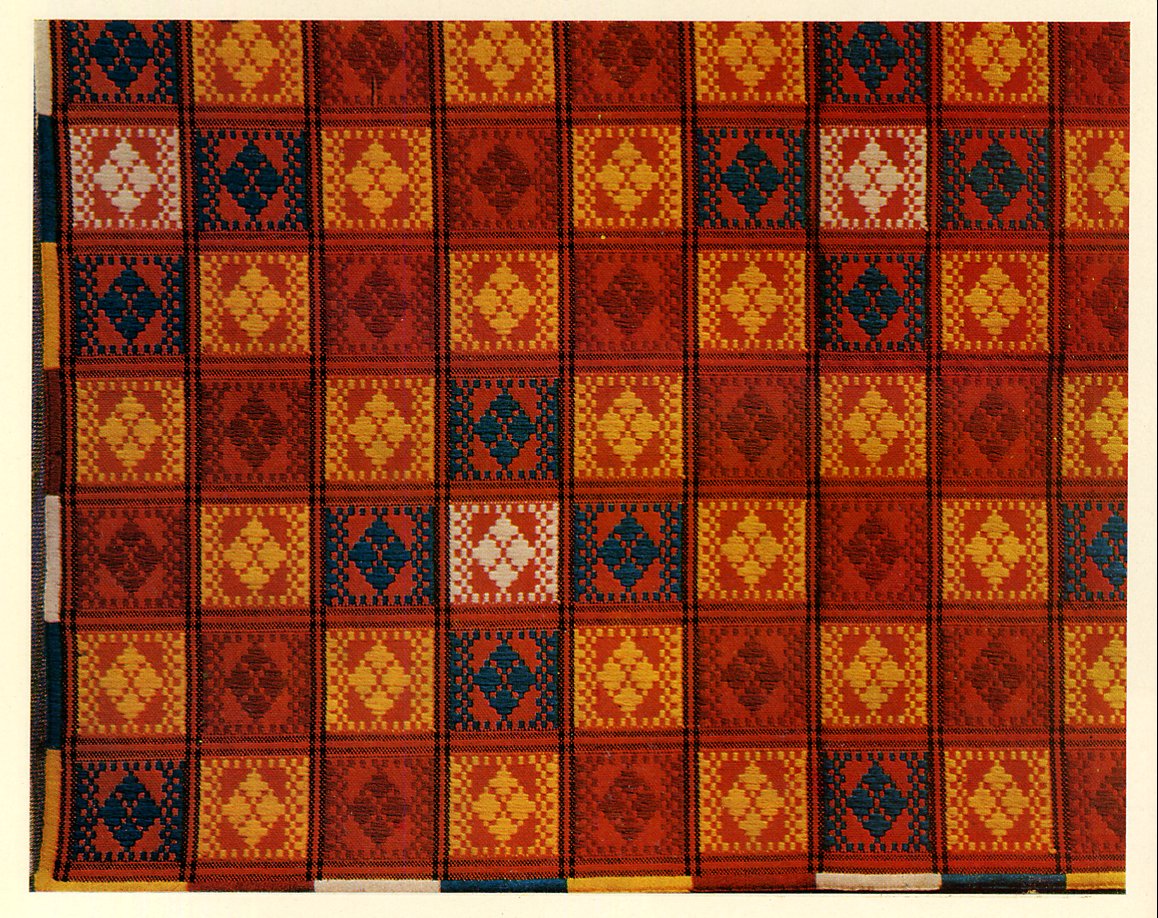
Here is a closeup of the design and weaving of one plakhta.

This one would seem to  have the same design repeated over the entire field of the garment, but in addition to this fine detailed design, there are also larger compositions made by extending different colors and designs diagonally as in this plakhta.

Note the decorative stitching sewing the two pieces of cloth together vertically, the outside edge bound with blanket stitch, and the pompoms on the lower corners. Here is another example of a diagonal design on a plakhta.

here the joining stitch up the middle back and the blanket stitch binding the edges is clearly visible.
Sometimes, as in the above example, all the squares have the same design, the composition being made only by the colors, other times as in this example below, there is more than one design woven into the squares.

it can also happen that the larger composition forms diamonds, instead of simple diagonal lines, as in this example.

Note that the blanket stitching is done in various colors to complement the design. Here are two more plakhtas, notice the difference in the texture of the design. In the one on the right, you can see the decorative stitching that forms the center vertical line. This is flanked by a stripe formed of a column of squares of a different design from the body of the garment. Then there is a zigzag design formed by the colors of the weave.

I will finish by giving some closeups of yet other weaving designs. It is amazing how much variety can be made out of the same basic concept and patten.


Thank you again for reading. I hope this inspires creativity. And i hope you appreciate these lovely designs as much as i do.


Feel free to contact me with requests for research. I hope to eventually cover all of Europe and the Former Russian Empire/Soviet Union. I also gratefully accept tips on source materials which i may not have. I also accept commissions to research/design, sew, and/or embroider costumes or other items for groups or individuals. I also choreograph and teach folk dance.

Roman K.
Rkozakand@aol.com


Source Material:
K. Matejko, 'Ukraijinskyj Narodnyj Odiah', [Ukrainian Folk Clothing] Kyjiw, [Kiev] 1977
T Nikolaieva, 'Ukrainskaia Narodnaja Odezhda Srednee Podneprove' [Ukrainian Folk Clothing of the Central Dnipro Region] Kyjiw [Kiev] 1988
V. Bilozub et al. 'Ukrajins'ke Narodne Mystetsvo - Tkanyny i Vyshywky' [Ukrainian Folk Art - Weaving and Embroidery] Kyjiw, [Kiev] 1960
V. Bilozub et al. 'Urajins'ke Narodne Mystetsvo - Vbrannia' [Ukrainian Folk Art - Clothing] Kyjiw, [Kiev] 1961
N. Maruchanova et al. 'Ukrajins'ke Narodne Dekoratywne Mystetsvo' [Ukrainian Decorative Folk Art]
Kyjiw, [Kiev] 1956
O. Dmytriw et al. 'Ukrainian Arts' New York, 1955
I Poshyvailo et al. 'Ukrajins'ke Narodne Tkannia' [Ukrainian Folk Weaving from the Honchar Collection] Kyjiw, [Kiev]

Ukrainian Plakhta costume, by request from Anna


Hello All, I am going to interrupt my series on the Volga area costumes at the request of my niece, Anna.
She is an artist, as most of the members of our family are. She has a cutout that my grandfather was going to paint, but never had the chance to finish. It is a girl in Ukrainian Plakhta costume dancing. So i am going to detail this costume. For those of you who are interested, here is Anna with the cutout, which has only the simplest of sketching in. She might let me show you the finished product.
This is one of the five major types of Ukrainian costume. It is sometimes called the Poltava costume, but in fact, it is much more widespread. The Poltava is just one version of this costume. I will describe a generalized version of this form of dress. This is what one generally sees presented as the national costume  of Ukraine.
 On this map, this is the costume of the light green, orange and dark yellow areas of this map, the central, eastern and southern regions of Ukraine.
 Like Most costumes of eastern Europe, the base of the costume is the chemise, in Ukrainian called Sorochka. The basic cut is this one.
This is the most common and widespread cut for Slavic Chemises. You will notice that there is a piece sewn on top of each shoulder, this is called the Ustawka, or inset. The sleeve is sewn to both the ustawka and the body of the shirt at right angles, in contrast to the Obhortka costume, of which i have already written, in which the sleeve was sewn on parallel to the body. The edge of the inset is always embroidered with a band of embroidery, which shows on the upper arm, just above the shoulder seam. There is a huge range of designs which Ukrainians use. I dont have time to show more than one here, on the right. The most common colors used are red and black. The sleeve is sometimes sewn smoothly onto the inset, and is sometimes made fuller and gathered at the seam with the inset, as shown in the photograph on the right. Sometimes the same design is embroidered in a second band below the seam,
and sometimes there are designs scattered over the lower sleeve, or forming a vertical line down the body of the sleeve. But the one band across the inset is always embroidered, even for everyday wear, there is at least a narrow band. The sorochka is also embroidered along the bottom hem, and sometimes along the neck and wrist  bands.
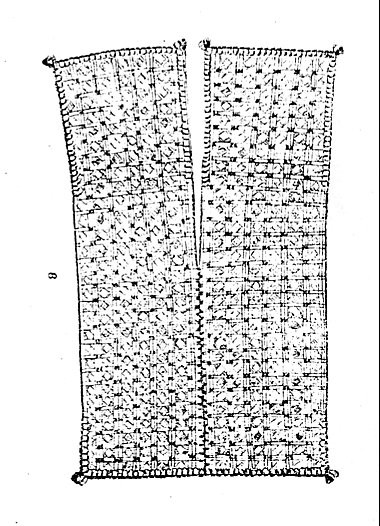
This costume is named after the type of overskirt worn, the Plakhta.This is made of two pieces of cloth woven in an intricate design composed of squares, with a design woven in each of the squares. It might be described as a checkerboard, but NOT a plaid. i will do a posting showing some of the designs later. The pieces of cloth are narrow because of the limitations of hand looms. These two pieces are sewn together with an ornamental stitch somewhat more than halfway in what will be a vertical seam. This is shown in the drawing on the left. The edges are bound, and the 6 corners are often decorated with pompoms. The top half is folded over a sash, and hangs over the bottom half. The sash is then tied around the waist, and tied so that the plakhta is secure, and centered on the back. Typically it does not meet in front. Here is a photo of a plakha folded and ready to put on. This is what will become the back side.
Here is a photo of a woman wearing the Plakhta. She is wearing a chemise with white on white embroidery. The apron is a simple rectangle, made of one width of material, either of linen with a horizontal embroidered band towards the bottom edge, or of a colored material, with woven designs, ribbon sewn in horizontal bands, or embroidery, again towards the bottom edge. A second sash is tied around the waist over the apron. The outfit is often worn like this, but over this may be worn the Kersetka.
This is a type of vest which hangs to the hips or below, hangs smoothly in front, and has pleats in the back for fullness below the waist. It can be made of any material, but not linen, is closed in front up to the neck, and is usually decorated with trim or applique along the bottom edge and the front edge, which overlaps right over left. This is a more recent garment, apparently based on the cut brought in by the Tatars.

 This is finished off with red coral beads, amber or other type of necklaces, and for unmarried girls, a crown with flowers and long many colored ribbons hanging down in back. This is the costume shown in the cutout. Here are a couple of examples of this costume.

You will notice that the hemlines of these photos are much longer than that in the cutout. Starting in the 1950's there was a  tendency to shorten the entire ensemble, the sorochka, the plakhta and the apron, to a position just below the knees. This was perhaps to make the outfit easier to dance in, but more likely was motivated by the fashion of the day, and the idea that bare female legs would be appreciated by the audience. This sometimes reached rediculous proportions. Here are some examples of the shortened version of the costume. Some performing groups are bringing back the longer hemline, especially for choirs.

Thank you again for reading. I am open to researching and/or making costumes or costume pieces for interested individuals or groups, or to provide information so that others can sew or embroider folk art item. This is something i enjoy and would like to make into a career, as unlikely as that may be. I am also available to teach folk dances.
As always, be creative, make something by hand, make an heirloom, make something that you can show off on your self or in your home.
Roman K


Rkozakand@aol.com

Source Material:
K. Matejko, 'Ukraijinskyj Narodnyj Odiah', [Ukrainian Folk Clothing] Kyjiw, [Kiev] 1977
T Nikolaieva, 'Ukrainskaia Narodnaja Odezhda Srednee Podneprove' [Ukrainian Folk Clothing of the Central Dnipro Region] Kyjiw [Kiev] 1988
V. Bilozub et al. 'Ukrajins'ke Narodne Mystetsvo - Tkanyny i Vyshywky' [Ukrainian Folk Art - Weaving and Embroidery] Kyjiw, [Kiev] 1960
V. Bilozub et al. 'Urajins'ke Narodne Mystetsvo - Vbrannia' [Ukrainian Folk Art - Clothing] Kyjiw, [Kiev] 1961
N. Maruchanova et al. 'Ukrajins'ke Narodne Dekoratywne Mystetsvo' [Ukrainian Decorative Folk Art]
Kyjiw, [Kiev] 1956
O. Dmytriw et al. 'Ukrainian Arts' New York, 1955

Friday, January 21, 2011

Kabachi, the Pride of Udmurtia


Hello All, As i mentioned in my last post about North Udmurt costumes, i am dedicating this posting to the kabachi. The kabachi is the single most distinctive piece of Udmurt costume [apart from the Aishon]. I will return to the Aishon at a later date. The kabachi is a rectangular piece of cloth tied around the neck that covers the front of the chemise, and over which the kaftan is worn, so that the embroidery is displayed on the chest. See my previous posting on North Udmurt Costume for more details. Here are a couple of drawings of women wearing the kabachi. These drawings are from the book 'Udmurtskiy Narodnyj Kostium' by L. Molchanova.

You can clearly see the kabachi worn under the kaftan. I put one photo of a kabachi in my previous post.
The embroidery is usually of one or both of two kinds, the first is a design executed in Holbein or outline stitch in black, after which areas are filled in with slant stitch, usually in red. The other is embroidery executed in darning, brick or counted satin stitch,  mostly in red or black. Or both kinds may be combined in the same piece. Here is an example of the first kind.
Notice the motif of the 8 pointed star. This is a very widespread motif, being found in folk embroideries of Norway and Palestine and many places in between. I myself grew up thinking it was a specifically Ukrainian motif.
Here is a photograph of an unfinished piece, with the outline stitch in place, but the filling not yet done.

You will notice the diamond shaped intrusion of a different design and stitch on the bottom of the composition. This seems to be very common, here is another example. I do not know if there is any significance to this; if someone out there is more familiar with Udmurt Embroidery, please feel free to inform me.

The repetitive chevrons on this piece remind me of the dresses embroidered in Palestine.
There are some kabachi that do not follow this type of composition, like this one.

this is a more unusual one. By the way, some of my sources insist on translating the name of this garment as 'chemisette'. When doing research in texts that are translated into English, one has to be very careful about taking translations literally. Do not assume that what they mean is the same as how you understand the word.
The shoes shown in the illustrations at top are woven out of birchbark, and are called Lapty in Russian, Lychaky in Ukrainian, and Koot in Udmurt. these are often translated as 'sandals' as are similar shoes resembling moccasins made of leather by peasants all over Europe. But the word 'sandal' conjures up a very wrong image. So be careful. Here is one executed completely in Darning stitch. Notice that this technique
does not include outlining the design.


There is a large admixture of black in this one, as also in the following one.


Notice that this one also has a horizontal design at the bottom, as do a couple of the previous ones.
I will finish with one last example.

I guess this was a lazy posting, but there is not much to say about these except to look at them and be inspired to go out and make one's own composition. I could not possibly get across the amazing artistry of folk embroidery except by showing images.
As always, thank you for reading, i hope you are inspired to go out and make something,
not from a 'project' where someone gives you step-by-step instructions on how to make something which they have already made. But to take old ideas and techniques and the universal human trait of creativity,
and make a new contribution.  None of these embroiderers whose work i have shown today copied any of the others' design exactly.
I am always open to suggestions as to subjects to write about. If, for example one of you would like to find out the folk costume or embroidery style of a precise region, please let me know. If it is within Europe or the former Soviet Union, i have a good chance of being able to answer.

Feel free to contact me with requests for research. I hope to eventually cover all of Europe and the Former Russian Empire/Soviet Union. I also gratefully accept tips on source materials which i may not have. I also accept commissions to research/design, sew, and/or embroider costumes or other items for groups or individuals. I also choreograph and teach folk dance.

Roman K.

Rkozakand@aol.com


Source Material:
S. Lebedeva 'Udmurt Kalyk Dyskut' ; 'Udmurt Folk Costume Izhevsk, 2008
L. Molchanova 'Udmurtskyj Narodnyj Kostium' Izhevsk, no year
S. Lebedeva 'Udmurt Kalyk Puzhyiaton' ; 'Udmurt Folk Embroidery' Izhevsk, 2009
Max Tilke, 'East European Costumes' London, 1926
K. Klimov, 'Folk Arts and Crafts in Udmurtia, Izhevsk, 1988
T. Kriukova, 'Udmurt Kalyklen Kiuzh Ustolykez' [Udmurt Decorative Applied Folk Art] Izhevsk, 1973
K. Kulikov, 'Vozrozhdennaia Drevnost' [Rebirth of the Ancient, the Folk Decorative Applied Art of Udmurtia] Izhevsk, 2005