Saturday, May 28, 2011

Cross Stitch Embroidery of Central Asia

Hello All,

 Cross stitch is very popular worldwide, but in central Asia, it is not very common, cursive embroidery styles are much more popular. But it does exist, and forms a distinctive style. It is most closely associated with one Tribe of Uzbeks who are still nomadic, the Lakai. The various peoples of Central Asia are closely linked with each other, and there was and  is much trade between the various nationalities, and mutual cultural influence as well. Today i will present images of various items from different sources. I hope that some of you will find these designs interesting enough to use them.
In this region, cross stitch is always worked very densely, covering the entire ground fabric. The color scheme is warm, the images are often large and blocky. It often serves to strengthen fabric that is to be used for purposes that need reinforcement.  I will start with images from Uzbek sources. Most are geometric designs, like this wall bag.


Many of these images were greatly enlarged, but i believe that they can still be graphed by those who like the designs. Being nomads, the Lakai have need of many sorts of bags and cases in which to carry things. Here is a spoon bag.


Here is a case designed to carry a porcelaine bowl or cup


Here is a bag designed to carry mirrors


As you can see, this has cursive floral designs, which are also found in cross stitch, but less commonly. They are also found in items of personal clothing and accessories. here is a man's cap. Being muslim, Uzbeks and the other central Asian men wear these caps, which have great variety in shape color, and ornament.


Here is a purse, meant to be worn suspended from a belt, as the traditional clothing had no pockets. This has the famous 'boteh' motif, which is derived from Kashmir.


Here is a bag designed to carry toiletry articles, and is attached to a loop meant to hang from a belt, which is also embroidered.


Here is a cuff from a man's chalat, or robe. This is very unusual.


Here is a pair of cuffs from aTurkmen woman's salwar, or baggy pants.


Here is a cloth for covering bread, among other uses.


and here is a closer look at the design.


Here are a couple of men's belts


This is a part of a child's bib, which combines turkmen designs with this Lakai Uzbek section


Here are a couple of Pillows found in a Kirghiz Yurt.


Here is a woman's cap and another personal bag.


And just one more image. This is a detail of a Tadjik Bridal veil. It was embroidered in silk, and not in cross stitch, but it is a design that would be very easy to do in cross stitch, and was possibly copied from a cross stitch original.


I was only able to find a couple of images in any one book, so this is a minority ornament in central Asia, and yet it has its own definite style. I hope that you enjoyed this presentation of a textile tradition. I also hope that you will be inspired to go and make something like this.

Thank you again,


Source Material:
Johannes Kalter, 'The Arts and Crafts of Turkestan', New York, 1984
Martha Longenecker, 'Folk Art of the Soviet Union', San Diego, 1989
Klavdiya Antipina et al, 'Kyrgysztan', Milan, 2006
Tatyana Razina et al, 'Folk Art in the Soviet Union', Leningrad, 1990
A. Morozova et al, 'Folk Art of Uzbekistan', Tashkent, 1978
V. Maksymov et al, 'The Kirghiz Pattern', Frunze, 1986

Thursday, May 26, 2011

Village costume of Tatarstan

Hello all,

Today i will continue to talk about the costume of Tatarstan. For location and a bit of history of the Volga Tatars, see my first posting about them. So far, i have presented the town costume, which is what one primarily finds presented in Tatar sources. Let us start with a photograph depicting a village wedding costume.


At first glance there seems to be little new.The woman would of course try to dress up as much as possible, and this generally means putting on a town costume if she can afford it. The headdress she is wearing is yet another type of Kalfak, short and flat, almost resembling a man's cap which is worn with a shawl over it. Often, as in this case, the shawl is made of a very fine knit. We see the man is choosing to wear his kamzul open. This is the only photo i have in my sources that show this, but the stage presentations which i have seen all choose to dress the men in open vests, similar to the women's. He is wearing typical peasant clothing otherwise, plain black boots, and wedding footcloths, ayak cholkaulary. These are the typical foot coverings of much of eastern Europe. Knitted stockings were known in the Balkans, Baltic countries and Scandinavia. In most of the interior, woven rectangular pieces of cloth, often made from old worn out shirts, were folded and wrapped around the feet, and then tucked into boots or held in place with laces from postoly [moccasins], or lapty/lychaky [shoes woven from birch or linden bark]. The Soviet Army used footcloths untill quite recently. These are unique in that one edge is specially embroidered in chain or tambour stitch, which is made to hang over the tops of the boots. This is a uniquely Tatar tradition, and he only wears them like this on the actual day of the wedding. They are traditionally a gift from the bride to be, and often handed down in families.
Here is the more typical day to day dress of the village Tatar woman.


As you can see, it greatly resembles the city costume. Dress of rather plain store-bought cloth, leather mosaic footwear, headband with kalfak, earrings and braid ornament. Two things stand out. She wears no vest, no kamzul, and she is wearing a richly embroidered apron with a bib. The apron, in the village costume became a focus of embellishment, being either richly embroidered, woven with bright designs, or made of colorful printed cloth. I suspect the apron was adopted by the Tatars after their arrival in the region from the other peoples living in the area. It makes no appearance in the city costume at all, and it often greatly resembles that of their neighbors, particularly the Udmurt. The chain stitch embroidery is a heritage from central Asia, resembling that of the Uzbek. Here is another peasant woman in an embroidered apron.


You will notice she is not wearing the Kalfak at all. Instead she has a large printed kerchief or shawl tied in a very specific fashion around the head and falling down the back. This is the typical headgear of the village woman. Again, you can see that her dress is made of plain bought cloth. Here is another girl with a rather more recent cut to the dress, featuring the peaked shoulders that became so popular in the early 20th cent, boots of leather mosaic, and rather less jewelry than a townswoman. This is clearly a dress up outfit.


In addition to dresses of bought cloth and aprons with chain stitch embroidery, village women also engaged in weaving their own cloth. This varied from place to place, and was rarer in more recent times. Here is an older Tatar woman at her loom.


Her dress is shorter, more practical for working, she appears to be wearing boots, and would certainly be wearing pants under her dress. The dress was sometimes made from patterned homespun, as in the following examples.


The cut is one typical of the Tatars, but they have picked up the love of plaid which is general in the region among the Finnic peoples. This dress is also finished off with patterned woven strips on the bottom. Hre is another example.


Here you can see that the top is of the traditional cut, but the skirt of the dress has been made quite a bit fuller, and has been attached on the bias. Men's pants were also made of homespun.


If you take another look at the woman above who is weaving, you will see that although her dress may be of printed cloth, her apron is clearly home woven with a patterned design. This type of apron was common in the region, especially among the southern Udmurts, but it was worn by village Tatar women as well. Here are a couple of examples.


The men, as is usually the case, only wore aprons as part of their working attire, for practical reasons. The cut is essentially the same, however.


For the village girl, the apron became a focus of embellishment, and was part of her dress up attire, whether woven or embroidered. The headcloth also was sometimes embroidered, as we see here.


The dress was made of printed cloth when that became available, sometimes embroidery was worked over the print. In later periods, the bib of the apron was sometimes widened, and a ruffle added.


And when the apron itself was made of printed cloth, the desire to embellish it was still there, taking the form of ruffles, ribbons and scalloped edges.


This is the costume that you see, [more or less] presented by perfoming groups. I would like to state here a warning. Stage costumes are STAGE costumes. There are groups which attempt to faithfully present the costume tradition of their people. There are many groups, however which exaggerate certain features, making skirts fuller, so they can swirl, shorter, so the audience can gawk at the girls' legs, the ornamentation coarser, so they can be more easily seen from the audience, [and be easier and quicker to make], and often lots of glitz, tinsel and glitter.
And some performers, particularly singers or musicians, invent a stage outfit that is only loosely based on tradition, and is only intended to be flashy and attention getting. Do not assume that an ethnic person on stage is even attemping a true representation of ethnic costume. Stage costume has its own function.

Here are some  links to videos featuring  Tatar dance groups. The costumes they are wearing are obviously based on the one i have covered today, but have equally obviously been 'enhanced'. The Tatar patterned boots figure prominently

This first one is not too bad, the enhancement being limited to shortening the girls' skirts, shrinking the aprons and adding glitz to the guys' vests and shirts.

This group did quite a good job, although they put the guys in satin shirts

Here is a group presenting a very nice dance. They have put black embroidered sashes on the men, the origin of which i am unclear on. the women's dresses have been made much much fuller, and only vaguely resemble those above. These are stage costumes.

This last group is attempting a very flashy glittery version of the town costume, complete with faux kalfaks on the women, silver lame, and huge sequins everywhere, on the singers. The dancers come out with a version of the village costume. The skirts enormously enlarged, with Izyu, but no vest or apron on the women. Quite a spectacle.

Stage costume has its own function.

I hope you have found this interesting, and as always, thank you for reading.

Feel free to contact me with requests for research. I hope to eventually cover all of Europe and the Former Russian Empire/Soviet Union. I also gratefully accept tips on source materials which i may not have. I also accept commissions to research/design, sew, and/or embroider costumes or other items for groups or individuals.
Roman K.
Rkozakand@aol.com


Source Material:
M. Zavyalova, 'Tatar Milli Kieme' [Tatar Costume], Kazan', 1996
Guzel Valeeva-Suleimanova, 'The Decorative Applied Art of the Kazan' Tatars', Moscow, 1990
E. Korneev, 'Costumes of the Peoples of Russia in the Graphic Arts of the 18th-20th centuries', Moscow, 1990
N. Kalashnikova, 'National Costumes of the Soviet Peoples', Moscow, 1990
F. Safina, 'Tkachestvo Tatar Povolzia i Urala' [Weaving of the Tatars of the Volga and Urals], Kazan', 1996

Friday, May 20, 2011

Tatarstan Men's Costume

Hello Alll,

One of my pet peeves is that men's costume gets short shrift in most publications, and i am finding that i am doing it as well. The fact is that for most peoples, there is less to say about men's clothing.  And often less is known, since men tend to give up their costume faster and easier than women do. [With some notable exceptions, the Scottish Highland kilt and the Greek/Albanian Foustanella come to mind].
So today i will continue my series on the costumes of Tatarstan by paying attention to the men. Here again is the painting by Pauli of the Kazan' Tatar costume. Notice the man is sort of hiding in back. The city costume and the peasant costume for men was the same, differing only in the materials used.


What we can see is shirt, vest, jacket, pants, slippers and hat. The shirt, kulmege, is one very typical of the Turkic peoples, with a central opening, standing collar, and tunic shaped cut.


The shirt is made of linen or cotton, white or with a fine striped or dotted design. Here is a photo of one such shirt.


Here is a photo of some men in the village. If you look carefully, you can see stripes on one shirt, and dots on the other. The man on the left is wearing a beshmet, a padded quilted jacket.


Two pairs of pants are worn, the first of a light material, the 'underpants', and the second of a heavier weight cloth. This is very common. The cut is one typical of the Turkic peoples, called 'khatyn-kyz', or 'wide-stride', because the central gusset is very wide. They are gathered on a drawstring, and give ample room for movement, whether on horseback or otherwise. Here is the cut.


And here is a photo of some typical examples.


In the villages they used stiped homespun, or plain dark wool in colder weather. Over these is worn the kamzul, as in the woman's costume, but it is usually worn closed, and as you can see from the gentlemen above, is double breasted, the right side overlapping the left. They generally extended to mid-thigh. The cloth used varied a great deal according to the wealth of the wearer and the occasion. Here is a well to do city man ready for a moderately special occasian. In this photo you can see the placement of the buttons, which are not done up.


Sometimes the shirt was worn tucked in, as this man shows us.


And sometimes worn outside the pants, as this student is doing.


Generally when going out in public, a jacket of identical cut, only with sleeves and longer, was worn over the kamzul, called the kazakin, or if padded and quilted, the beshmet. Both the jacket and the vest had a fitted cut. Here is the cut of the vest and jacket.. It is very similar to the woman's kamzul.


And here is a city man wearing a dress kazakin, the vest being visible at the neck. The second photo shows a more day to day version. The same cut was used for heavy coats in the wirnter as well.


On especially grand occasions, a different jacket was worn which recalls the central Asian khalat. It is called the djilen. It is not fitted and was often made of extremely ornate materials as in this example.


You will notice that his shirt is also made of ornate material and has a fold down collar. A cap is always worn, most Tatars being of the Muslim faith. The cap, kelepush, can be hemispherical or truncated cone shaped, plain or highly embroidered, with a tassel or without. The above photos give some examples, Here are a few more.


Slippers were worn indoors, boots outdoors. Villagers would wear footcloths and lapty, [shoes woven of birch or linden bark].  In heavy snow, valenki [felt boots] would be worn. Here are some indoor slippers, made with the famous Tatar 'leather mosaic' technique, a type of patchwork. You can see the man in the splendid djilen above wearing these.

Here is an example of a boot done in the 'leather mosaic' technique. Solid color boots are also worn.


An example of a unique and amazing craft.
Thank you for reading, aa always, and i hope that you found this informative.

Feel free to contact me with requests for research. I hope to eventually cover all of Europe and the Former Russian Empire/Soviet Union. I also gratefully accept tips on source materials which i may not have. I also accept commissions to research/design, sew, and/or embroider costumes or other items for groups or individuals.
Roman K.
Rkozakand@aol.com

Source Material:
M. Zavyalova, 'Tatar Milli Kieme' [Tatar Costume], Kazan', 1996
Guzel Valeeva-Suleimanova, 'The Decorative Applied Art of the Kazan' Tatars', Moscow, 1990
E. Korneev, 'Costumes of the Peoples of Russia in the Graphic Arts of the 18th-20th centuries', Moscow, 1990
N. Kalashnikova, 'National Costumes of the Soviet Peoples', Moscow, 1990
F. Safina, 'Tkachestvo Tatar Povolzia i Urala' [Weaving of the Tatars of the Volga and Urals], Kazan', 1996

Wednesday, May 18, 2011

Kalfak the embroidered cap of Tatarstan

Hello All,

Today i am going to present some more information on the costume of the Kazan' Tatars. Specifically the richly embroidered headgear, the kalfak. This is still the town costume. Peasant costume will be in another forthcoming posting.
If you look at the portrait of the princess i showed you in the previous posting, you will see that she is wearing the ancient headress 'kashpau', a tall stiff cone shaped hat which has cognates in several central Asian cultures, most noteably the Kazakh and the Kirghiz. Here is a reconstructed costume of the 16th cent.


In the 18th cent. this was replaced by the kalfak, a stocking cap knitted in more or less the same shape, with bands of velvet sewn on, and then 3 dimensional embroidery done all up one side. Since the cap flopped over when worn, only one side is visible. Here is a woman wearing the soft kalfak.


The kalfak was worn with a band around the base. I dont have any images of the band by itself. There were two kinds of embroidery done on the kalfak. Both were freehand floral designs of great richness and in three dimensions. The first kind is basen on chenille yarn. Here is an example.


And a second example.


And here is a closeup of this type of work.


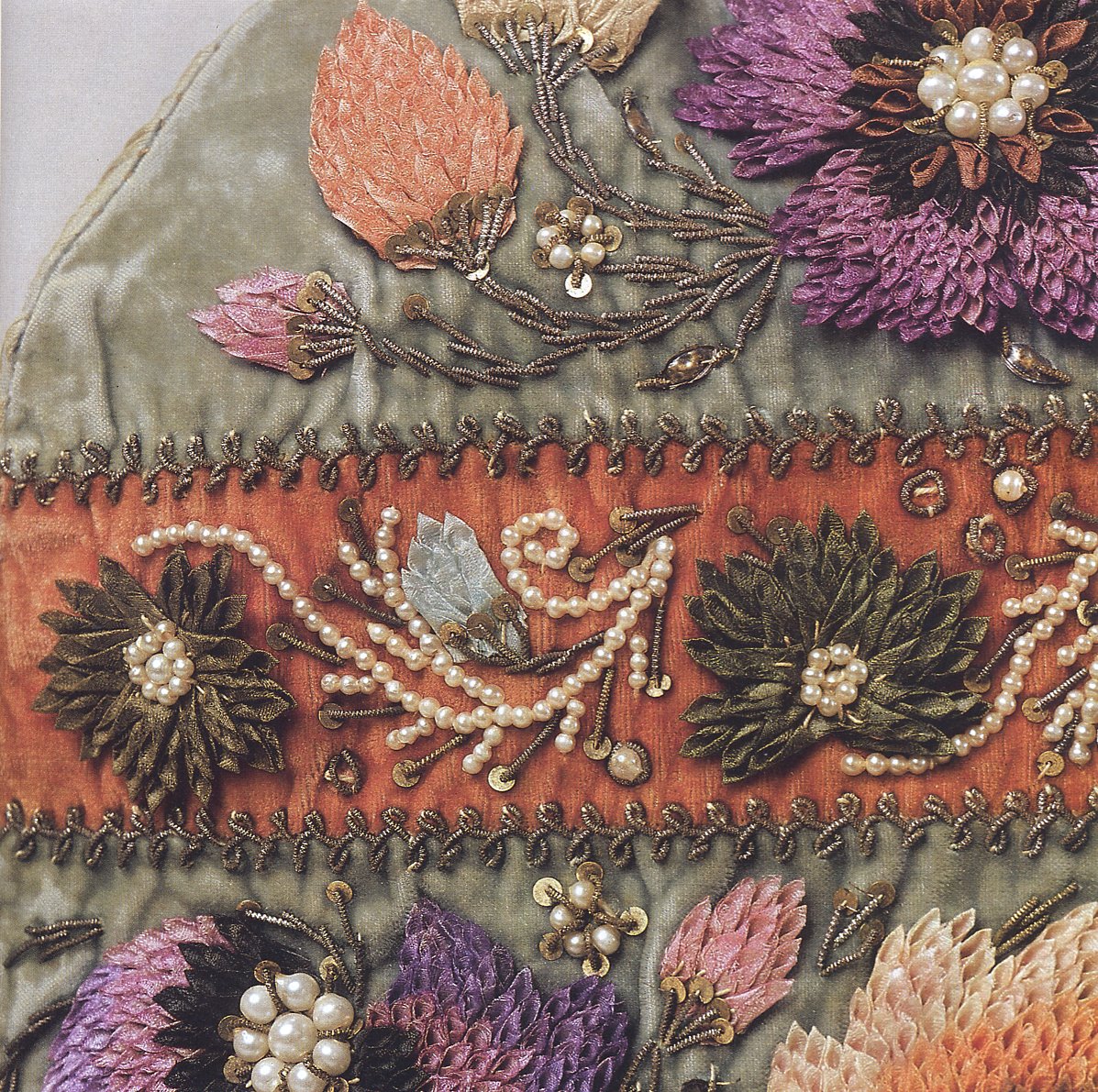
The second type is made up of little pieces of silk folded and curled up, which are then appliqued onto the kalfak so as to make petals of flowers. Here is an example of this type of kalfak.


And a closeup of this kind of  embroidery.


Both types were accompanied by sequins, beads, pearls and twisted metal wire.


Here is a photo of a young woman wearing this type of kalfak and holding another one stretched on a frame in order to be embroidered.


Later on, in the 19th cent. a rather smaller kalfak of velvet with gold embroidery became popular.


Here are some young women wearing this type of kalfak. They have an embroidered band around the base, and are worn without any seperate headband. They are sitting on european style furniture, and notice that the dresses have been modified with set in sleeves gathered into a peak on the shoulders. The basic costume remains essentially the same, however.


Here are a couple more examples of this kind of work.


Older women often wore a shawl, the orpek, embroidered in chain stitch, with a plain fur and velvet cap. Here is such a woman hosting tea in a much more traditional house than the modern young ladies above. Note the chain stitched wall hangings and the chain stittch embroidery on the hem of her dress.


I hope this has inspired someone. Thank you for reading, as always.

Feel free to contact me with requests for research. I hope to eventually cover all of Europe and the Former Russian Empire/Soviet Union. I also gratefully accept tips on source materials which i may not have. I also accept commissions to research/design, sew, and/or embroider costumes or other items for groups or individuals.
Roman K.
Rkozakand@aol.com


Source Material:
M. Zavyalova, 'Tatar Milli Kieme' [Tatar Costume], Kazan', 1996
Guzel Valeeva-Suleimanova, 'The Decorative Applied Art of the Kazan' Tatars', Moscow, 1990
E. Korneev, 'Costumes of the Peoples of Russia in the Graphic Arts of the 18th-20th centuries', Moscow, 1990
N. Kalashnikova, 'National Costumes of the Soviet Peoples', Moscow, 1990