Showing posts with label kaftan. Show all posts

Thursday, March 10, 2011

Krzczonow Kaftan

Hello all, Welcome again to Krzczonow, Lublin Province, Poland. I thought that the original posting was starting to run long, so i decided to split it. This posting will cover one garment only, the Kaftan. For the rest of the Krzczonow costume, please refer to my previous posting. I will be writing a posting on the historical development of Krzczonow embroidery in my next posting. Kaftan is a rather generic word meaning some sort of overgarment, usually a long one. In Krzczonow, and some other parts of Poland, kaftan specifically refers to a short jacket. I will talk about the men's kaftan, and two closely related types of the women's kaftan as well. The woman here on the right is a young married woman wearing the slightly older form of the kaftan. The kaftan is of a  solid material, usually wool, with ribbons sewn on the front parallel to the opening, each of which turns at a right angle and continues around the waist. The colorful ribbons alternate with strips of plain cloth covered with decorative topstitching.
The following two photos also show the old style woman's kaftan.

The ribbons are often of different colors, but the main colors used are black, red, yellow and green.
here is a drawing of an old kaftan, showing details of the ornamentation.
And this is a schematic of the cut of the woman's kaftan. Notice that the cuff is a separate piece, there is no collar, also there is no peplum, the garment ends at the waist, and it buttons down the front.


Next, Here is a photo of a modern version of the man's kaftan. These two are students at the Jagiellonian University of Poland who participate in their dance group, Slowianki.


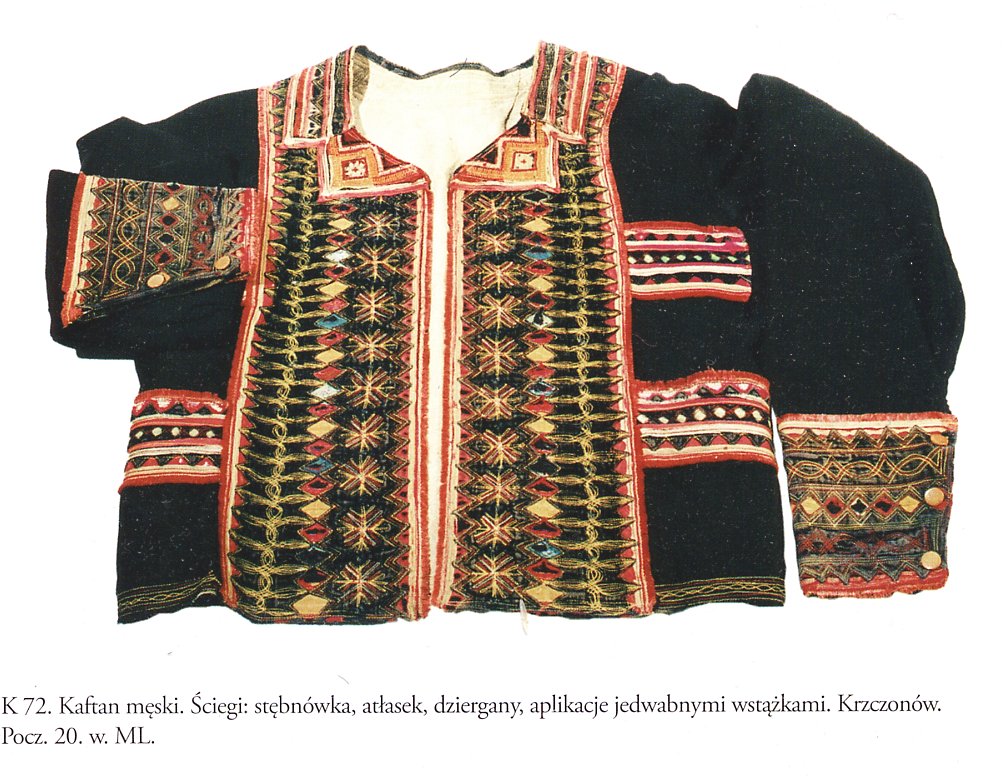
The man's kaftan was sewn of wool, in either black, burgundy or red, lined, like the woman's kaftan in linen or cotton. The cuffs, also like in the woman's kaftan are sewn on separately, Here is the cut of the man's kaftan.


Two wide strips of black or dark cloth are then sewn to the front edges of the kaftan. Each has one, two or three rows of diamond-shaped openings cut into them, which are called 'okienki', [little windows] under the openings are sewn pieces of plain colored red, green and yellow ribbon, each of which shows through one of the openings, in a form of reverse applique. These wide strips are then secured with topstitching in a contrasting color, which binds the edges and also adds a decorative effect. In one form of the kaftan, the outer edges are cut in a toothed or saw-edged design, and rows of colored ribbon are sewn underneath the edges, which are also topstitched as in this drawing. All this is repeated on the cuffs. In the photo above, you see a variant of this which is common today, in which the edges of the wide strip of cloth 'z okienkamy' are cut straight and edged with a short brush fringe, to give contrast to the edges.


Following are a couple of other photos of old kaftany.

The front top corner of the kaftan is folded back and tacked into place to form a small lapel. This is ornamented either with embroidery, or appliqued ribbon, around the edges and in a little square.
Then a rounded collar is sewn on to the back, also edged and ornamented with stripes of narrow ribbon. Here is a closeup of the collar in the black and white photo above.

There seems to be some variation in the back of the garment. Some people, like the group Slowianki, sew an additional similar strip around the waist in the same manner, the ends of which are under the strips sewn on to the front., like this.


This would seem to be consistent with the drawing above. However, examination of the two photographs might lead one to conclude that there is no such strip, but rather three patch pockets sewn on to the front of the kaftan decorated in the same manner, with reverse applique, ribbons and topstitching. If you consult the video of the dance group 'Mazowsze', you will see that they sewed separate patches on the back of the kaftan rather than one long continuous strip. I don't know if there is a 'correct' way. I suspect there were always variations. I have provided links to dance videos of both Mazowsze and Slowianki at the end of this posting.
The man's costume is completed with a belt worn over the shirt and under the kaftan, either made in the same reverse applique method, like this:

or made of velvet with gold trim and sequins sewn on, like this.


Somewhat later, the women's kaftany were also made 'z okienkamy', with ornamentation in this same reverse applique and topstitching method. A full, gathered peplum was added to these kaftany. The peplum was ornamented with rows of ribbon in the same way as the skirt and the apron. Here is one artist's depiction of this type of kaftan.


Here are two photos showing the front and the back of a woman's kaftan 'z okienkamy'.


And finally, here is a closeup of possibly the same kaftan drawn by the textile artist Jadwiga Turska. The round red objects are the buttons.


Thank you very much for reading.
Stay tuned for the next exciting installment, lol.
As always, i encourage you to use these ideas to create something. Help these beautiful ideas and items live again in a creation of your own.
And as always, i welcome any requests for research, as well as any commissions to make, research or embroider costumes or other textiles.
Roman K.


Mazowsze dance video

Slowianki dance video

And here is a link to a company in Krakow called Perfekt, who make and sell Polish [and some other] Folk Costumes for stage groups and others. They are quite good for stage costumes, although not the equivalent of having one made in the village, which would be very difficult.

Feel free to contact me with requests for research. I hope to eventually cover all of Europe and the Former Russian Empire/Soviet Union. I also gratefully accept tips on source materials which i may not have. I also accept commissions to research/design, sew, and/or embroider costumes or other items for groups or individuals.
Roman K.
Rkozakand@aol.com


Source Materials:
Jadwiga Turska, 'Polish Folk Embroidery', Warsaw, 1997
Janusz Swiezy, 'Stroj Krzczonowski' from the series Atlas Polskich Strojow Ludowych, Poznan, 1952
Elzbieta Krolikowska, 'Polski Stroj Ludowe' [The Polish Folk Dress] sic, Warsaw, 2000
Majka and Hunt, 'Polish Folk Costumes', Halifax, 1991
Stanislaw Gadowski, 'Stroj Ludowe w Polsce', Warsaw, no year shown
Aleksander Blachowski, 'Hafty Polskie Szycie', Lublin 2004
Kazimierz Pietkiewixcz, 'Haft i Zdobienie Stroju Ludowego', Warsaw, 1955


Tuesday, March 8, 2011

Krzczonow Costume

Hello all, I'm dedicating this posting and the following to my friends Karen M. and Ted Zed. Today i will be venturing into the world of Polish Costume. I will be talking about the costume from the region around the town of Krzczonow, marked in red in this map.


For the sake of those of you who may be unfamiliar with Polish orthography, Krz is pronounced 'ksh', like a bus door opening, czo is pronounced  'cho' as in chocolate, and ow is pronounced 'oof' like someone punched you in the stomach. So Krzczonow is pronounced 'Ksh-cho-noof', except that you only get one syllable for each vowel, so try to pronounce Kshcho as one syllable. This is often called the Lublin Costume as it is the best known costume from Lublin Province. It is not from the city of Lublin.
I have a couple of personal ties to this costume. In college I was a dancer with the Oakland University Slavic Folk Ensemble, and in my time we had a Polish Choreographer teach us a Polish Set. We made these costumes. This costume is a good one for an amateur group, as it is relatively well known, colorful, attractive, and easily made from materials that you can go out and buy, as opposed to say the Zakopane or Lowicz costumes which are beautiful, but require specific sorts of cloth that is not easy for people outside Poland to obtain. Also i have been long fascinated in figuring out how the particular embroidery is done, but that is a topic for the next posting.
Here are a couple of images to help you get acquainted with this costume.


In this last photo, the woman on the right is wearing the 18th century costume which i will not be covering in this posting. The woman's costume is based on the chemise, although it is  not as prominent as it is in many eastern European costumes. The cut is identical to womens shirts in western Ukraine, with two separate body sections for front and back, an 'inset' przyramek in Polish, sewn on top of the body pieces, the opening then gathered into the collar, which in this case is a sort of wide 'sailor collar', and sleeves sewn perpendicularly. Here is the cut of the woman's chemise and other costume pieces.

The chemise is embroidered on the cuffs, collar, shoulder pieces, and sometimes around the front opening with particular Kzczonow embroidery, later replaced by cross stitch.
The Skirt is sewn of store bought wool, in 'quiet colors', a quick glance at the various images indicates a wide range of colors. There is usually a band of velvet or other dark cloth on the bottom hem, a short 'brush fringe' on the hem itself, it is very full and rather long, coming to the top of the low, typically Polish lace-up boots.
In the center of the skirt are sewn several different bands of ribbon of different colors, widths and designs, 
usually forming a palindromic effect, with a particularly wide and patterned ribbon forming a center, and symmetrically placed ribbons of other colors above and below. There seems to be a minimum of three to five ribbons, although many more are often used. 
The apron is unique, in that it is basically a short version of the skirt, gathered into a waistband and wrapping completely around the body. It is also sewn with several ribbons, and is usually edges with lace.
again, a couple of images to give you a good idea.

 
The bodice is the typical Polish lace up type, known as a gorsetka. The cut is shown on the bottom right of the diagram above that shows the cut of the chemise. It has lappets around the bottom, very typical for Malopolska, and it is decorated with rows of ribbons sewn on vertically to either side of the front, and around the bottom edge just above the lappets. The lappets are edged with ribbon. The gorsetka itself is made of a dark quiet color, like black or burgundy. Here are a couple of examples.

Of course, several necklaces would be worn to complet the costume. For unmarried girls, the hair was worn in braids which were wrapped around the back of the head. A headress in the shape of a horseshoe was worn on the back of the head, covered with artificial flowers, and with ribbons falling down behind. At her wedding, this would be replaced by a full cap of artificial flowers, with beads and ribbons around the edge, as seen in the colored photo above. Here is a photo showing the hair arrangement.

In cooler weather women would often wear a short jacket, the kaftanik instead. This was also considered to be appropriate for women 'of a certain age'. This custom was widespread in Poland and elsewhere. I am running long, so i will devote a separate posting to the mens and womens kaftan.

The Mens costume is based on a shirt which has a cut identical to the womens, except the collar is smaller, and the shirt itself is shorter. It is worn outside the pants. It has embroidery like the womens, but with no or less extensive embroidery on the shoulder. Here is a diagram of the cut. The pants were linen in summer, but for cooler weather or special occasions they were made of black or other dark material.


Often there was a vest worn with the costume, either black or white with buttons and pocket patches of the opposite color, as seen in this old photograph.


Over this was worn a long heavy overcoat, as seen in some of the images.  But what has come to be worn most often is a jacket, called the kaftan as it is the most unique to this costume. The cut is shown above, It was decorated with rows of ribbons down the front and around the waist, with bands of black cloth overstitched and with reverse applique.Again, I will have to take a seperate posting to talk about this. I will close with this photo of a wedding group.


Thank you all for reading. If you have any requests for research, or comissons to make costumes or embroidery, please let me know.
Thank you,
Roman K.

Here are a couple of links to  sites showing more of this and other Polish costumes.

This is the famous Polish Song and Dance Ensemble Mazowsze, perfoming their Lublin Suite, featuring this costume.


Here is a link to the Folk Dance Ensemble 'Slowianki', of the Jagiellonian University in Poland website, showing some very good photos of this costume and others. I would like very much to be able to see them perform, oh well. Click on the images to enlarge
Here is one of their photos, just to give you an idea.


OK, i found a video of Slowianki doing dances from this region; they are pretty good.


And here is a link to a company in Krakow called Perfekt, who make and sell Polish [and some other] Folk Costumes for stage groups and others. They are quite good for stage costumes, although not the equivalent of having one made in the village, which would be very difficult.

Thank you very much again

Feel free to contact me with requests for research. I hope to eventually cover all of Europe and the Former Russian Empire/Soviet Union. I also gratefully accept tips on source materials which i may not have. I also accept commissions to research/design, sew, and/or embroider costumes or other items for groups or individuals.
Roman K.
Rkozakand@aol.com

Source Material:
Janusz Swiezy, 'Stroj Krzczonowski' from the series Atlas Polskich Strojow Ludowych, Poznan, 1952
Elzbieta Krolikowska, 'Polski Stroj Ludowe' [The Polish Folk Dress] sic, Warsaw, 2000
Majka and Hunt, 'Polish Folk Costumes', Halifax, 1991
Stanislaw Gadowski, 'Stroj Ludowe w Polsce', Warsaw, no year shown
Aleksander Blachowski, 'Hafty Polskie Szycie', Lublin 2004
Kazimierz Pietkiewixcz, 'Haft i Zdobienie Stroju Ludowego', Warsaw, 1955


Wednesday, January 19, 2011

North Udmurt Costume


Hello again, Today I will continue the series on the costumes of the Volga peoples. This posting will describe the costume of the Northern Udmurts. The Udmurt are shown in the golden yellow color on this map. In older documents they are referred to as the Votyak. During Soviet times it was decided to refer to [most] indigenous peoples by their self-designation, which, by the way, Americans still  do not do. The Udmurt have an Autonomous Republic in the Russian Federation, the capitol is Izhevsk, and this is their flag.

 Here are  some women wearing one version of the north Udmurt costume.

The southern Udmurt costume is quite different, and will have to wait for another post. You will notice that the costumes i am covering in this series form a coherent group. The basic garment of the north Udmurt costume is, as usual, the chemise, of which nothing shows when the entire costume is worn, except the sleeves, and often the lower hem. The cut of the chemise is very typical.
You will notice the appliqued strips of red cloth, which is quite popular in this costume and also among the neighboring Chuvash. A glance at the above photo will show that the embroidery of the sleeve has two possibilities. The women on the right show the first, a lengthwise strip, nowadays is narrow and flanked by red applique strips, formerly the strips of embroidery were wider, as seen below.The two women on the left show the other possible way of embroidering the chemise, with a small crosswise design high on the arm. Here is a closeup of one such piece of embroidery.

You will notice the similarity to the Mari embroidery, the black outlines in Holbein stitch is worked first, and then the areas are filled in with slav or slant stitch in red, with other colors added for accent. the bottom edge is sometimes left unadorned, if it will not show, but usually it has a narrow strip of embroidery, or a woven ornamental strip sewn on, with a red strip of cloth or a narrow ruffle added to the bottom, as you can see from the women pictured above. Over the chemise a kaftan is always worn. This kaftan always has a slit in the upper sleeve, as you can see in this drawing by Max Tilke, who drew a specimen from the collection
of a museum in Hamburg, but they did not have any of the rest of the costume. In fact, the kaftan is never worn in this way. The arms are always put through the slit in the upper sleeve so that the sleeve of the chemise is visible, as in the above photograph. The sleeves of the kaftan hang down behind, and are often cut short, so they do not fall below the elbow. The hem of the kaftan is usually somewhat shorter than that of the chemise, as seen in the photo above.
 

Here is shown the cut of the kaftan. There are ornamental strips of embroidery and/or applique on the upper part of the garment, as in the drawing on the right. Occasionally on particularly festive garments, the strips continue to the bottom edge as in the drawing by Max Tilke. Over the chemise and under the kaftan, there is worn a rectangular breastpiece, or dickey, which is tied with string around the neck, this garment in Udmurt is called kabachi. it is always heavily embroidered, and completely covers the front of the chemise.
 As you can see, each of the four  women above has a different design on her kabachi. Here is a closeup of one. This is the major focus for the embroidery of the women of northern Udmurtia. Again you can see the outline stitch filled in with slant stitch.
The bottom has designs executed in darning stitch.  I will have to publish another posting showing some of the diversity of the embroidery of this garment. The kaftan is held closed by an apron tied over it. Some of the older ones were made of material with ornamental stripes woven into them,.
sometimes with additional embroidery in between to supplement the design.
here below is one such specimen. Otherwise the apron is made of cloth woven with a small plaid, with the primary color being red. Sometimes the apron has a small removable bib, as shown on the photo of the woman below on the left. The costume is finished with strings of beads, a decorative cloth folded and worn on one or both hips, and a woven sash.
See the two photos below.


The man's costume consists of a shirt  with the opening on the side, the older ones seem to have it on the right side, in the old Persian style, and the newer ones have it on the left, as in Russian shirts. Although, noone knows why the Russian Shirts open on the left, none of the other Slavic peoples do that. It is possible that the Russians took it from the Finnic Peoples, as they have certainly assimilated several. The man's shirt was made of material woven in stripes, as shown here, sometimes with embroidery on the collar and opening placket. Otherwise it was made of the same kind of plaid as in the women's apron shown above, as you can see from the bottom photo. The mens costume was finished off with a sash, dark striped trousers, and either boots or footcloths and shoes woven of birchbark, as in the Mari. 


 Thank you very much for visiting my blog, and as always i welcome your comments and any suggestions of specific costumes or folk embroideries to research and write about.

Feel free to contact me with requests for research. I hope to eventually cover all of Europe and the Former Russian Empire/Soviet Union. I also gratefully accept tips on source materials which i may not have. I also accept commissions to research/design, sew, and/or embroider costumes or other items for groups or individuals. I also choreograph and teach folk dance.
Roman K.

Rkozakand@aol.com


Source Material: Recently there seems to have been quite a bit of material published in Izhevsk on this topic.
S. Lebedeva 'Udmurt Kalyk Dyskut' ; 'Udmurt Folk Costume Izhevsk, 2008
L. Molchanova 'Udmurtskyj Narodnyj Kostium' Izhevsk, no year
S. Lebedeva 'Udmurt Kalyk Puzhyiaton' ; 'Udmurt Folk Embroidery' Izhevsk, 2009
Max Tilke, 'East European Costumes' London, 1926
K. Klimov, 'Folk Arts and Crafts in Udmurtia, Izhevsk, 1988
T. Kriukova, 'Udmurt Kalyklen Kiuzh Ustolykez' [Udmurt Decorative Applied Folk Art] Izhevsk, 1973
K. Kulikov, 'Vozrozhdennaia Drevnost' [Rebirth of the Ancient, the Folk Decorative Applied Art of Udmurtia] Izhevsk, 2005