Thursday, January 24, 2019

Costume and Embroidery of the village of Yaseniv-Pil'nyi - Ясенів-Пільний, Horodenka district, Pokuttia, Ukraine


Hello all, 
  Today I will continue to talk about the costume of Pokuttia, focusing again on one village, Jaseniw-Pil'nyj. This lies near Serafyntsi, which also has its own distinct costume. 

Both lie southeast of the town of Horodenka, quite close to the border with Bukovyna, which coincides, more or less with Cherniwtsi Oblast. 

Here is Ivano Frankiwsk Oblast within Ukraine.
 

Here is Horodenka district within the Oblast.


Here is Yaseniv-Pil'nyi within Horodenka district. Serafyntsi is shown but not labelled, just to the northeast.


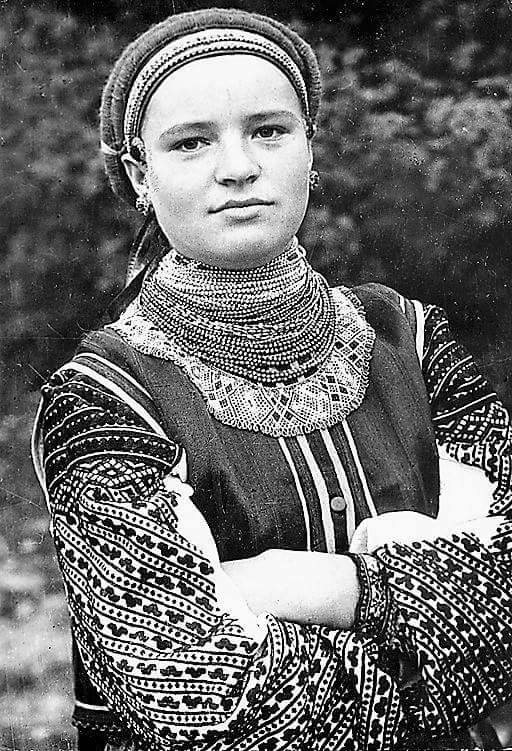
We are lucky that someone in the village took and saved a number of photographs early in the 20th century. The image above is a wedding photo of Anna Tychyns'ka and Stepan Bodnaruk. The costume resembles that of the rest of Horodenka district with the exception of the womens' vest. Similar vests are worn in Polissia, parts of Volyn' and Halychyna, and even by some Boikos and Lemkos, but by no other village near Jaseniw-Pil'nyj. 

The base garment is the chemise, with embroidery on the shoulder piece, sleeves, cuffs, and sometimes around the collar and front opening. The embroidery is usually of one of two kinds, curly stitch or cross stitch. The curly stitch designs use Holbein or back stitch with a heavy thread causing the design to be made up more of texture than outline. 
Here is one example, called sleeve with circles. 


This is always done in some shade of red, usually a maroon. You can see the three part canon which is typical for the whole Podillia - Pokuttia - Bukovyna - Moldavia region. Sometimes it is done in a brighter shade of red. 


Here is the same design done in narrow thread so that the stitching is visible. They do not wear it this way, Iryna Svyontek did this just to show how it is made. Click to enlarge.


Here is another design from this village, called winged sleeves. Here the three part canon is even clearer.




A third design is called sleeves with pasochky.


This woman has decided to do hers in black, to reflect her age.


Another design called sleeve with flies.


Here is a famous photograph showing a bride with two bridesmaids. if you look carefully, you will see that each is wearing a chemise with one of the above designs. From left to right, 'wings', 'circles' and 'flies'.

Cross stitch designs are also used in this village. These are probably newer, and often did not have embroidery on the sleeves, but only on the shoulder and cuffs. Here are some of them.


Traditionally, a wraparound overskirt 'obhortka' was worn, the corners tucked into the sash, and a vertically pleated apron worn in front. This was replaced later on, at least for less formal attire with a skirt and gathered apron as you can see here above.


A multiplicity of gerdans [beaded necklaces] were worn, both around the neck and on the head, as well as other jewelry. Brides wore complex crowns with hanging ribbons, and married women wore kerchiefs which replaced the earlier namitky.

The unique vests are cut straight, trimmed with ribbon, and are usually a plain blue, red or black, although sometimes they were made with patterned material, as we see here worn by this bride in 1945


In the early 20th cent. the men abandoned their traditional attire for jodphurs, vests and suits, likely under the influence of Austrian Army dress, but still wore embroidered shirts for festive occasions, as Ukrainian men do to this day.


Here are a few older photographs from this village, likely from the turn of the 20th cent.. These show the older men's outfits, and seem to indicate that the distinctive vest was adopted later, likely in the 1920's or 30's.


 Just a few more images from this village.


 Thank you for reading, I hope that you have found this to be interesting and informative. Try your hand at some of these embroidery designs.


Roman K.


email:  rkozakand@aol.com


Source Material:
Iryna Svyontek, 'Pokuts'ki Vyshywky Prykarpattia', L'viw, 2013
V. Bilozub et al. 'Urajins'ke Narodne Mystetsvo - Vbrannia' [Ukrainian Folk Art - Clothing] Kyjiw, [Kiev] 1961


Sunday, December 23, 2018

Hutsul flat stitch embroidery, Rakhiw district, Transcarpathian Hutsulshchyna, Ukraine


Hello all,
Today I will talk about a little known type of Hutsul embroidery. The image above is from the book 'Derzhawnyj Muzej Etnohrafiji ta Khudozhn'oho Promyslu AN Ukssr' image 28 under embroidery. I have always loved this design, and is one example of why I hate black and white photography. There is much valuable material which has been preserved this way, but I would have loved to replicate this design in its original colors. The book attributes this to the village of Lazeshchyna in Transcarpathia. This is a Hutsul village which lies between Yasinya and the crest of the Carpathians. I doubted this, because this did not look like any Hutsul embroidery with which I was familiar, and also because the book attributed another image which was clearly from the Khust region to the same village. Soviet era books often had mistakes which were missed in proofreading.
I have since come across more examples from other sources, and It does actually appear to be from this region.

Here is an example from 'L'art Populaire en Russie Subcarpathique'. This is labelled as being from 'Rakhovo' [Rakhiw].


This is clearly a related design. As in the first, this is multicolored, and executed in flat stitch, or counted satin stitch. This is one of my favorite techniques.

Most commonly we associate the Hutsuls with nyzynka, like this example from Yasinya,


Or cross stitch, like this example from Kobylets'ka Poliana.


Both of these designs are shoulder insets [ustawky] from womens' chemises. You will even see these stitches combined, as in this example, also from Yasinya.


I believe that the flat stitching may have originated out of a desire to incorporate more colors, and originally sort of imitated nyzynka, like this example from Kobylets'ka Poliana.


This example incorporates both flat stitching and nyzynka, also from Kobylets'ka Poliana.


In this example, the flat stitches have changed orientation, and now the stitches run horizontally instead of vertically. From Kosiws'ka Poliana.


This example is also from Kosiws'ka Poliana, and has flat stitching in both directions, as well as eyelets, braid stitch and nyzynka.


This example somewhat resembles nastyl embroidery from around Tlumach. The difference is that nastyl stitches run diagonally, whereas these run horizontally or vertically. Here the design is built up from multiple rows of brick colored stitches, with just a little black for contrast. This is from Yasinya. I believe my grandmother once copied this design.


Here is another example from Yasinya done mostly in white on white. This would be a wonderful design to copy.


Here are a couple of unusual pieces from the village of Bohdan, using kachalochka.


Here you can see the placement of the embroidery in the Rakhiw costume.


Here are some images from Iryna Svyontek's 'Hutsul'ska Vyshywka Karpat', album 4, that show the same kind of embroidery.


I will close with just a couple more examples of the Rakhiw district costume with this kind of embroidery.


Thank you for reading, I hope that you have found this to be interesting and informative.

Roman K.


email:rkozakand@aol.com


Source Material:

O. I . Kubajewych, 'Derzhawnyj Muzej Etnohrafiji ta Khudozhn'oho Promyslu AN Ukssr', Kyjiw, 1976
S. Makovsky, "L'arte Populaire en Russie Subcarpathique', Prague, 1926
Iryna Svjontek, 'Hutsul'ski Vyshywky Karpat' Album 4, L'viw, 2016
V. Bilozub et al. 'Ukrajins'ke Narodne Mystetsvo - Tkanyny i Vyshywky' [Ukrainian Folk Art - Weaving and Embroidery] Kyjiw, [Kiev] 1960