
I will be covering more of the Balkans and Scandinavia, but today I am going to cover an area that needs less research, the region of Kujawy or Kuyavia in Poland.
Kujawy is sometimes considered to be part of the Macroregion of Wielkopolska [Greater Poland], and sometimes considered to be a region in its own right. It was an independant duchy in the past, but the costume is within the sphere of Wielkopolska, and typical of Western Poland, although the music is closer to that of central Poland.
It is the center of origin of one of the five National Dances of Poland, the Kujawiak.
Here is a map showing the location of Kujawy within Poland.

The pink shows the area which is ethnically Kujawiak, while the yellow shows areas which were at some time politically part of the duchy of Kujawy.
http://en.wikipedia.org/wiki/Kujawy
There are various regional sub-groups within Kujawy, but I have not been able to find any information on costume or embroidery differences between them.
Today there are considered to be two costumes, one for younger single people, and the other for older married people, but this distinction is somewhat exaggerated, and in the past people mixed it up more, especially since the costume for older people mostly consists of putting on an extra layer of clothing.
As far as those who wish to perform Polish music or dance, this is a good choice, as the costumes are completely made of bought materials, and as such would be relatively simple to make, and yet are attractive.
Here is an old plate of the young people's costume.

And here is a plate from the same series of the older people's costume, as is the image at the head of the article.

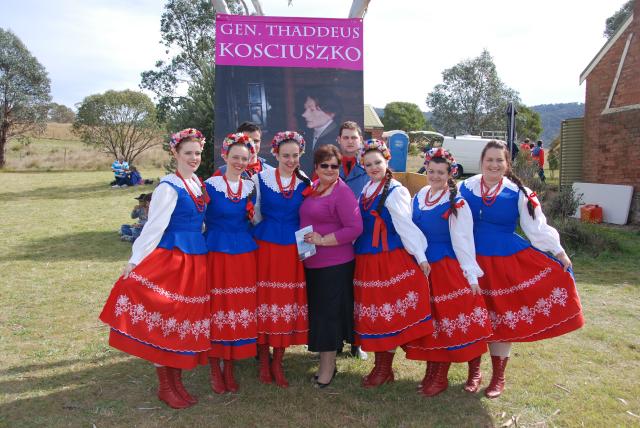
The most distinctive part of the woman's costume is the jacket with shoulder cape which is called Kabat. Often you will see the men in the first costume and the women in the second, as in this photo from the Polish dance group Mazowsze, although, in effect, it just means that the men left the overcoat off.

The chemise is of white linen, and was originally long, forming a single layer under the outer clothing. Later it became cut in two and the shirt was made separately from the first underskirt.
It is of the type typical of Slavic peoples, with a shoulder inset. There is no embroidery on the chemise

Over the chemise are one or two underskirts, as you can clearly see in the photo above. These are called Halki, are less full than the skirt, and may have hand embroidery on them of the type used on petticoats in western Europe.


The skirts are long, full and of a single color. There are ribbons sewn onto the lower part of the skirt and an edgeing on the hem.

The skirt is often blue or green, but may be of other colors, and in the past was also made of patterned material.

Girls wear the skirt shorter than married women, and often sew a strip of contrasting color to the bottom of the skirt.


Aprons are of three kinds, one is the type seen here above, which is generally worn by unmarried girls. They are made of very light linen or tulle, with tulle embroidery. This use of tulle became very popular in many regions of Poland at the close of the 19th cent, notably in Wielkopolska, Żywiec and Krakow.


In the 19th cent. the apron was very full and long, and was made of percale or often of a patterned cloth, either a print or a brocade. This is seldom seen today.


What is most commonly seen today is an apron made of a single color, usually red, sometimes blue, occasionally red and white striped, with white floral embroidery around the three free edges, and the tie ends. This is one of the main foci of embroidery on this costume, and there are many variants of the embroidery. The embroidery is satin stitch, stem stitch, both of which are sometimes padded for texture, and not uncommonly tulle is appliqued in some motifs for additional texture.


The bodice, Gorset, comes in two forms, with square lappets around the bottom edge at the waist or in one single piece that flares at the waist. Either may be laced closed with ribbon or may close completely on hooks. There is minimal ornamentation on these, often just the edges are bound with gold or red. Scan the various images in this article to see examples of both.

You will occasionally see a gorset with more ornamentation on the front. Here is a contemporary example and an old print showing this type. You will note that when the apron is blue, the skirt is then made of a contrasting color.


Red beads, korali, amber, and other necklaces are worn to complete the costume.

For unmarried girls, the headgear is either a wreath of flowers, such as girls almost anywhere might wear, or a wreath made of pleated ribbons, perhaps with feathers or flowers or tassels added on top. Thus the hair is left uncovered in good weather. Scan the various photos and you will see examples of each.


For cooler weather, or for older women, a jacket called Kabat or Kaftanik is worn. This is generally either blue or black, and is edged with either golden yellow or red. Often performing groups elect to wear this onstage, as it is much more distinctive than the gorset. It has a shoulder cape, pointed lapels, and a full peplum which leaves a gap in front. This may be worn over the gorset. Here are two possible cuts.


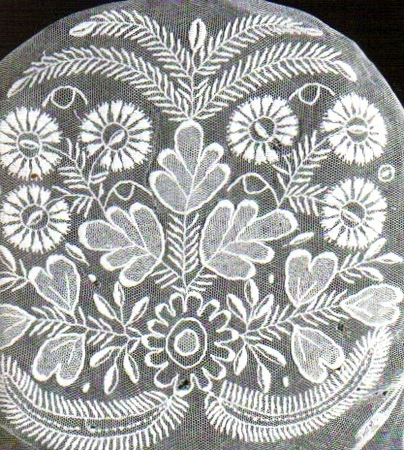
A wide lace collar is often worn with either the gorset or the kabat. This is usually a separate piece and is another focus for embroidery in this costume.They may be of linen with broderie anglaise, the form of openwork known in Polish as snutky, or may be of embroidered tulle.


Married women in Kujawy, as everywhere else in Europe, covered their hair.
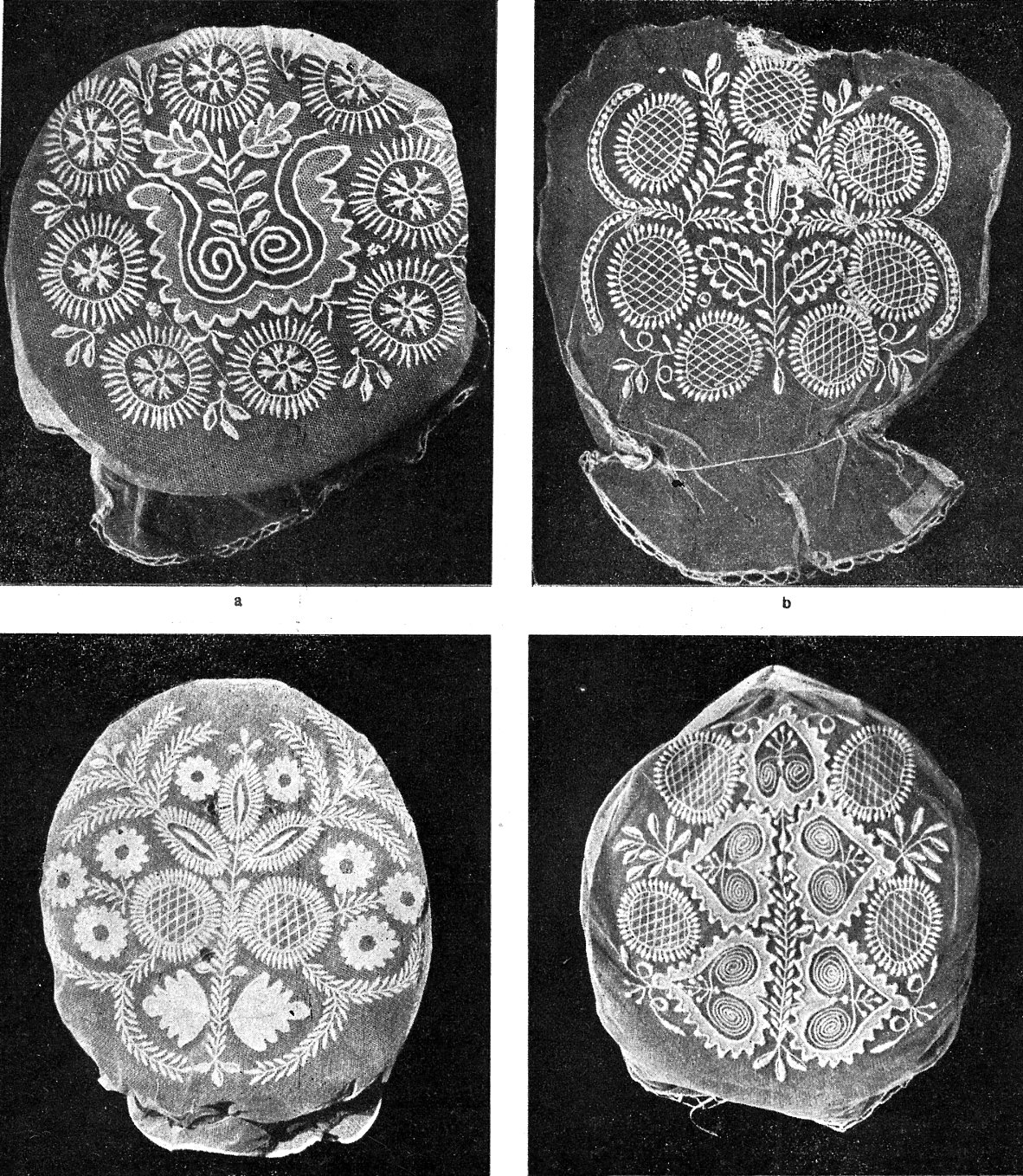
The Czepec, a form of the 19th cent. mob cap which was so common in Western Europe is worn with the Kujawy costume. It consists of a round piece which is gathered around the edge, and a flap that hangs down over the neck in back. A kerchief is rolled up and tied around the cap. The back of the cap is the third major focus of embroidery for this costume. The range of embroidery is as great as that for the collar, ranging from quite opaque to embroidered tulle. Ruched lace or tulle may be sewn onto the front. Some tulle bonnets had linen applique.
Originally it completely covered the hair, but later some hair was allowed to show around the edges.


The range of embroidery designs and techniques is quite extraordinary.



The costume is worn with typical Polish lace-up boots in red or black, or shoes.

Other outerwear is worn at need.
The men's shirt may have a couple of different cuts, but as only the collar and sometimes the sleeves show when fully dressed, it makes little difference. It should be linen and the sleeves should be full. Here is one typical cut showing town influence. A scarf is often worn tied around the collar.

The pants are usually blue, although some older artist's renderings show striped pants.
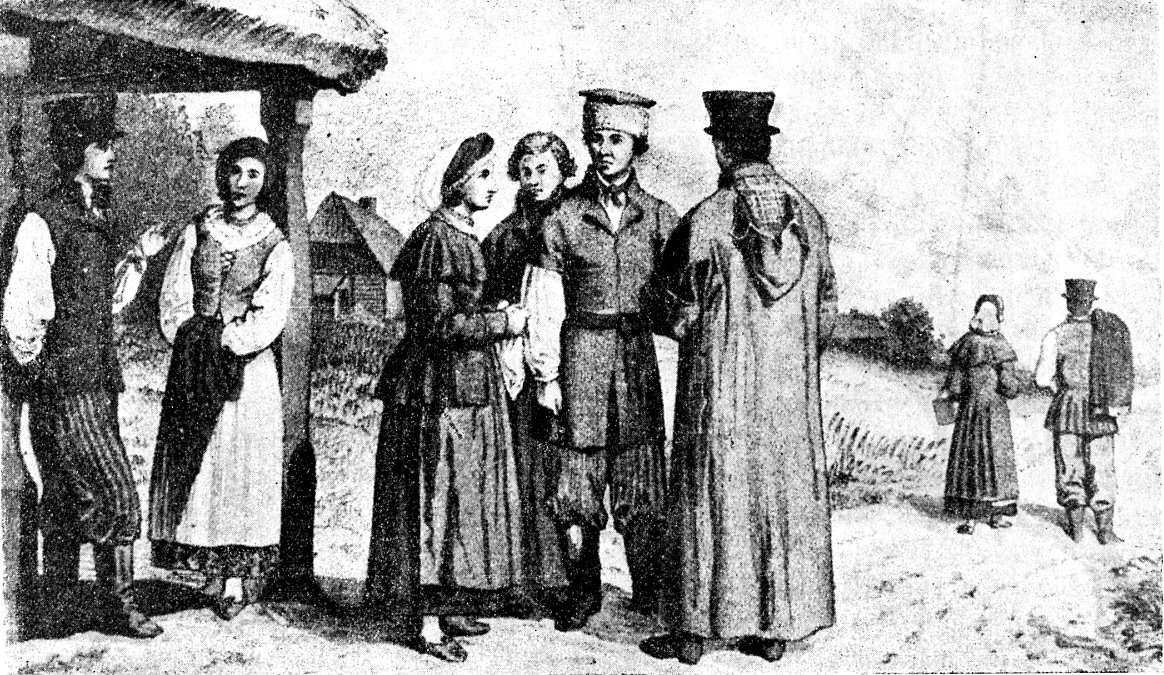

Usually, a jacket, Jaka, is worn over the shirt. If you look at the artist's drawing above, The men seem not to be wearing it, but the rest of the images they do. It is made of wool, and is red. In the photo immediately above, this group decided to make them out of the same blue striped cloth as their pants, but this is unusual. [in fact, if you look closely, the sleeves are fake and are just sewn onto the kaftan].
Here is the cut. This garment is decorated with topstitching on the cuffs, collar and front opening. This garment is worn over all of Wielkopolska.


Over the jaka is worn a vest called kaftanek. This is usually dark blue, sometimes black. It is cut full in the back and the length varies from hip to mid-thigh or so.The shortest cut looks much like a vest. This type is worn by boys.

Men wear a more fitted version of the kaftanek. It is also longer, and has prominent buttons and/or frogs. It is closed with a belt or red sash worn over it. It may also have short sleeves.


A short felt hat may be worn with this costume, a top hat, either straight or with a bulbous top, or a rogatywka, the typically Polish square topped hat with lambswool around the brim.


For formal occasions, a coat sukman is worn over the shirt, jaka, and kaftanek. It also may have a shoulder cape, is closed with straps that cross over the chest, the cape, cuffs, closing straps, back belt and fake pockets are often edged in black or another color.


The red sash, or another one, may be worn over the sukman if desired, or it can be worn open.
Thank you for reading, I hope you have found this interesting. I will close with just a few more images of this costume.


If you don't feel like trying to make the costume by yourself, or only want to do the embroidery, here are two different companies which make Polish costumes that you can order from.
http://www.perfekt.krakow.pl/costumes/kujawy
http://stroje.pl/p/kujawski-costume/2
Here is Mazowsze, a Polish dance ensemble presenting a stage piece from Kujawy.
http://www.youtube.com/watch?v=BJJoJqfZfpM
The Kujawiak is a flowing slow dance in 3/4 time, with a gentle spring and pulse
Here is a group of young people performing a medley of Kujawiak followed by Oberek.
They are not wearing the Kujawy costume, but do a pretty good job of the dance.
http://www.youtube.com/watch?v=gNRIiSXRtIw
Feel
free to contact me with requests for research. I hope to eventually
cover all of Europe and the Former Russian Empire/Soviet Union. I also
gratefully accept tips on source materials which i may not have. I also
accept commissions to research/design, sew, and/or embroider costumes
or other items for groups or individuals. I also choreograph and teach
folk dance.
Roman K.
Source Material:
Dorota Kalinowska, 'Strój Ludowy na Kujawach', Włocławek, 2002
Halina Mikułowska, 'Strój Ludowy', Torun, 1971
Aleksander Blachowski, 'Haft Ludowy', Torun, 1979
Halina Mikulowska, 'Atlas Polskich Strojow Ludowych - Strój Kujawski' Poznan, 1953
Elzbieta Krolikowska, 'Polski Strój Ludowy', Warsaw, 2000
Stanislaw Gadomski, 'Strój Ludowy w Polsce', Warszawa,
K Burza et al, 'Rekodzielo Ludowe i Artystyczne Cepelii', Warszawa, 1989

