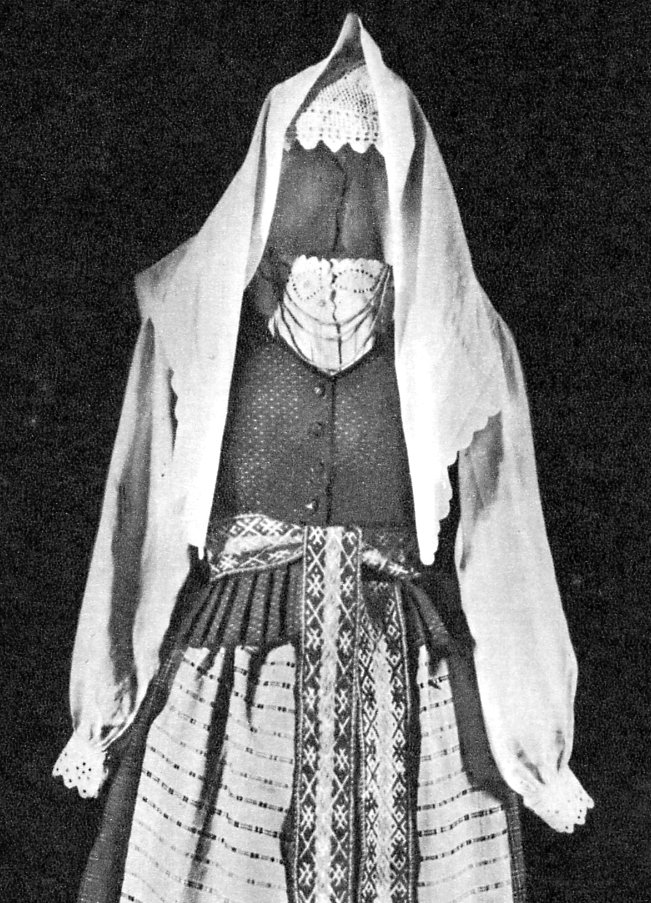
Saturday, August 6, 2011

Overview of Sardinian Costume

Hello all,

I am going to change focus for a while. There is much left to say about Lithuania and the Baltic area, and i will return to it.

Research of Italian costume is quite challenging, as in many places in Italy, there has long been little interest in maintaining this part of their culture. Another factor is that the large cities of Italy have always been in the forefront of developing the latest fashion. Because the local folk costume is further in time from current memory than some other places, there is less material available.
Italy can be divided into 4 regions when it comes to folk costume. Northern, Central, South, and Sardinia.
The north is characterized by costumes that fall within the general Alpine culture. There are several linguistic minorities that inhabit this region, Franco-Provencal in Aosta, Tyrolean Austrians in Alto Adige, Ladins just to the east of them,  Friuli [Furlan] in the northeast corner, and Slovenian in the valley of Resia. Many communities have tenaciously clung to their folk costume as a part of their identity. To the south is the wide and very fertile valley of the Po river, which has been so much in the center of the general development of European fashion and history that little distinctive peasant culture has developed or survived.
The center includes the hilly country from Tuscany to Molise. There are some notable costumes preserved in this area, including Pescocostanza with their beautiful lace, Assisi with its distinctive embroidery, Scanno whose costume is derived from the middle East, and others.
The south includes Basilicata, Puglia, Catania, Calabria and Sicily, with some very colorful and rich costumes. Some of the most impressive are those of the Arbereshe, the Albanian ethnic minority which have developed their own distinctive costumes.
Sardinia,  however, is the jewel of folk costume in Italy, having easily as many variants of folk costume as the entire mainland combined. Sardinia is currently divided into 8 provinces, and i will be presenting a short overview of only a handful of costumes from each. I was forced to leave out much material.Here is a map of Sardinia, showing the provinces and the major cities. You will notice that each location has two labels, the one on top is in Italian, while the one underneath is in the Sardinian language.


Although Sardinia has been politically part of Italy for quite some time, the Sardinian language is only very remotely related to Italian. Castillian and French are both more closely related to Italian than Sardo is. In addition, there is a Catalonian colony in and around the city of Alghero, in the northwest corner, Genovese speaking communities in the far southwest, and a Corsican speaking community in the far north.
Several times a year there occur large festivals in various places around the island. The largest is the Cavalcata Sarda. Representatives from various communities attend, and they all march in parade at some point of each festival. This provides an incredible photo opportunity, as well as an amazing chance to view the rich variety of costumes. If you want to glut yourself on a surfeit of such photos, here is a wonderful website. I will be presenting some photos from this site, as well as from other sources.

While the map above shows the cities and their locations in admirable detail, the names of the provinces are only shown by abbreviations. Here is a much simpler map which shows the provinces by name.


For ease of reference, i will present the material under the place names in Italian rather than Sardo, with apologies to the purists. I will proceed roughly north to south.


 Olbia-Tempio
 named after the two largest cities of the province.

Here is a sober but elegant costume of Tempio Pausania


The mens costume, which is found all over the island with minor variations. It also includes a long soft cylindrical stocking cap, which he is either holding or has tucked into his belt. The most striking feature are the short overpants which resemble a kilt, or woolen foustanella. 


Olbia
. Many of these folk groups carry banners when participating in the parades.


 Sassari

 Ittiri
 The pink panels are ribbons lacing the bodice together. The oversized silver buttons on the woman's sleeve are unique to this area.


Ploaghe
 Notice the cross on the headcloth, typical of this area. The embroidery on the back of the bodice shows some of the incredible handwork found all over Sardinia.


Bonnanaro
 As close to the 'typical' Sardinian costume as one can get.


Osilo
 The elaborately embroidered head shawl is only worn on festive occasions.


The Province of Nuoro
In my opinion, this province contains some of the most spectacular costumes in all of Sardinia.

Orgosolo
 This to me has a very 'Art Deco' look.


Aritzo
 Print by Emma Calderini. The present day costume is essentially the same.


Atzara


Oliena
 which has a unique way of wearing the embroidered head shawl.


The Province of Oristano

Cabras
 In this  seacoast town, the local folk group calls itself the 'Scalzi', they are unique in that the men wear red kilts instead of black, and they insist on marching and performing barefoot.


Samugheo
The girl's headress consists of several kerchiefs rolled up and arranged at various angles. The married woman's headdress is visible at left.


Busachi
 [in Italian, an H is inserted between a G or a C and a following I or E to indicate that it is to be pronounced hard. So this is pronounced 'Buzakee'.] More modest than some of the Sardinian costumes, but quite attractive. The man has his stocking cap rolled up. This is one of the typical ways that this hat is worn.


City of Oristano
 Again, one of the more spectacular costumes of the island. Two variants of the woman's costume are shown.
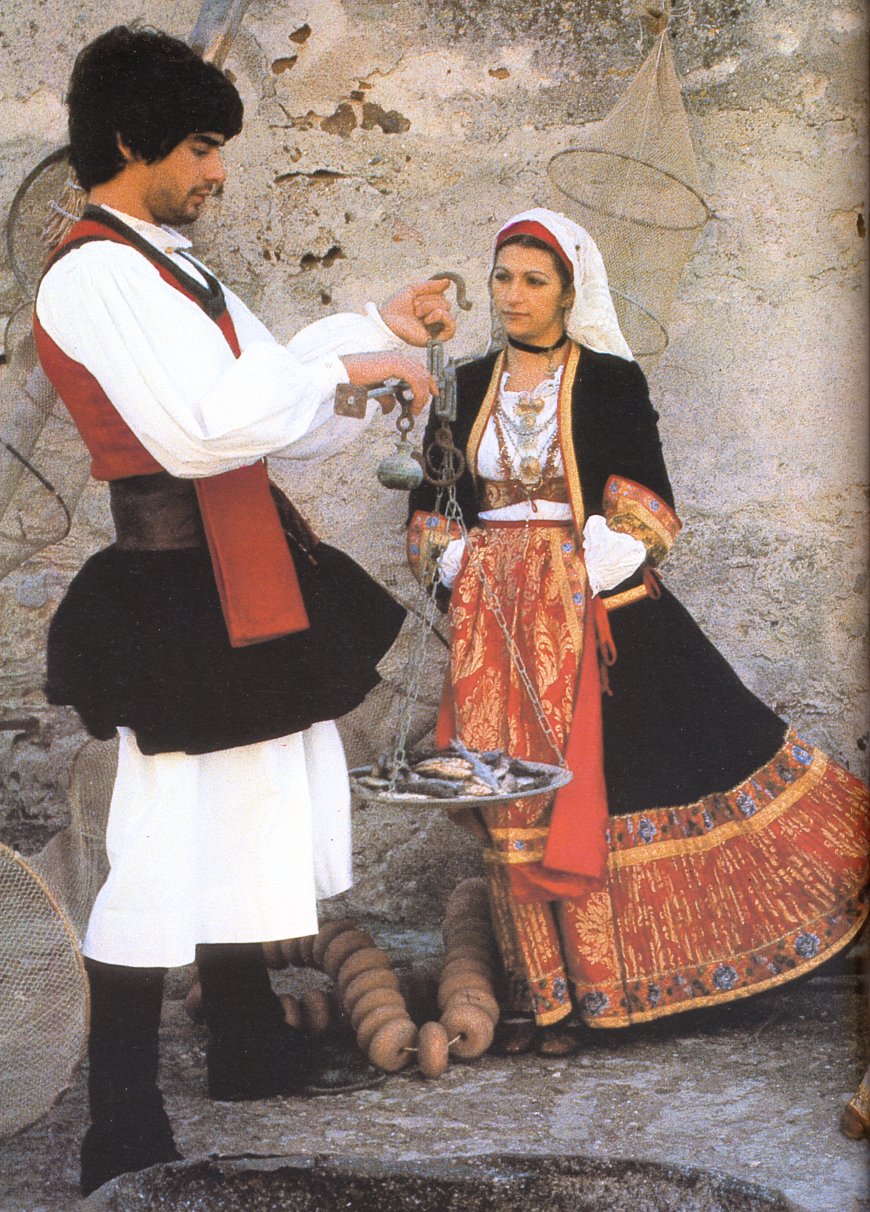


The Province of Ogliastra

[The G is NOT pronounced, but palatalizes the L, just as it does in the word Lasagna. This is always the case in Italian. I admit that this is one of my pet peeves.]

Villagrande Strisaili
 Note the headdress, which seems to be a mini apron. This is also found in some other areas, and oddly enough, also in Poland.


Lotsorai


Urzulei
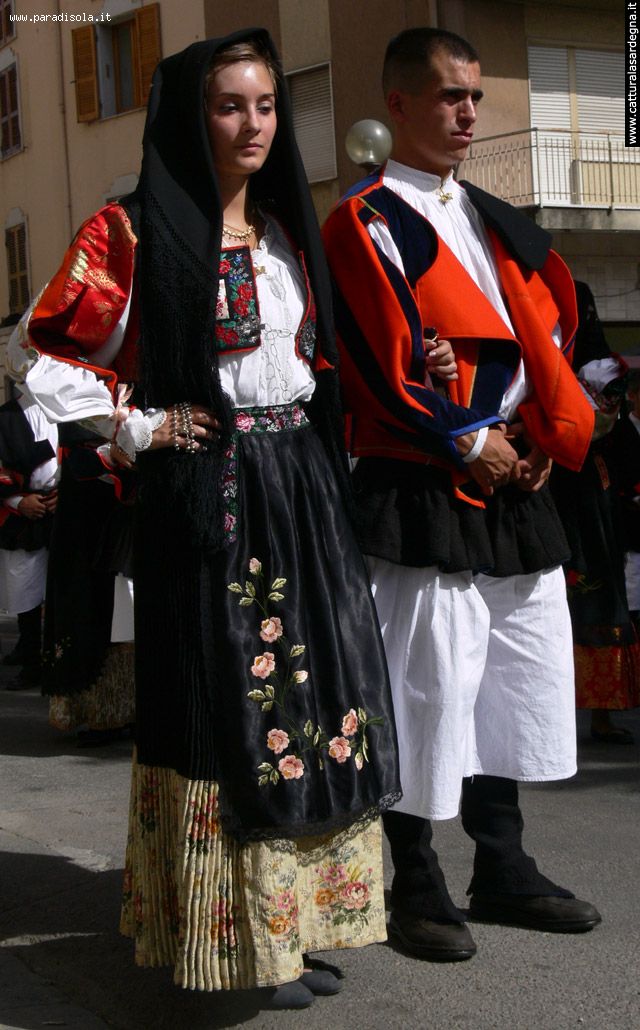

Ussassai


The Province of Medio Campidano

Arcidano


Collinas
 You have to admire those saddlebags


Gesturi


Sanluri
Notice the men with leather kilts, vests, gaiters, and stiff hats.


Tuili
Note the sheepskin vests on the men and the elaborately embroidered shawls on the women.


Province of Carbonia-Iglesias

Iglesias women.
 The blue and white headress is distinctive for this area.


Iglesias men.
 In the entire southwest corner of the island, the 'kilts' are replaced by Spanish style 'Sobrapantalones'. Sardinia was under Spanish domination for some time. Or perhaps the 'kilts' are just shortened versions of the Sobrapantalones.


Sant'Antioco


A closer look at the Sant'Antioco costume. Notice the rich brocades and the lavish jewelry.
 [Is it just me, or does that look like a blanket on her head?]


Domusnovas


Nuraxi Figus


Province of Cagliari

Teulada
 There is a strong Spanish influence on the men's costume of this area. Not only do they wear the sobrapantalones, but they also wear a hat instead of the stocking cap, which they call 'sombrero'. They also wear beautifully embroidered vests.


Isili


Villaputzu


Silanus 


The half circle of cities and towns around Cagliari have basically two costumes which they share between them with small local variations. Here are a couple of examples of the 'plain' costume. This first one is from Settimo San Pietro. I do not know the exact provenance of the other. The 'plain' costume is characterized by the skirt with blue and red stripes.


Here are a couple examples of the 'fancy' costume. The first one is from Quartu Sant'Elena, and the second from Quartucciu. Notice the traditional chain worn by married couples, and the multitude of other jewelry.


City of Cagliari 

The city itself has its own distinctive costume.


Thank you for reading. I hope that you have found this interesting and enjoyable. This overview is FAR  from exhaustive. There are many costumes which i had to omit due to lack of space, several of which are just as striking, colorful and elaborate as any of the ones i chose to portray.


Feel free to contact me with requests for research. I hope to eventually cover all of Europe and the Former Russian Empire/Soviet Union. I also gratefully accept tips on source materials which i may not have. I also accept commissions to research/design, sew, and/or embroider costumes or other items for groups or individuals


Roman K.
Rkozakand@aol


This is a link to a website dedicated to photographs of Sardinia. This website presents many facets of the culture of Sardinia.There are literally thousands of photographs posted. I freely acknowledge that this website is one of my sources for this posting. It is called 'Cattura la Sardegna' [Capture Sardinia] at Paradisola. It

Other Source Material:
Chiara Samugheo, 'Costumi di Sardegna', L'Unione Sarda, 1987
Otto Jenny, 'Sardinien, Insel der Trachten', Zurich, 1962
Luca Villani et al, 'Vecchia Sardegna', Ivrea, 1979
Manilio Brigaglia et al, 'Sardegna', Milan, 1981
Emma Calderini, 'Il Costume Popolare in Italia', Milan,
Anna Maria Colomo, 'I Costumi della Sardegna', Nuoro, 1983
Paolo Piquereddu, 'Costumi' Ilisso Publishing, Nuoro, 2003


Friday, August 5, 2011

Kykai, netted or sprang caps of Lithuania and crocheted descendants

Hello all,

I received an inquiry concerning the history of women's crocheted caps in Lithuania. In response, i will give a part of what i have found in my research. Crochet does not seem to go back earlier than the middle of the 19th century in Lithuania, at least as far as caps. The tradition of crocheting or looping footwear from twine may well go back earlier, but i cannot verify that.
Women's caps were originally made from netting, This technique is old and widespread, it was also used in western Ukraine, as well as Scandinavia where it is called Sprang, and undoubtedly in other places. I will insert here the words of A & A Tamosaitis/Tamosaitiene on the subject, as they give a good description of the technique.


Here is a photograph of  a pair of caps in progress, two caps were made at a time, because every time you twist two threads, it crosses twice, and the two twists are separated, and the design is built up from both the bottom and the top. This image is from a Ukrainian Museum, but the technique was essentially the same in Lithuania, and undoubtedly over a wider area as well.


Here is a drawing showing close up how the threads interact in the netting.

A large section of untwined warp was left in the middle when the twined material was finished. The tension was released, and as the shed rod was removed, the warp threads were separated into bundles, formed into loops and the loops pulled through one another to keep the work from unraveling untill the 2 middle edges could be secured. [Incipient crochet!]. Here is an example from a Lithuanian museum of a piece of netting at this stage. The short edges will become the sides, and the long edges will be gathered to form the front and back.


This technique resulted in a very elastic, breathable material. The finished product was taken off the frame, cut into two caps, the front and back were gathered, and often the sides were bound with cloth. The open work on top was able to expand to contain all the hair, which was usually braided and pinned on top of the head, had a pleasant design, and enabled the head to breathe. Thus the social requirement of married women to keep their hair covered was satisfied  in a way that was reasonably comfortable. When going out in public,  a nuometa or kerchief was worn over the cap, kykai or chepets. Here is a closeup of one example.


Here is an example of a piece of netting apparently destined for another use, as the edge has been knotted to secure it.


And here is a photograph of a nuometa from northeastern Lithuania with a decorative netted edge, as well as a woven in design.


Here is a photograph which was posed and taken in the 1970's. She is wearing the cap incorrectly, the hair should not be visible. She was most likely unaware of this.


Here are a few more examples, showing some of the diversity in the design of the netting and also of the decorative edging.


In the 19th century, with urban influences from outside, caps came to be made in other ways, with open work cloth, brocade, damask, knitting, etc. One technique which reached Lithuania is crochet. The origins of crochet are obscure, I have done a little research on the subject, and there are several theories, some of which are highly unconvincing, but no hard evidence. Some claim that it is derived from the very old tradition of knitting, single needle knitting, finger looping, or needle looping, all of which have an ancient heritage, which has survived particularly well in Scandinavia. The 'ice man', a bronze age man who was frozen in a glacier in Switzerland, and whose body was recovered several years ago, had a pouch which had been made by finger looping. These techniques are essentially similar.They all involve making loops in thread or yarn and then pulling the loops through other loops. All it would require is for someone to have the idea to use a little hook to execute the technique. Here is a photo of a long length of warp which is ready for the loom and is being temporarily stored by looping it back into itself in a long chain, showing that the basic concept had been around for a long time.


Another theory is that it derived from the practice some people had of using a small hook to do embroidery on netting, reticello. Perhaps, although in reticello one does not create a tissue, one makes patterns on a net which already exists. Others claim that it derived from tambour work, which was very popular in Central Asia, and certainly many examples of which survive from northwest Russia, Southeast Finland and other places in Europe. The problem with that is that tambour work is a shortcut to executing chain stitch embroidery. Again, the point is to make a design on the surface of an existing fabric. Another point which argues against this is that tambour hooks had a little gate, or baffle; this was open when the hook was pushed through the cloth so as to catch the thread underneath, but then closed on the return journey so as not to snag the cloth. This is essential to the technique of tambour, but also makes it impossible to use such a hook to do crochet. I find this unconvincing. It seems to me that those who propose this theory are focusing too greatly on the hook itself, rather than on the process.
A similar theory is put forth to derive crochet from hooks used to make rugs.
For more discussion of this topic, you can consult this article.
I would find it credible that someone may have seen tambour work done who was familiar with one needle knitting or finger looping, and thought that it would be easier to do with a hook, just as tambour work proceeds more quickly and easily than doing chain stitch with a needle.
In any case, what actually happened is not recorded. People who write history do not usually take notice of such daily activities, especially when done by women. As far as we can tell, crochet appeared around 1800 in Europe, became very popular, and reached Lithuania about the mid 19th century.
There started about that time the practice of making these caps using crochet instead of netting. It was easier, you didn't need to carry around a frame, industrial thread and yarn of great uniformity of thickness was readily available, it had the same qualities of being elastic and breathable, and it was fashionable. At first such caps were bound around the edges in the same manner as the netted caps. here is one example with a cross stitch design in red and black on the edge.


Here are a couple more examples of crocheted caps made in the form of the old netted caps.


Most were all white or ecru, but this one has a design in red worked in, and is almost more in the shape of a bonnet.


They continued to be worn under the kerchief outside the home.


As you can see from these last two images, it was not long before the caps were being made entirely in crochet, taking advantage of crochet's ability to make decorative edges. Here are a few more examples of crocheted caps from the late 19th century.


Eventually, with the change in social mores, the caps came to be worn by themselves, even in public, like this example from Lithuania Minor.


In fact, all of these older examples are from southern Lithuania, especially Dzukija, although a few are known from Suvalkija as well.


A very few caps have long flaps worked in, perhaps in imitation  of the tulle caps popular in Mazovia at this time, or the ribbons sometimes attached to the backs of them in other countries.


With the disappearance of the taboo of married women showing their hair in public, the caps became smaller, showing the hair around the edges.


Such caps remain popular today, and are now worn by girls as well as married women. I am informed that one can easily find them being sold at souvenir shops in Lithuania to this day. Here is a photograph of girls from the dance group Seltinis posing with their crocheted caps.


Thank you for reading, I hope that those of you who crochet may find inspiration in the concepts and/or patterns set forth here. Perhaps someone will be inspired to try netting. It seems like a craft which it would be very good to revive.

Thanks also to Karina, who provided the impetus and inspiration for this posting, and who will shortly be writing an article herself on this subject for the online magazine Crochet Insider, focusing on the more recent history of the crocheted version of these caps. 

A couple of people have asked me more about the actual process of how to do netting, pletinya or Sprang. I have looked online, and i have found a couple of informative websites that give instructions.


Feel free to contact me with requests for research. I hope to eventually cover all of Europe and the Former Russian Empire/Soviet Union. I also gratefully accept tips on source materials which i may not have. I also accept commissions to research/design, sew, and/or embroider costumes or other items for groups or individuals


Roman K.
Rkozakand@aol


Source Material:

AntanaTamoÅ¡aitis and Anastazija TamoÅ¡aitienÄ—, 'Lithuanian National Costume', Toronto, 1979
Mikalina GlemžaitÄ—, 'Lietuvių Tautiniai Drabužiai', [Lithuanian National Clothing] Vilnius, 1955
StasÄ— BernotienÄ—, 'Lietuvių Liaudies Moterų Drabužiai XVIII a XX pr.' [Lithuanian Women's Folk Clothing from the XVIII to the XX cent], Vilnius, 1974
S. Sydorovych, 'Khudozhnia Tkanyna Zakhidnykh Oblastej URSR', [Artistic Weaving of the Western Provinces of the Ukrainain SSR], Kyjiw, [Kiev] 1979
J. Grigienė et al, 'Lietuvių Liaudies Menas - Drabužiai' [Lithuanian Folk Art - Clothing], Vilnius, 1974
Kati Reeder Meek, 'Reflections from a Flaxen Past, For Love of LIthuanian Weaving', Alpena, Michigan, 2000