Showing posts sorted by relevance for query ukraine. Sort by date Show all posts

Friday, April 15, 2011

Embroidery of Rudky county, Lviw Oblast, Halychyna, Ukraine


Hello All,
Today i will do on of a series of followups to my previous posting, on Halychyna costume. There is a lot of material to cover. Halychyna has several traditional regional embroidery styles. Probably the most famous is that of Javoriw [or Yavoriw, the Latin alphabet is a pain, English really should switch to Cyrillic]. Today i will cover a less well known tradition, that of the county of Rudky. Here is a county map of Lviw Oblast, in Western Ukraine.


And here is a close up map of the area, I will be citing source villages when they are known. The map is in Ukrainian. but I have put the names of the towns and villages mentioned in latin letters in red.


For the costume of this region, see my previous posting, Halychyna Costume. These designs were of course used on many household linens as well as on clothing.
The most typical embroidery of this region as of the beginning of  the 20th century is cross stitch. The basic motif is small red roses, similar to the embroidery of the Drohobych area, but in Drohobych the designs are mostly black. These designs are geometrized to a large degree, and do not much resemble the floral rose designs of East Ukraine. This regional style was well documented by L. Krawchuk. Here are several charts of designs from her publication, 'Ukrainian Folk Embroidery of Lviw Oblast'.
They use a turn-down collar in this region, as in many parts of Western Ukraine. Here are a couple of charts of designs of the corners of collars from the village of Kolbaievychi. Notice the overcast edges.


You will notice the combination of stylized floral motifs with the geometric. The colors depicted are schematic, you should choose shades that complement each other, and not take these prints as exact depictions of the shade of each color. Ukrainians generally embroider with either DMC 666 or 321 red. The original embroidery was very fine. These would make fine edgings for table scarves, etc.
Here are a couple of designs from the shoulder inset 'ustawka' of women's chemises. These are from the actual town of Rudky.


This first one shows a border extending up the sides of the shoulder inset. It includes herringbone stitches, which are common motifs in this part of Ukraine. If I were to embroidery this, I would reverse the design on the other shoulder inset. 

On the originals, the linen was home woven, and the braid or herringbone stitch was done in thread thin enough to be seen like this.  This is a good example of rows of small motifs put together to make a larger design. Both the green and blue should be brighter than this depiction.

Here you have a largrer center motif with only one lesser motif on either side. The framing of a motif, and providing a definite edge is very typical of Ukrainian embroidery compostion. 

Here is a more stylised central motif. This design is found in other parts of Ukraine, but here it is done in the pallete of colors typical of Rudky. Again note the framing and edging of the design.

insets for young girls or everyday wear were narrower and less elaborate. 


This design shows influence from Horodok, to the northeast. The zigzag motif was originally embroidered in a wide chain stitch. Here it has been reinterpreted as cross stich.


This is a design for collar and shoulder inset from the village of Zav'yazantsi, to the northwest of Rudky. It shows a combination of stitches used on the shoulder inset, upper sleeve, and the body of the shirt. This shows clear influence from the Yavoriw region further north.


Free form stem stitch and satin stitch is not common in Ukraine, but it does occur. This style is called Hapt or Haft in Ukrainian. Here are a couple of examples of woman's ustawky done in this style from this region, also from the town of Rudky.


Here i would like to show some works by the famous embroidery artist Ol'ha Voznytsia which
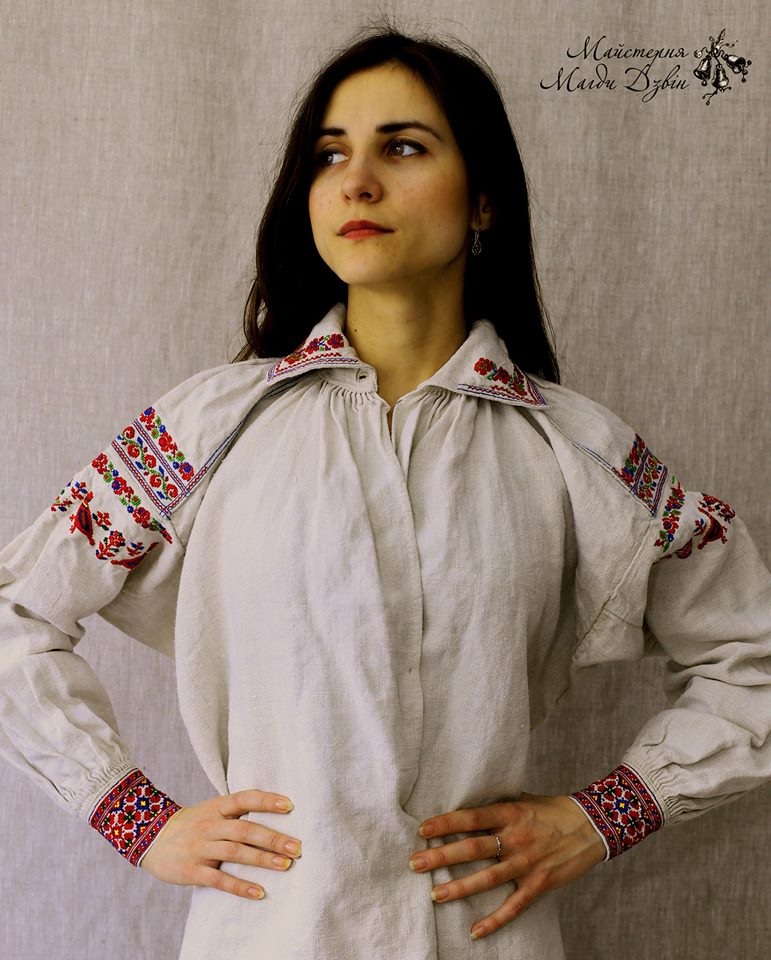
are done in the style of this region. Here is a photo of Ol'ha herself, wearing a blouse in a modern cut with Rudky embroidery.


You will notice that the embroidery is colorful and lively, but the colors complement each other without being gaudy or eye-piercing. This is the effect that should be strived for. Here is a close-up of the embroidery on this blouse. You will notice that there is embroidery on the shoulder piece and also on the uppper sleeve, complemented with hemstitching.


Here is a table scarf, 'servetka', done in Rudky style embroidery.


Here is a reasonable reconstruction of the Halychyna costume, minus the headgear and with modern shoes. you will notice that she is wearing a solid color skirt, no patterns, no ribbons, this would be a modern take on the outfit, it would be more traditional to make the skirt more ornamented.


Sometimes the apron was made from one loom width, sometimes from two. When working on a hand loom, it becomes very difficult if the loom is wider than about 22 inches, just for physical reasons. If the choice is made to use two loom widths, in western Ukraine, instead of trying to hide the central seam, they make it part of the design, with a fancy hand joining technique of some sort, and emphasized by the placement of the embroidery, as you can see here. This is also typical of the Javoriw costume. Below is a closeup of the embroidery. You will notice that it is done on Aida cloth. This I  DO NOT RECOMMEND. In Ukraine, when people no longer wove their own cloth, they worked on whatever they could get. You will get a much nicer finished product working with some even weave cloth, Jobelin, Salem Cloth, even weave linen, hemp, or a blend. I would also not recommend 'hardanger cloth' or panama. There are many types of fiber blends available in various thread counts and weights for various purposes.


Just one example of Rudky style Haft embroidered by Maria Kalyniak.


Some other examples of embroidery from this region.


Widows and older women would often use darker and more somber colors in their embroidery.


The following couple of images are from the book 'The Art of Ukrainian Embroidery', by Olena Kulynych-Stakhurska. 


In this image, the shirt on the left is from Horodok region, typified by the 'snake' motif, here done in white. The one on the right could be Horodok or Rudky region.


Mens' shirts in this area were also sewn with the shoulder inset, which sometimes had very simple embroidery around the edges. 


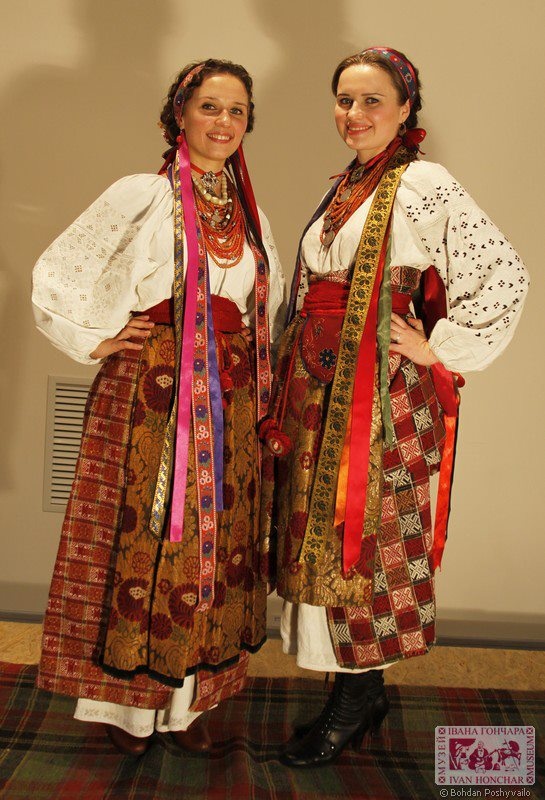
To finish, i will show you a photo of a performing group wearing the Rudky variant of the Halychyna costume. Remember, the biggest difference between the various counties is in the embroidery. If you look closely, you will notice that the skirts are different colors, and the embroidery is somewhat different on each girl. I personally find this a good thing in a performing group. I have never thought that having each person wear the exact same outfit with the exact same embroidery is a good presentation. In the village, each would have a somewhat different expression within a common style.


Thank you all for reading, I hope that you found this interesting, informative and inspiring. We should note the tradition our ancesters had of making beautiful things to use in daily life come to an end. Go forth and create.


Feel free to contact me with requests for research. I hope to eventually cover all of Europe and the Former Russian Empire/Soviet Union. I also gratefully accept tips on source materials which i may not have. I also accept commissions to research/design, sew, and/or embroider costumes or other items for groups or individuals.
Roman K.
Rkozakand@aol.com

Source Material:
L. Krawchuk, 'Ukrainian Folk Embroidery of Lviw Oblast' Kyjiw [Kiev], 1961
Ol'ha Voznytsia, 'Vyshywka Moje Zhyttia' [Embroidery of My Life], Drohobych, Ukraine, 2006
Maria Kalyniak, 'Ukrajinska Vyshywka, Suchasne Traktuvannia' [Ukrainian Embroidery, a Modern Approach], Lviw, 2004
Olena Kulynych-Stakhurska, 'The Art of Ukrainian Embroidery - Techniques and Technology', L'viw, 1996 


Sunday, May 26, 2019

The 6 types of Ukrainian Folk Costume


Hello All,
Today I will talk about the 6 general types of Ukrainian folk Costume. I have earlier referred to 5 types, but my more recent research has informed me that there are, in fact, 6. These costumes are distinguished by the type of women's lower body garment. The base, or foundation garment for all of these is the chemise, or sorochka. This was originally ankle length, and usually embroidered on the shoulder, upper sleeve, collar, cuffs, and often the hem. Traditionally, the sorochka hem was visible below the lower body garment. In more recent years, there has been a tendency to cut the chemise in half, and make the lower part into a separate garment.


1   Costume with Plakhta


The costume with plakhta was widespread in central, eastern and southern Ukraine, from about Cherkassy to the east. It had the same origin as the Russian poneva [paniova]. It is a woven rectangle of cloth wrapped around the hips from the back, and leaving a gap in front. Both have a woven in checkerboard pattern. In Russia, this pattern is very simple, usually consisting of white lines on a black background. Here is an example from around Tula.


The poneva is further ornamented with woven cloth sewn to the edge, as here, or with ribbons and galloons sewn on, and even with stripes of embroidery. Here is an example from Kaluga.


The Ukrainian plakhta is equally highly ornamented, but in a very different way. The individual squares or rectangles of the cloth have designs woven in, the colors varying from one square to the next.


The top of the plakhta may be folded over and sewn into a tube with a drawstring strung through it, like the poneva, but often two long pieces are sewn together side by side, as seen above, for a bit more than half its length.  The plakhta is folded over a sash tied around the waist, and the upper half falls over the lower. This is called plakhta with wings, and is the original form. 


Note that sometimes other types of overskirt are mistakenly called 'plakhta', but this is incorrect. This is the only garment which is properly referred to as plakhta.


2 Costume with Obhortka.


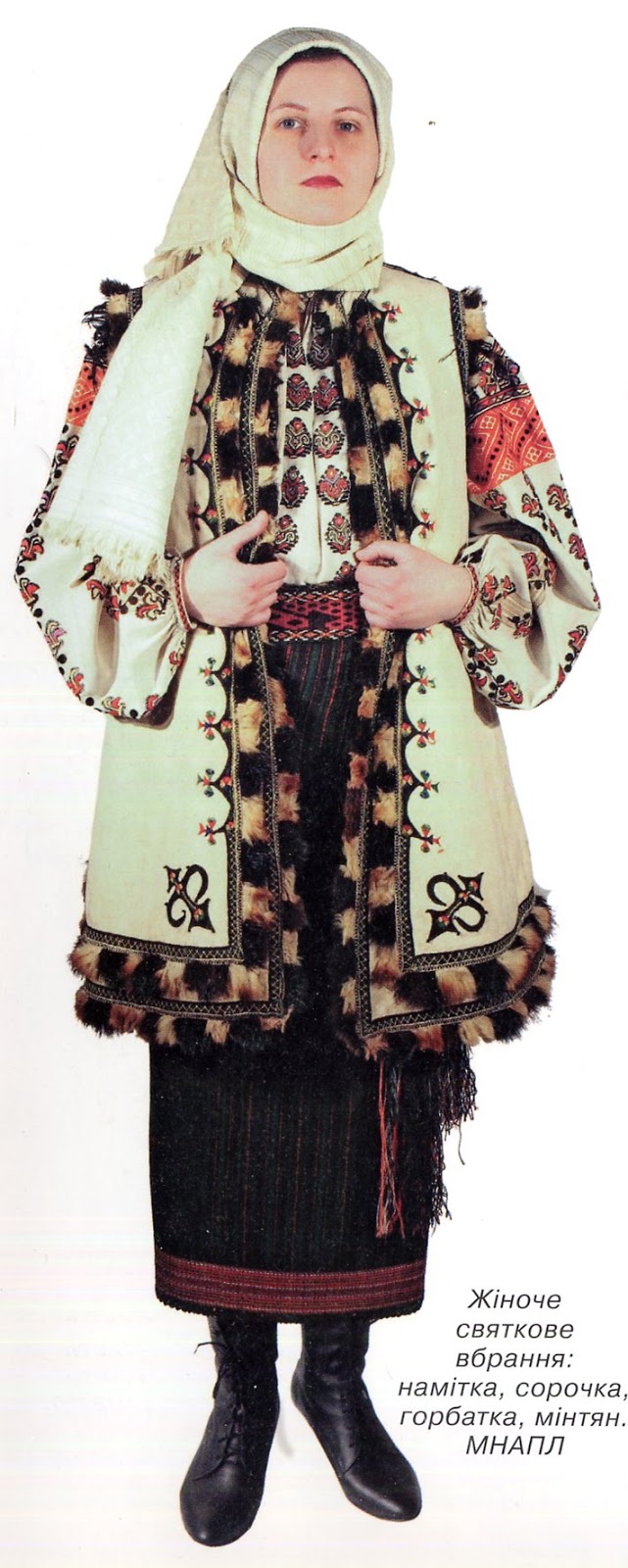
The obhortka is also sometimes called 'horbotka', 'fota', 'opynka', or 'derka'. 'Obhortka' means 'that which is wrapped around'. This consists of a rectangle of heavy cloth which is wrapped around the hips from behind, overlaps in front, and is held in place by a sash. This is found in Podillia, Pokuttia, Bukovyna, Bessarabia, and also in Eastern Romania; Moldavia and Muntenia. Here is an example of a wedding couple from Mușcel, Argeș County, Muntenia, România. This image is sometimes presented as Ukrainian. It is not.


The Obhortka also has woven in ornament, but generally fine lines vertically, and also around the edges. The base color is often black, but in eastern Pokuttia it is brick red.


In Bukovyna as well as in Muntenia there may be more overt ornamentation on the overlap.


This garment is often worn with one or both corners pulled up and tucked into the waist. It is usually worn without an apron, but in some regions an apron is worn.

In central Ukraine, a simple wrap-around skirt called derka was often worn as working attire.


3 Costume with double apron.


While the plakhta is technically a back apron, it is not included in this type, but considered to be a separate type of costume. While there are written records of double apron costumes being worn in central Ukraine, none have survived. The Hutsul region is the only place in which this costume has survived to modern times in Ukraine. It is also found in western Romania; Transylvania, Banat and Oltenia. The two aprons are woven with fine horizontal lines, and vary in color from almost black, in Zhabie,  to bright orange, in Kosmach.


You will see Ukrainian performing groups using the double apron in stage costumes intended to portray central Ukraine. It is my opinion that this should be discouraged. Here is the performing group Vyshnia, who sing quite well. There are other details of the costume which are incorrect, although they are attractive and recognizably Ukrainian.


https://www.youtube.com/watch?v=lS1jEefrQfU&list=RDO6QyYC7Tt2A&index=5


4 Costume with a skirt


These are the costumes which include an actual skirt with a waistband. They are found in the traditional costumes of the north and west. In addition, they started to spread in the east of Ukraine in the 19th cent, replacing the plakhta in some locations, as they were easier to make. The above images show examples of this.

The following images show traditional skirts from different regions of Ukraine

Chernyhiw, the embroidered skirt called andarak.


Polissia  woven linen skirt.


On the right we see a home woven skirt of wool. This kind was also worn in Volyn'.


This skirt was made in Polissia of bought cloth.


Volyn'.


Halychyna  This is a linen home woven and printed skirt from around Horodok.


Halychyna. This is a home woven wool skirt called shorts from Yavoriw area.


Halychyna. These girls are from around Rava Rusa, wearing skirts of bought cloth.


Opillia. This is a linen home woven and printed skirt from around Drohobych.


Boiko. These are home woven and embroidered skirts which are part of the traditional dress attire of the Boikos.


Lemko.  These are skirts of bought cloth from various parts of Lemkovyna.


This is the costume of the Shliakhtova Lemkos. In the first image they have erred in putting the man's vest on the female mannequin, but it is correct otherwise.


Transcarpathia. Marmorosh region


Transcarpathia. region around the villages of Cherna and Novoselytsia.


Transcarpathia. region around Uzhhorod.


5 Costume with single apron.

These last two costumes have the smallest areas in which they are found. While it often happened that women working in the fields would wear just a chemise and apron, the single apron costume was worn as dress attire only in the central lowlands ofTranscarpathia, in the regions around Irshava and Khust, and as far east as Teresva.

Irshava


Khust region. In this area the apron is very wide, going almost all the way around the waist, and is called plat.


6. Costume with a skirt and bodice.

While the 5th costume is restricted to one small area, this costume is found in odd islands in southern Podillia and eastern Polissia in Ukraine. It is called variously talijka, riklia, or sharafan. It is a bodice with an attached skirt. This type of costume is common in western Europe and Scandinavia, in Bulgaria, and among some of the Hungarians in Mezoseg, Transylvania. None of these appears to be a likely source for this garment appearing in sporadic places in Ukraine.

Toporivtsi, Bukovyna.

In this village this garment is called riklia. It was apparently once more widespread in Bukovyna, but now appears only in this one village as part of the wedding costume. In other parts of Bukovyna the bodice has disappeared and the gathered skirt is called riklia by itself. This is a wedding couple from Toporiwtsi in the 1940's.


Here are a couple of older shots of this garment.


It is possible that this garment was borrowed from German or Hungarian settlers in the area.


Kamianka - Kodyma region.

This region forms the southernmost part of Podillia. Part of this area lies in northern Odessa oblast, and the other part lies over the border in Transdnistria, once part of Moldavia. In this region the garment is called sharafan.


Zhytomyr - Chernyhiw - Novhorod Syvirskyj

This garment is found in pockets through eastern Polissia. Here it is called talijka. Again it is formed as a bodice with attached gathered skirt. It is not cut like a Russian Sarafan.


And that concludes this article. I have not included city costume or costumes of the aristocrats, each of which are a separate tradition.

Thank you for reading, I hope that you have found this to be interesting and informative.


Roman K.


email: rkozakand@aol.com