
Hello all.
I wrote this article a while ago, but I have found new material that I would like to share with you. Most of these images are from the artwork of O. L. Kul'chytska, who is well known for her work in Ukrainian Costume. This costume is recorded as being from the villages of Sosnytsia or Sosnica, and Torki. Sosnytsia is about 12 km north and slightly east of Peremyshl or Przemysl, while Torki is about 5 km east and a little north of Peremyshl. They seem to be variants of the same costume. This is an area of mixed Ukrainian-Polish settlement. Here is the image of the first, drawn in 1930 in Sosnytsia.
Kyl'chystka gives a very short description: "Woman's festal costume. Long coat of blue factory-made cloth with red lapels, with wide woolen belt; headress constists of 'peremitka' tied in a 'chub'. Embroidery pattens of 'peremitka'. Village of Sosnitsa near Przemysl."

At first glance, i must say it doesn't look very Ukrainian, but on the other hand, it doesn't look very Polish either. I might guess that there was Tatar influence, but i have no idea if there was a Tatar colony in the area. It is very common to find an image of a costume listed in some literature, only to find that the image consists of a person in an overcoat. It would seem that people went around much of the time with their coats on, to be completely dressed. The coat is typical of the area, so are the boots and the sash over the coat. I can see a turned down collar with embroidery, also typical. There seems to be a floral apron over a white skirt, or possibly the bottom edge of the chemise is showing, although this is not as common in this area. There also seems to be a sort of vest/bodice of a floral material, which in this area was called leibek or kamizolia. Then there is the headcloth. the headcloth itself is a common garment in this area, being very old and found in various forms from Lithuania down to Romania. What is unusual is that it is tied in a knot on top of the head, with fringe waving about and looking like a turban. This knot is referred to as the 'chub' [pronounced choob]. Ms. Kul'chyts'ka drew the embroidery on a couple of the headcloths:

Chain stitch, [stem stitch?] slab stitch, running stitch, fringe. This looks like it belongs to an old embroidery tradition that was once widespread but has only survived in a few places, showing some similarity to the embroidery of Horodok, Yavoriw, Bilgorai, Kurpie, and even the old Lowicz embroidery. I may mention here that at least some archaeologists believe that west Ukraine/southeast Poland was the original homeland of the Slavs, certainly there have been Slavic settlements in the area for a very long time. The other two drawings she published do not really fit into the same style, being very free form floral interepretations of chainstitch. These also remind me of Tatar work.


I have some imput from a reader, Vasyl, who sent me an actual photograph of what i believe is the very same piece of embroidery from this region. You can see that it is mostly free-form satin stitch. The green seems to have faded.

The image at the head of the article is of the same piece.
There are examples of uncounted floral embroidery in western Ukraine, but they are based on satin stitch and stem stitch. This is unique in Ukrainian embroidery, as far as i know.
Here is Kul'chytska's sketch of the man's costume which has recently become available.

Then there is the depiction of the costume from the village of Torki.

Chemise with ustawka cut,
embroidered on the shoulder, collar and cuffs, the outlining of the ustawka and the lines down the middle are typical for this general region. Skirt and apron from factory-made cloth, gathered and pleated. Short vest, and again the peremitka tied around the head and tied in a knot on top, with fringe waving. This was drawn in 1927.
Recently more of her sketches have become available. Here is another one.

Recently more of her sketches have become available. Here is another one.

Kul'chytska provides a close up sketch of the chemise and embroidery.
.

Buttonhole stitch, back stitch, running stitch, slab stitch, and she seems to indicate in the bottom sketch that the zigzags are chain stitch. Here is another, newly available sketch.

She also provides a closeup of embroidery on the peremitka, or more than one.

Here are photographs of the actual museum pieces.


This again seems to have clear affinities with Bilgoray and Horodok embroidery. I wonder if this is still practiced or remembered in these villages.
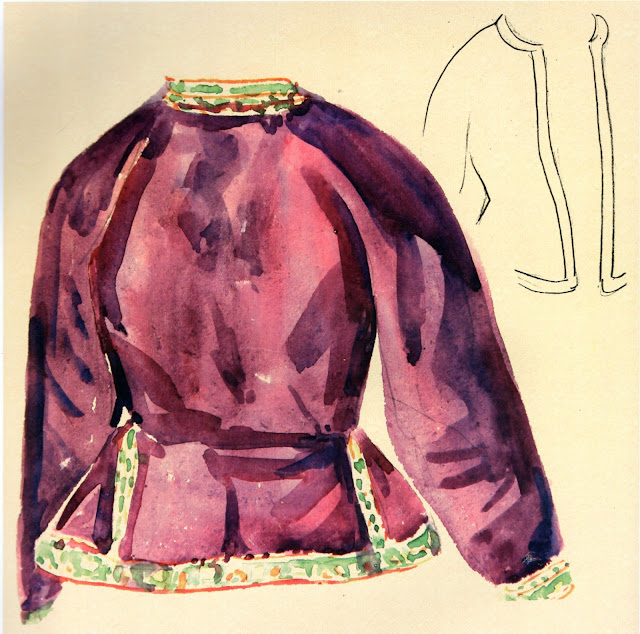
Besides this, Kul'chytska made sketches of the kabat, or jacket, worn in this village, with floral embroidery, or perhaps appliqued ribbon or printed material.

This sort of short jacket is again typical for the general area.
Again, here are a couple of her sketches which have recently been pubished. In this one we can see the skirt and apron as well.

In 1937 in the city of L'viw, there was a 'Folk Costume Fashion Show' [which i would dearly love to go back and take pictures of with a very good digital camera, come to think of it, i would dearly have loved to go around with Kul'chytska and taken lots of photos as well].
Again, here are a couple of her sketches which have recently been pubished. In this one we can see the skirt and apron as well.


In 1937 in the city of L'viw, there was a 'Folk Costume Fashion Show' [which i would dearly love to go back and take pictures of with a very good digital camera, come to think of it, i would dearly have loved to go around with Kul'chytska and taken lots of photos as well].
One of the participants was the ethnographer Savyna Sydorovych. And here is a photo of her taken at that time, dressed in the Torki costume.

But again, here are a couple of other sketches which have been recently published. The first seems to be a bride, and the second of a young woman. In this first sketch, the chemise embroidery is similar to that shown above, and she is wearing what I assume is a bridal wreath.

In this image, we see a great deal of polychrome embroidery on the ustawka and sleeves.


In this image, we see a great deal of polychrome embroidery on the ustawka and sleeves.

The embroidery reminds me very much of this piece I recently saw online.


I will close with some old photographs from the Torki area. Compare with the above images. I do not see anyone wearing the peremitka though.


Thank you for reading, I hope that you have found this to be interesting and informative.
I would like to find more material if anyone has some.
I would like to find more material if anyone has some.
Roman K.
Source Material:
O. L. Kul'chytska, 'Folk Costumes of the Western Regions of the Ukrainian SSR', Kyiw {Kiev] 1959
Petro Odarchenko et al, 'Ukrainian Folk Costume', Toronto, 1992
Olena Kul'chytska, 'Narodnyj Odiah', L'viw, 2018
Olena Kul'chytska, 'Narodnyj Odiah', L'viw, 2018


