I received an inquiry concerning the history of women's crocheted caps in Lithuania. In response, i will give a part of what i have found in my research. Crochet does not seem to go back earlier than the middle of the 19th century in Lithuania, at least as far as caps. The tradition of crocheting or looping footwear from twine may well go back earlier, but i cannot verify that.
Women's caps were originally made from netting, This technique is old and widespread, it was also used in western Ukraine, as well as Scandinavia where it is called Sprang, and undoubtedly in other places. I will insert here the words of A & A Tamosaitis/Tamosaitiene on the subject, as they give a good description of the technique.
 |


Here is a photograph of a pair of caps in progress, two caps were made at a time, because every time you twist two threads, it crosses twice, and the two twists are separated, and the design is built up from both the bottom and the top. This image is from a Ukrainian Museum, but the technique was essentially the same in Lithuania, and undoubtedly over a wider area as well.

Here is a drawing showing close up how the threads interact in the netting.

A large section of untwined warp was left in the middle when the twined material was finished. The tension was released, and as the shed rod was removed, the warp threads were separated into bundles, formed into loops and the loops pulled through one another to keep the work from unraveling untill the 2 middle edges could be secured. [Incipient crochet!]. Here is an example from a Lithuanian museum of a piece of netting at this stage. The short edges will become the sides, and the long edges will be gathered to form the front and back.

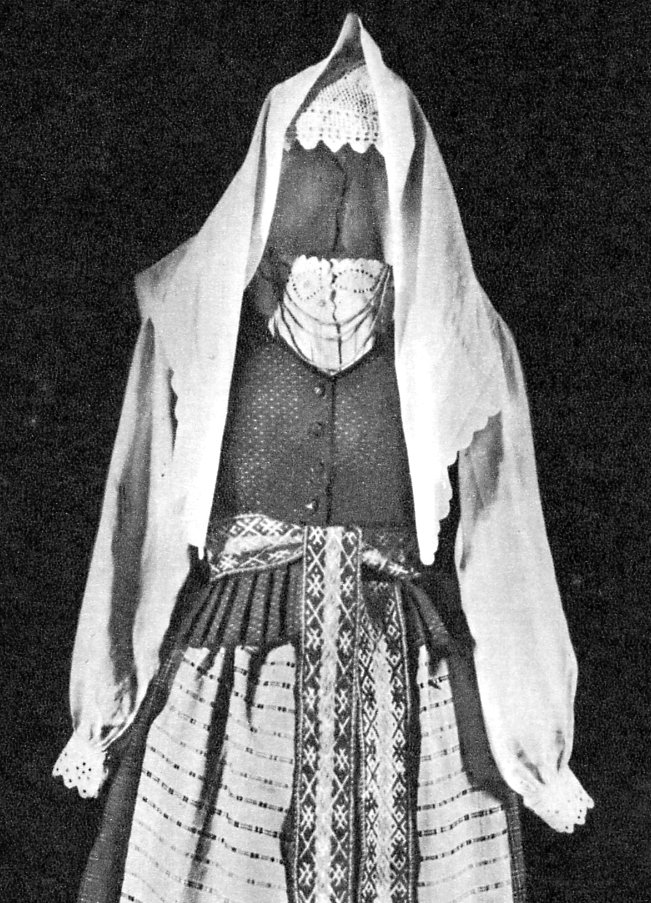
This technique resulted in a very elastic, breathable material. The finished product was taken off the frame, cut into two caps, the front and back were gathered, and often the sides were bound with cloth. The open work on top was able to expand to contain all the hair, which was usually braided and pinned on top of the head, had a pleasant design, and enabled the head to breathe. Thus the social requirement of married women to keep their hair covered was satisfied in a way that was reasonably comfortable. When going out in public, a nuometa or kerchief was worn over the cap, kykai or chepets. Here is a closeup of one example.

Here is an example of a piece of netting apparently destined for another use, as the edge has been knotted to secure it.

And here is a photograph of a nuometa from northeastern Lithuania with a decorative netted edge, as well as a woven in design.

Here is a photograph which was posed and taken in the 1970's. She is wearing the cap incorrectly, the hair should not be visible. She was most likely unaware of this.

Here are a few more examples, showing some of the diversity in the design of the netting and also of the decorative edging.


In the 19th century, with urban influences from outside, caps came to be made in other ways, with open work cloth, brocade, damask, knitting, etc. One technique which reached Lithuania is crochet. The origins of crochet are obscure, I have done a little research on the subject, and there are several theories, some of which are highly unconvincing, but no hard evidence. Some claim that it is derived from the very old tradition of knitting, single needle knitting, finger looping, or needle looping, all of which have an ancient heritage, which has survived particularly well in Scandinavia. The 'ice man', a bronze age man who was frozen in a glacier in Switzerland, and whose body was recovered several years ago, had a pouch which had been made by finger looping. These techniques are essentially similar.They all involve making loops in thread or yarn and then pulling the loops through other loops. All it would require is for someone to have the idea to use a little hook to execute the technique. Here is a photo of a long length of warp which is ready for the loom and is being temporarily stored by looping it back into itself in a long chain, showing that the basic concept had been around for a long time.

Another theory is that it derived from the practice some people had of using a small hook to do embroidery on netting, reticello. Perhaps, although in reticello one does not create a tissue, one makes patterns on a net which already exists. Others claim that it derived from tambour work, which was very popular in Central Asia, and certainly many examples of which survive from northwest Russia, Southeast Finland and other places in Europe. The problem with that is that tambour work is a shortcut to executing chain stitch embroidery. Again, the point is to make a design on the surface of an existing fabric. Another point which argues against this is that tambour hooks had a little gate, or baffle; this was open when the hook was pushed through the cloth so as to catch the thread underneath, but then closed on the return journey so as not to snag the cloth. This is essential to the technique of tambour, but also makes it impossible to use such a hook to do crochet. I find this unconvincing. It seems to me that those who propose this theory are focusing too greatly on the hook itself, rather than on the process.
A similar theory is put forth to derive crochet from hooks used to make rugs.
For more discussion of this topic, you can consult this article.
I would find it credible that someone may have seen tambour work done who was familiar with one needle knitting or finger looping, and thought that it would be easier to do with a hook, just as tambour work proceeds more quickly and easily than doing chain stitch with a needle.
In any case, what actually happened is not recorded. People who write history do not usually take notice of such daily activities, especially when done by women. As far as we can tell, crochet appeared around 1800 in Europe, became very popular, and reached Lithuania about the mid 19th century.
There started about that time the practice of making these caps using crochet instead of netting. It was easier, you didn't need to carry around a frame, industrial thread and yarn of great uniformity of thickness was readily available, it had the same qualities of being elastic and breathable, and it was fashionable. At first such caps were bound around the edges in the same manner as the netted caps. here is one example with a cross stitch design in red and black on the edge.

Here are a couple more examples of crocheted caps made in the form of the old netted caps.

Most were all white or ecru, but this one has a design in red worked in, and is almost more in the shape of a bonnet.

They continued to be worn under the kerchief outside the home.

As you can see from these last two images, it was not long before the caps were being made entirely in crochet, taking advantage of crochet's ability to make decorative edges. Here are a few more examples of crocheted caps from the late 19th century.


Eventually, with the change in social mores, the caps came to be worn by themselves, even in public, like this example from Lithuania Minor.

In fact, all of these older examples are from southern Lithuania, especially Dzukija, although a few are known from Suvalkija as well.

A very few caps have long flaps worked in, perhaps in imitation of the tulle caps popular in Mazovia at this time, or the ribbons sometimes attached to the backs of them in other countries.


With the disappearance of the taboo of married women showing their hair in public, the caps became smaller, showing the hair around the edges.

Such caps remain popular today, and are now worn by girls as well as married women. I am informed that one can easily find them being sold at souvenir shops in Lithuania to this day. Here is a photograph of girls from the dance group Seltinis posing with their crocheted caps.

Thank you for reading, I hope that those of you who crochet may find inspiration in the concepts and/or patterns set forth here. Perhaps someone will be inspired to try netting. It seems like a craft which it would be very good to revive.
Thanks also to Karina, who provided the impetus and inspiration for this posting, and who will shortly be writing an article herself on this subject for the online magazine Crochet Insider, focusing on the more recent history of the crocheted version of these caps.
A couple of people have asked me more about the actual process of how to do netting, pletinya or Sprang. I have looked online, and i have found a couple of informative websites that give instructions.
Feel free to contact me with requests for research. I hope to eventually cover all of Europe and the Former Russian Empire/Soviet Union. I also gratefully accept tips on source materials which i may not have. I also accept commissions to research/design, sew, and/or embroider costumes or other items for groups or individuals
Roman K.
Rkozakand@aol
Source Material:
Mikalina Glemžaitė, 'Lietuvių Tautiniai Drabužiai', [Lithuanian National Clothing] Vilnius, 1955
Stasė Bernotienė, 'Lietuvių Liaudies Moterų Drabužiai XVIII a XX pr.' [Lithuanian Women's Folk Clothing from the XVIII to the XX cent], Vilnius, 1974
S. Sydorovych, 'Khudozhnia Tkanyna Zakhidnykh Oblastej URSR', [Artistic Weaving of the Western Provinces of the Ukrainain SSR], Kyjiw, [Kiev] 1979
J. Grigienė et al, 'Lietuvių Liaudies Menas - Drabužiai' [Lithuanian Folk Art - Clothing], Vilnius, 1974
Kati Reeder Meek, 'Reflections from a Flaxen Past, For Love of LIthuanian Weaving', Alpena, Michigan, 2000
S. Sydorovych, 'Khudozhnia Tkanyna Zakhidnykh Oblastej URSR', [Artistic Weaving of the Western Provinces of the Ukrainain SSR], Kyjiw, [Kiev] 1979
J. Grigienė et al, 'Lietuvių Liaudies Menas - Drabužiai' [Lithuanian Folk Art - Clothing], Vilnius, 1974
Kati Reeder Meek, 'Reflections from a Flaxen Past, For Love of LIthuanian Weaving', Alpena, Michigan, 2000


