Showing posts sorted by relevance for query lithuania. Sort by date Show all posts

Monday, August 1, 2011

Costume and embroidery of Lithuania Minor, Mažoji Lietuva, or Klaipeda region, Lithuania

Hello all,

Today i will talk about the costume of Lithuania Minor,Mažoji Lietuva in Lithuanian, the westenmost region of Lithuania, much of which remains outside the borders of the present state of Lithuania. The major city of this region in Lithuania is Klaipeda, and the region is sometimes named after this city. The history of this region is distinct from that of the rest of the territory inhabited by Lithuanians, in that it very early came under the control of the Teutonic Knights, and was an integral part of the Kingdom of Prussia for many centuries. The influence of Germanic culture and the Lutheran faith was very strong in this region. For more information about the history and development of this region, see this article.

http://en.wikipedia.org/wiki/Lithuania_Minor

Here is our map again, so you can orient yourself.


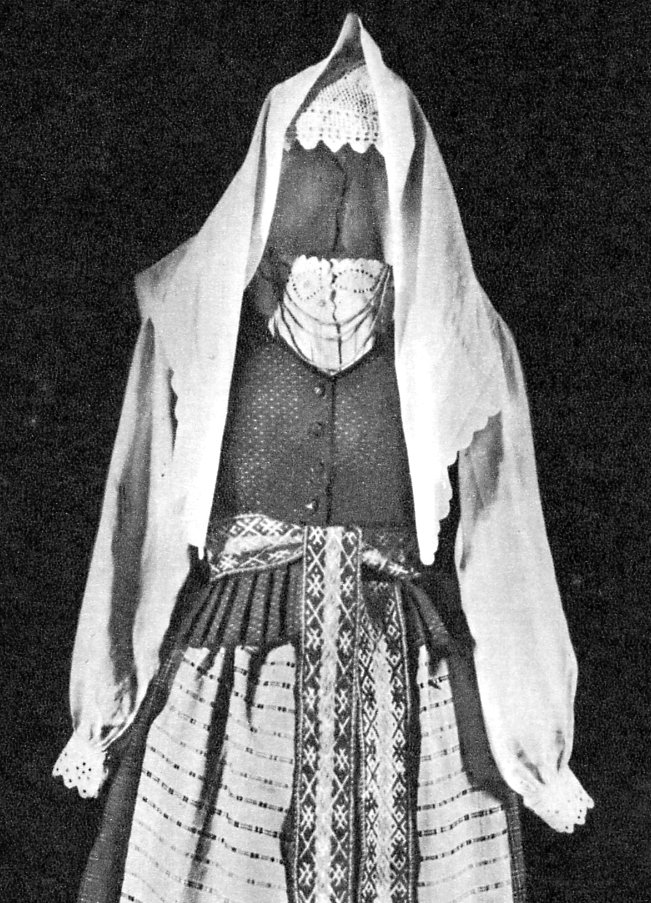
There is a lot of variety in the costume of this region. Sometimes the clothing is as colorful as in other parts of Lithuania, but sometimes the clothing is quite dark and soberly colored, in keeping with protestant sensibilities. Some features of the costume of this region, while not always present, are diagnostic. 1. The main part of the chemise embroidery being on the uppper  sleeve and shoulder inset. 2. pleated skirts, 3. aprons with vertical woven ornament completed with a piece with horizontal ornament attached to the lower edge. 4. a narrow sash supporting an ornamented seperate pocket, worn on the hip. 5. basket shaped headress braided from cord in netting. 6. rectangular white shoulder wrap with curvilinear floral embroidery in white or red down the center lengthwise.
I will start by presenting some images from various sources. Keep an eye open for the above costume characteristics.


The chemise in this region is often sewn with a different cut than in the rest of Lithuania, with a shoulder inset sewn to the top or side of the main body pieces. The shoulder inset has woven ornament or is embroidered, the ornament being displayed on the uppper arm. Sometimes embroidery is also added at the top of the sleeve. This is very similar to what is found in slavic costume. It is interesting to speculate where this came from, as this part of Lithuanian is furthest from Russian/Bielorussian influence. Other cuts are also used. Here is a schematic of the cut.

Here are some examples of the embroidery used on the chemises.


Here are some of the embroidery patterns used.


One unfortunate recent development is that the embroidery is sometimes placed lower on the sleeve through a misunderstanding of the cut  of the chemise, especially when the entire sleeve is made in one piece. This unfortunate tendency is also seen in modern Ukrainian blouses as well. Here is one example of embroidery hanging too low on the arm.


Skirts are plaid or striped, or, unusually for Lithuania,  of a solid color. The skirts are sometimes pleated, which one does not find in other parts of Lithuania, although it is common in Estonia. Skirts are also sometimes shorter than in other parts of Lithuania. Take a look at the skirts in the various images presented.

Aprons, as in other parts of Lithuania vary quite a bit. Some have vertical ornament in red on a white background, copied perhaps from brocades of the 18th cent. They may be of a solid color, of linen or damask, and may have a flounce on the bottom.  Take another look at the various images.


The type of apron usually considered to be the most unique to the region has vertical woven ornament in the body of the apron, with a piece attached to the hem which has horizontally sewn ornament. Here is an example.


Bodices are short in this region, often not extending past the waist, but bodices with short peplums are also known.  Here is one cut given for a bodice from Lithuania minor.


These bodices are sometimes ornamented with braid or ruched ribbon. The neckline can be cut more deeply than in other parts of Lithuania, showing moree of the chemise, and giving the effect of narrow straps over the shoulders. One type of bodice used in this region is cut straight across the top under the arms, and in fact does have straps, the result being a square 'neckline'. Here is an example.


Sashes are worn here as in the other regions of Lithuania. Some are wide with showy patterns. But another kind of sash is also used here, which is narrow and has many different patterns woven into it, the so called 'hundred pattern sashes'.


A pocket was often worn with the costume in Lithuania as in many other places. this was usually worn under the skirt or apron. In Lithuania Minor, there was also a very decorative pocket called delmonas, which was worn on the outside of the skirt. This garment, while very common in Scandinavia, is rare or unknown in the other parts of Lithuania. The most casual perusal of the images in this posting will show the incredible veriety of shapes and ornament used on these pockets. However they are usually flat with an open top, or a slit on the front, or a flap, and are threaded onto a length of the 'hundred pattern sashes'. Here are a few more examples.


The festive attire was finished with a necklace of glass, coral, or especially amber, as this region lays on the shore of the Baltic Sea. Headgear is varied, consisting of a kerchief, karuna, cap, or bonnet. The most unique headgear consists of netted string placed over a frame, which was only worn by married women. This does not seem to have been worn in the city of Klaipeda. Unmarried girls did not cover their hair, but braided it into a crown, and sometimes added wreaths of flowers or leaves, especially of rue, which has a special significance for the Lithuanian people. See the following two photos.


At the end of the 19th century, in some places, especially in the cities, short jackets were popular. Over these, and even over bodices were worn triangular folded shawls which were similar to those worn in central and western Europe.


In other areas, the old rectangular shoulder wrap, the Drobule was retained. These were made of one panel of cloth, and often embroidered in a wide strip down the center. When they were worn, they were folded to be relatively narrow, and wrapped around the shoulders, perhaps in imitation of the empire style. The embroidery was either in white or in red. Here are two examples of the distinct embroidery done on the Drobules.


Thank you for reading, i hope that you have found this to be interesting, informative, and perhaps inspiring. Let us continue to make beautiful things to fill our world. Here is one last image for this posting.


For more information on the Klaipeda costume see this article by Jurkuviene.


Feel free to contact me with requests for research. I hope to eventually cover all of Europe and the Former Russian Empire/Soviet Union. I also gratefully accept tips on source materials which i may not have. I also accept commissions to research/design, sew, and/or embroider costumes or other items for groups or individuals


Roman K.
Rkozakand@aol


Source Material:
Albert Kretschmer, 'Das Grosse Buch der Volkstrachten', 1977, Basel, CH [Reprint of the 1890 original]
AntanaTamošaitis and Anastazija Tamošaitienė, 'Lithuanian National Costume', Toronto, 1979
Vida Kulikauskienė et al, 'Lithuanian National Costume', Vilnius, 1994,
Kati Reeder Meek, 'Reflections from a Flaxen Past, For Love of LIthuanian Weaving', Alpena, Michigan, 2000
Teresė Jurkiuvenė, 'Lithuanian National Costume', Vilnius, 2006
Mikalina Glemžaitė, 'Lietuvių Tautiniai Drabužiai', [Lithuanian National Clothing] Vilnius, 1955
Stasė Bernotienė, 'Lietuvių Liaudies Moterų Drabužiai XVIII a XX pr.' [Lithuanian Women's Folk Clothing from the XVIII to the XX cent], Vilnius, 1974,
Stasė Bernotienė, 'Lietuvių Valstiecių Išeiginės Prijuostės XIX a. - XX a. pradžia' [Lithuanian Aprons of the 19th and 20th cent], Vilnius, 2007
J. Grigienė et al, 'Lietuvių Liaudies Menas - Drabužiai' [Lithuanian Folk Art - Clothing], Vilnius, 1974
Elena Matulionienė, 'Klaipėdos Krašto Tautiniai Drabužiai' [Folk Clothing of the Klaipeda Region], Klaipeda, 2005
V. Palaimas, artist, set of postcards, 'Lithuanian Folk Costume', 1961
R. Paknys, photographer, set of postcards, 'Lietuvių Tautiniai Drabužiai', 1991
Tatyana Razina et al, 'Folk Art in the Soviet Union', Leningrad, 1990
Irma šidiškienė, 'Buti LIetuve', Vilnius, 2004


Monday, July 4, 2011

Introduction to LIthuanian Costume

Hello All,
I am sorry that i have not been able to post for a while due to computer problems and a heavy work load.

Lithuania is Latvia's neighbor to the south and speaks a distinct, albeit related language. Lithuania ruled a large area after the decay of the Mongol Empire in the area, including all of Belarus and a good portion of Ukraine. The royal line intermarried with the kings of Poland, and around 1400, the Lithuanian king also became king of Poland. This had the result of Lithuania becoming subordinate to Poland, and the Lithuanian gentry becoming Polonized. This has happened several times in history. Scotland became subject to England when King James of Scotland took over the throne of England as the closest heir of the royal line. Manchuria conquered China, and became assimilated by the Chinese. During the partition of Poland, Lithuania became part of the Russian Empire, except for the westernmost region which was part of the Prussian Empire [which was really German, the Prussians having been assimilated by the Germans by the beginning of the 18th cent.]
Like the Ukrainians and the other Baltic States, the Lithuanians attempted to establish an independent state during the final part of WWI. Like Latvia and Estonia, and unlike Ukraine, the Lithuanians succeeded. They were annexed by the Soviet Union in 1940, and only regained their independence in 1991. For further detail see this article.
http://en.wikipedia.org/wiki/Lithuania

Culturally, Lithuania is divided into between 4 and 7 regions, depending on which source you consult.The simplest categorization is to divide the country with more or less straight lines east-west and north-south which intersect a little to the northwest of the city of Kaunas. The northwest quadrant is called Samogitia, Žemaitija, or Lower Lithuania, the northeast is called Aukštaitija or Upper Lithuania, the southeast is called Dzūkija or Dainava, the land of song, and the southwest quadrant is called Suvalkija or Sūduva. Here is a map showing this.

Most sources would include a fifth region, Lithuania Minor, Mažoji Lietuva, or Klaipeda, after its largest city. The reason that some authorities do not include it is because most of the territory of Lithuania Minor is outside the present day borders of the state of Lithuania except for a narrow strip along the coast as you can see above. Here is a map of the five regions.


This map shows the historic range of the Lithuanian people. Much of the territory outside the current borders was of mixed population, especially in the south. In the 20th cent. many of these populations have been moved.
Some sources will split the region of Suvalkija into two regions which vary somewhat in costume. dialect and culture. They also point out that the city of Suvalkai after which the region is named is now in Poland. The northern half is called Zanavykia, and the southern half Kapsai. Finally, some authorities in the mid 20th cent. considered the area around Vilnius to constitute a distinct region as pertaining to costume. Thus we are now up to 7 regions.
There are some distinctive features of the costumes of the various regions, but they tend to be in the details of the color schemes, cut of bodice, weaving techniques, type of ornamentation and suchlike. Lithuanian costume forms a quite distinct whole, and it is quite possible to construct a costume made of pieces which lack the distinctive features and is difficult or impossible to assign to any region.

There are two tendencies currently seen in the presentation of Lithuanian Folk Costume. The first is a continuation of the tradition began around the beginning of the 20th cent. This was the time of the development  of National Identity in many countries. In Lithuania, as in other places, city people began to recognize National dress as a symbol of their nation, and as an expression of Native Art. They began to wear National dress as a symbol of their identity on special occasions. Scholars began to collect rural clothing, and analyzed them for those characteristics which were most unique to Lithuania, and for the elements which were most decorative and impressive. Items of clothing which resembled those of the Polish or Belorussians were downplayed. The most impressive techniques were copied and developed. Urban women were encouraged to learn to weave on hand looms. This became seen as a patriotic mode of expression. Much artistic effort and creativity went into the development of weaving techniques. The result is the spectacularly beautiful type of costume seen worn by Lithuanians on cultural and political occasions, and at the mass dance gatherings which continue to this day. Here is a typical example.


 Here is a link to a local Lithuanian dance group website. You can see the variety of patterns and colors within the basic costume structure.

This might fairly be considered a National Costume rather than a folk costume. There was at some level an attempt to preserve the differences in the regional costumes while developing each of them. I have, however,  seen many amateur groups in which pieces from various regions are combined in one ensemble.  I myself once purchased a skirt and apron which, upon arrival, were obviously from different regions. Many times however, the color schemes are different enough to not allow regions to be mixed. 
This type of costume is depicted in the illustrations of Vitautas Palaimas, which were popular in the 1950's.  


These types of costumes often take center stage at Museum Exhibitions. Here is a link to the Lithuanian Museum of Art in Lemont, Illinois in the Chicago Area, showing exceptionally artistic variants of the costumes of different regions.


The second current tendency in Lithuanian Costumes, which might give rise to some confusion to those who peruse the existing material, started around 1990. [I am informed by one of my readers that it in fact dates back to the period between the two World Wars, and was fueled in part by pro-Soviet and anti-Soviet camps.]  It is typified by a couple of excellent books, Both entitled 'Lithuanian National Costume' one by Terese Jurkuviene, published in 2004, and the other by Vida Kulikauskiene et al in 1994. The watercolor illustrations of the second are typical of this new school. [If someone who reads Lithuanian can tell us the artist's name, i would be very grateful, as i cannot make out which of the names cited is the artist].

This movement has gone back to the 19th century and emphasizes reconstruction of the clothing actually worn at that time. It has abandoned the artistic elaboration of the 20th cent, in part, i believe, because hand work in general is no longer as accepted a part of our daily lives in the same way that it was a century ago. This school may be considered to be more concerned with 'Folk Costume' as opposed to 'National Costume'. There is more emphasis on simpler clothing, on bought materials, such as brocades and damasks, rather than on the elaborate artistic weavings emphasized in the 20th cent. The 20th cent. interpretations emphasized nagines [moccasins], or clogs, whereas this new school emphasizes shoes and boots.
Here is an excellent website which typifies this school of thought. It includes several illustrations by the same artist as in the book cited just above.


It would seem to me that both can be considered equally 'authentic', as both are expressions of the art of Lithuanian costume.

Embroidery does of course, exist in Lithuanian Costume,
but the larger emphasis by far is on woven ornament.
Basic Lithuanian costume consists of:
Chemises,  Marškiniai
The chemise has relatively narrow shoulder pieces, as in most Latvian costume, Typically the collar, cuffs, sometimes the front opening and shoulder pieces, and especially the LOWER sleeves were decorated with designs woven into the linen. The concentration of ornament on the lower sleeves is unusual and typically Lithuanian. The lower part, from the waist down were typically made of a coarser linen. As in many places, starting in the 1950's the upper part of the chemise was sometimes cut off so as to be able to wear it with modern clothing.


Skirts, Sijonai,
Skirts were usually worn at ankle length, of wool or linen, generally 3.5 to 4 meters/yards around.
Plaids are more common in the East, and Stripes, [usually vertical] in the West, Horizontal bands of ornament are also known, and greatly emphasized in the 20th cent. elaborations.


Aprons, Prijuostes,
Unlike Latvia, in Lithuania the apron is considered to be an indispensable part of female costume. There is an extremely wide variety, short, long, wide, narrow, linen, wool, brocade, plaid, plain, striped, horizontal ornament, vertical ornament. There isn't space to go into this here, i will return to this subject.


Bodices, Liemeneles,
The costume could be worn without the bodice, but when dressing for a special occasion, it was considered necessary. The exact cut varied with the region, but generally was hip length, included a peplum or large lappets, had woven designs finer than those found in the apron or skirt, and fastened in front. Examine the various photos here in this posting.


Headcoverings, Karunas
There is a wide variety of these, most commonly seen in dance groups is one of the variants of the crown-shaped open topped headdresses proper to unmarried girls. These generally have woven ornament and ribbons hanging down the back. There are various names depending on which exact type one is referring to. Married women traditionally used forms of headdress which covered the hair.

Sashes, Juostos,
The sash is considered the single most important piece of the national costume. It tends to be 3 to 4 inches  wide, circles the waist twice and hangs down quite a bit. It is usually inkle woven, although other techniques are also used. There are many elaborate designs used. One of the most common types of folk art sold as souveniers or displayed in the home are the sashes, sometimes with a place name or phrase woven into the design. They always end in fringes, and usually have supplemental fringes inserted between the weft at both ends.


Even when the men abandoned traditional wear for contemporary city clothing, the sash was the last piece of the costume retained.


This has been just a general introduction, and is far from complete. I will be preparing posts on each of the seven regions, and on some of the individual costume pieces and ornamentation techniques. There are many exceptions to most of what i have stated here. I will end this post with a photo of an exceptional costume in the 20th cent style. This was given to Princess Diana by the Lithuanian community of Great Britain. It was designed and woven by Anastazija Tamošaitienė, sash woven by Aldona Veselkienė, and silver brooches crafted by Antanas Tamošaitis.


Thank you all for reading.

Feel free to contact me with requests for research. I hope to eventually cover all of Europe and the Former Russian Empire/Soviet Union. I also gratefully accept tips on source materials which i may not have. I also accept commissions to research/design, sew, and/or embroider costumes or other items for groups or individuals


Roman K.
Rkozakand@aol


Source Material:
AntanaTamošaitis and Anastazija Tamošaitienė, 'Lithuanian National Costume', Toronto, 1979
Vida Kulikauskienė et al, 'Lithuanian National Costume', Vilnius, 1994,
Kati Reeder Meek, 'Reflections from a Flaxen Past, For Love of LIthuanian Weaving', Alpena, Michigan, 2000
Teresė Jurkiuvenė, 'Lithuanian National Costume', Vilnius, 2006
Mikalina Glemžaitė, 'Lietuvių Tautiniai Drabužiai', [Lithuanian National Clothing] Vilnius, 1955
Stasė Bernotienė, 'Lietuvių Liaudies Moterų Drabužiai XVIII a XX pr.' [Lithuanian Women's Folk Clothing from the XVIII to the XX cent], Vilnius, 1974,
Stasė Bernotienė, 'Lietuvių Valstiecių Išeiginės Prijuostės XIX a. - XX a. pradžia' [Lithuanian Aprons of the 19th and 20th cent], Vilnius, 2007
J. Grigienė et al, 'Lietuvių Liaudies Menas - Drabužiai' [Lithuanian Folk Art - Clothing], Vilnius, 1974
Elena Matulionienė, 'Klaipėdos Krašto Tautiniai Drabužiai' [Folk Clothing of the Klaipeda Region], Klaipeda, 2005
V. Palaimas, artist, set of postcards, 'Lithuanian Folk Costume', 1961
R. Paknys, photographer, set of postcards, 'Lietuvių Tautiniai Drabužiai', 1991
Tatyana Razina et al, 'Folk Art in the Soviet Union', Leningrad, 1990
Irma šidiškienė, 'Buti LIetuve', Vilnius, 2004

Friday, August 5, 2011

Kykai, netted or sprang caps of Lithuania and crocheted descendants

Hello all,

I received an inquiry concerning the history of women's crocheted caps in Lithuania. In response, i will give a part of what i have found in my research. Crochet does not seem to go back earlier than the middle of the 19th century in Lithuania, at least as far as caps. The tradition of crocheting or looping footwear from twine may well go back earlier, but i cannot verify that.
Women's caps were originally made from netting, This technique is old and widespread, it was also used in western Ukraine, as well as Scandinavia where it is called Sprang, and undoubtedly in other places. I will insert here the words of A & A Tamosaitis/Tamosaitiene on the subject, as they give a good description of the technique.


Here is a photograph of  a pair of caps in progress, two caps were made at a time, because every time you twist two threads, it crosses twice, and the two twists are separated, and the design is built up from both the bottom and the top. This image is from a Ukrainian Museum, but the technique was essentially the same in Lithuania, and undoubtedly over a wider area as well.


Here is a drawing showing close up how the threads interact in the netting.

A large section of untwined warp was left in the middle when the twined material was finished. The tension was released, and as the shed rod was removed, the warp threads were separated into bundles, formed into loops and the loops pulled through one another to keep the work from unraveling untill the 2 middle edges could be secured. [Incipient crochet!]. Here is an example from a Lithuanian museum of a piece of netting at this stage. The short edges will become the sides, and the long edges will be gathered to form the front and back.


This technique resulted in a very elastic, breathable material. The finished product was taken off the frame, cut into two caps, the front and back were gathered, and often the sides were bound with cloth. The open work on top was able to expand to contain all the hair, which was usually braided and pinned on top of the head, had a pleasant design, and enabled the head to breathe. Thus the social requirement of married women to keep their hair covered was satisfied  in a way that was reasonably comfortable. When going out in public,  a nuometa or kerchief was worn over the cap, kykai or chepets. Here is a closeup of one example.


Here is an example of a piece of netting apparently destined for another use, as the edge has been knotted to secure it.


And here is a photograph of a nuometa from northeastern Lithuania with a decorative netted edge, as well as a woven in design.


Here is a photograph which was posed and taken in the 1970's. She is wearing the cap incorrectly, the hair should not be visible. She was most likely unaware of this.


Here are a few more examples, showing some of the diversity in the design of the netting and also of the decorative edging.


In the 19th century, with urban influences from outside, caps came to be made in other ways, with open work cloth, brocade, damask, knitting, etc. One technique which reached Lithuania is crochet. The origins of crochet are obscure, I have done a little research on the subject, and there are several theories, some of which are highly unconvincing, but no hard evidence. Some claim that it is derived from the very old tradition of knitting, single needle knitting, finger looping, or needle looping, all of which have an ancient heritage, which has survived particularly well in Scandinavia. The 'ice man', a bronze age man who was frozen in a glacier in Switzerland, and whose body was recovered several years ago, had a pouch which had been made by finger looping. These techniques are essentially similar.They all involve making loops in thread or yarn and then pulling the loops through other loops. All it would require is for someone to have the idea to use a little hook to execute the technique. Here is a photo of a long length of warp which is ready for the loom and is being temporarily stored by looping it back into itself in a long chain, showing that the basic concept had been around for a long time.


Another theory is that it derived from the practice some people had of using a small hook to do embroidery on netting, reticello. Perhaps, although in reticello one does not create a tissue, one makes patterns on a net which already exists. Others claim that it derived from tambour work, which was very popular in Central Asia, and certainly many examples of which survive from northwest Russia, Southeast Finland and other places in Europe. The problem with that is that tambour work is a shortcut to executing chain stitch embroidery. Again, the point is to make a design on the surface of an existing fabric. Another point which argues against this is that tambour hooks had a little gate, or baffle; this was open when the hook was pushed through the cloth so as to catch the thread underneath, but then closed on the return journey so as not to snag the cloth. This is essential to the technique of tambour, but also makes it impossible to use such a hook to do crochet. I find this unconvincing. It seems to me that those who propose this theory are focusing too greatly on the hook itself, rather than on the process.
A similar theory is put forth to derive crochet from hooks used to make rugs.
For more discussion of this topic, you can consult this article.
I would find it credible that someone may have seen tambour work done who was familiar with one needle knitting or finger looping, and thought that it would be easier to do with a hook, just as tambour work proceeds more quickly and easily than doing chain stitch with a needle.
In any case, what actually happened is not recorded. People who write history do not usually take notice of such daily activities, especially when done by women. As far as we can tell, crochet appeared around 1800 in Europe, became very popular, and reached Lithuania about the mid 19th century.
There started about that time the practice of making these caps using crochet instead of netting. It was easier, you didn't need to carry around a frame, industrial thread and yarn of great uniformity of thickness was readily available, it had the same qualities of being elastic and breathable, and it was fashionable. At first such caps were bound around the edges in the same manner as the netted caps. here is one example with a cross stitch design in red and black on the edge.


Here are a couple more examples of crocheted caps made in the form of the old netted caps.


Most were all white or ecru, but this one has a design in red worked in, and is almost more in the shape of a bonnet.


They continued to be worn under the kerchief outside the home.


As you can see from these last two images, it was not long before the caps were being made entirely in crochet, taking advantage of crochet's ability to make decorative edges. Here are a few more examples of crocheted caps from the late 19th century.


Eventually, with the change in social mores, the caps came to be worn by themselves, even in public, like this example from Lithuania Minor.


In fact, all of these older examples are from southern Lithuania, especially Dzukija, although a few are known from Suvalkija as well.


A very few caps have long flaps worked in, perhaps in imitation  of the tulle caps popular in Mazovia at this time, or the ribbons sometimes attached to the backs of them in other countries.


With the disappearance of the taboo of married women showing their hair in public, the caps became smaller, showing the hair around the edges.


Such caps remain popular today, and are now worn by girls as well as married women. I am informed that one can easily find them being sold at souvenir shops in Lithuania to this day. Here is a photograph of girls from the dance group Seltinis posing with their crocheted caps.


Thank you for reading, I hope that those of you who crochet may find inspiration in the concepts and/or patterns set forth here. Perhaps someone will be inspired to try netting. It seems like a craft which it would be very good to revive.

Thanks also to Karina, who provided the impetus and inspiration for this posting, and who will shortly be writing an article herself on this subject for the online magazine Crochet Insider, focusing on the more recent history of the crocheted version of these caps. 

A couple of people have asked me more about the actual process of how to do netting, pletinya or Sprang. I have looked online, and i have found a couple of informative websites that give instructions.


Feel free to contact me with requests for research. I hope to eventually cover all of Europe and the Former Russian Empire/Soviet Union. I also gratefully accept tips on source materials which i may not have. I also accept commissions to research/design, sew, and/or embroider costumes or other items for groups or individuals


Roman K.
Rkozakand@aol


Source Material:

AntanaTamošaitis and Anastazija Tamošaitienė, 'Lithuanian National Costume', Toronto, 1979
Mikalina Glemžaitė, 'Lietuvių Tautiniai Drabužiai', [Lithuanian National Clothing] Vilnius, 1955
Stasė Bernotienė, 'Lietuvių Liaudies Moterų Drabužiai XVIII a XX pr.' [Lithuanian Women's Folk Clothing from the XVIII to the XX cent], Vilnius, 1974
S. Sydorovych, 'Khudozhnia Tkanyna Zakhidnykh Oblastej URSR', [Artistic Weaving of the Western Provinces of the Ukrainain SSR], Kyjiw, [Kiev] 1979
J. Grigienė et al, 'Lietuvių Liaudies Menas - Drabužiai' [Lithuanian Folk Art - Clothing], Vilnius, 1974
Kati Reeder Meek, 'Reflections from a Flaxen Past, For Love of LIthuanian Weaving', Alpena, Michigan, 2000